
 An illustrated travel map
Travel guide · Updated 2026-11-05
Can I live in China for a few months?
Yes, but the visa decides how long. Citizens of 50 countries may stay 30 days at a time without a visa, and China has no digital nomad visa. For two or three months there is the tourist visa (L); for up to 180 days, a short-term study visa (X2) for a course, or a family visit visa (Q2, S2); for longer, a work, study or family visa and then a residence permit. Hong Kong and Macau set their own rules, with visa-free stays of up to 180 days for some passports.
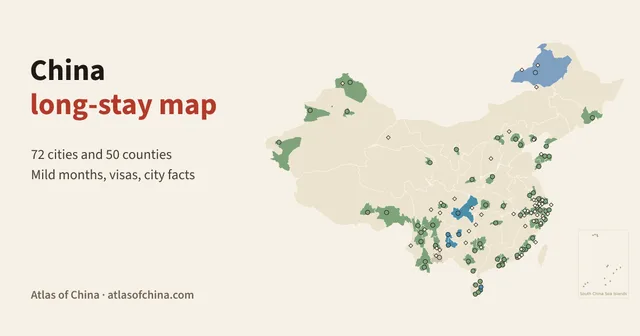 China long-stay mapThe 72 cities month by month: mild, cold, hot or rainy, with how long your passport may stay.
The visa routes, by length of stay
How long you can stay depends on your passport and on why you are there. These are the routes as the official sources describe them.
- Up to 30 days: visa-free entry for ordinary passports of 50 countries, per entry, on a list that runs to 31 December 2026; the visa-free map shows which. Hainan adds 30 days on the island for 61 nationalities.
- Two or three months: a tourist visa (L). The stay allowed per entry is printed on the visa.
- Up to 180 days: a short-term study visa (X2) for a language or other course, with an admission letter from the school; or a family visit visa, Q2 for relatives who are Chinese citizens or permanent residents, S2 for the family of foreigners working or studying in China.
- More than 180 days: a work visa (Z) when an employer in China hires you; a long-term study visa (X1) for a degree or a long course; or a family reunion visa (Q1, S1). Each is followed by a residence permit, applied for at the local exit-entry office within 30 days of entry.
- Hong Kong and Macau: their own immigration rules, with visa-free stays set by passport, up to 180 days for some. Trips to the mainland then follow the mainland's rules.
We only restate the official rules and give no legal advice. For your own case, ask the National Immigration Administration (its line is 12367) or a Chinese embassy or consulate.
Digital nomads
China has no digital nomad visa. Visa-free entry is for business, tourism, visiting family and friends, exchanges and transit, and the tourist visa is for tourism. No visa covers working remotely for an employer abroad, so it is a grey area: ask the authorities before you rely on it.
Two things to set up before you land: the apps and services you work with, many of which need a workaround in China (internet and apps), and paying, which is by Alipay or WeChat Pay linked to a foreign card (paying in China).
The first month after arrival
- Registration: staying anywhere but a hotel, you or your host register with the local police within 24 hours of arriving. Hotels do it for you.
- Residence permit: on a Z, X1, Q1 or S1 visa, apply at the local public security exit-entry office within 30 days of entry.
- Payments: banks set their own terms for opening an account; until you have one, a foreign card linked to Alipay or WeChat Pay works in most places.
- Phone: a Chinese mobile number is registered to your passport at the operator's own shop, and many services ask for one.
- Lease: get it in writing, check that the landlord will help register your stay, and keep the receipts. This guide lists no agents or prices.
- Health insurance: check that your policy covers China. The city cards on the long-stay map say whether a city has a grade III public hospital on an official list.
- Schools: the map says only whether a city has a school for foreign nationals' children on an official list.
- Tax: living in China for 183 days or more in a tax year makes you a tax resident; the State Taxation Administration has the rule.
Choosing a city
The long-stay map shades 72 cities by how each month's weather feels, with each city's air quality, rent tier, flights abroad and metro, and 50 long-stay counties: old towns, lakes, mountains and islands. Kunming and Dali are mild most of the year; Hainan, Xiamen and the Guangdong coast are warm in winter; Guiyang, Dalian and the Yunnan plateau are cool in summer.
Hot springs, forest stays and traditional medicine are on the wellness theme.
Official sources
The rules above change; these are the pages to check before you travel, and the ones this guide was checked against on 2026-11-05.
- National Immigration Administration (English) entry, visas and residence permits; 12367 service line
- National Immigration Administration: unilateral visa-free countries the 50-country list, in Chinese, updated February 2026
- National Immigration Administration: regional visa-free policies Hainan's 61 nationalities
- Shanghai Municipal People's Government: visa categories the Ministry of Foreign Affairs' table of visa types, L to Z
- Shanghai Municipal People's Government: visa-free policies what a visa-free stay is for
- Exit and Entry Administration Law, Embassy of China in the United States article 30 (residence permit within 30 days) and article 39 (registration within 24 hours)
- State Taxation Administration: Individual Income Tax Law article 1, the 183-day rule
- Hong Kong Immigration Department: visa requirements for visitors visa-free periods by nationality
- Macao SAR Government Portal: immigration visa and entry permit exemptions
Related guides
- Visas and visa-free entry
Can I visit China without a visa? Updated November 2026 - Paying for things
How do I pay for things in China without a Chinese bank account? Updated October 2026 - Internet and apps
Will Google and my other apps work in China? Updated October 2026
Start planning
Pick the places you want to see on the illustrated map, add them to a trip, and the planner lays out the days and the trains between them.
Open the mapCite this page
- APA
- Atlas of China. (2026, November 5). Can I live in China for a few months? https://www.atlasofchina.com/guides/long-stay-in-china/
- MLA
- “Can I live in China for a few months?” Atlas of China, 5 Nov. 2026, www.atlasofchina.com/guides/long-stay-in-china/.