 Atlas of China
Mausoleum of Genghis Khan 成吉思汗陵Chéngjísīhán Líng
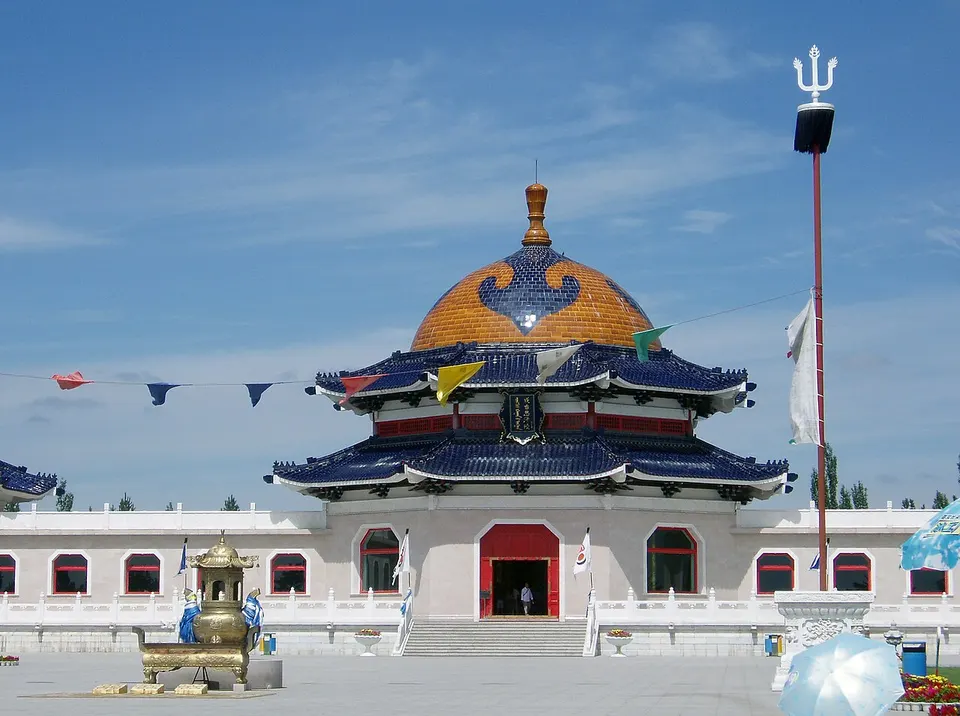
A 1950s memorial to the Khan, where hereditary Darkhad guardians still keep the rites
- Best time
- Jun–Oct
- Time needed
- 2–3 hours
- Days to budget
- Half a day
- Stay in
- Ordos
- Region
- Inner Mongolia
- Type
- Culture
- Listed as
- 5A scenic area, National heritage site
Why go to Mausoleum of Genghis Khan
Three linked, ger-shaped halls with white walls, red windows and blue-tiled roofs stand on the Ejin Horo grassland south of Ordos. The Khan's actual burial place has never been found, so these halls, built in 1955–56, are a memorial and the main centre of his worship rather than a verified tomb. You see a living shrine with murals, a marble statue, relics and offerings.
The story
For centuries the Eight White Chambers, the shrine tents tied to the Khan, moved with the Ordos Mongols; they went west to Gansu and Qinghai in the 20th century and returned here in 1954. The Darkhad, hereditary custodians in two wings, keep a long cycle of rites, from daily and monthly offerings to the seasonal and dragon- and tiger-year sacrifices, listed as national intangible heritage.
What to see at Mausoleum of Genghis Khan
- Main Hall 正殿: An octagonal hall under a blue-tiled, tent-shaped roof, held up by eight gilded dragon pillars. A 4.3 m white marble seated statue of Genghis Khan faces a large map of the Mongol empire, and the walls carry 1,206 painted golden dragons.
- Sleeping Hall 寝宫: Behind the main hall, three yellow satin tent-shaped shrines stand before a large butter lamp. They hold the caskets of the Khan and his wives and are the main place of sacrifice; the walls carry passages of a sacrificial text in Uyghur-Mongolian script.
- West Hall 西殿: Keeps three of the Eight White Chambers: the golden saddle, the bow and arrows and the sacred milk pail. A nine-pointed banner hung with horse and yak hair, the sulde, stands here, and murals trace the Khan's birth and youth.
- East Hall 东殿: Holds the White Chambers of the sacred horse and of the ritual vessels used in sacrifices, and the caskets of the Khan's youngest son Tolui and his wife. Connecting galleries between the halls are painted with his campaigns and the unification of the Mongol tribes.
- Mausoleum tourist area 成吉思汗陵旅游区: The grassland around the halls has sections on sacrificial and folk culture, horse riding, archery and wrestling, and staged shows.
How to visit Mausoleum of Genghis Khan
Enter from the south and go first to the main hall, then to the sleeping hall behind it, then the west and east halls, with their connecting galleries; the core takes 1–1½ hours. A half-day visit adds the surrounding tourist area for the folk-culture displays and shows. Go in the morning and arrange a driver from Ordos or Baotou to wait, as onward public transport is thin.
How to get to Mausoleum of Genghis Khan
It is about 32 km by road south of Kangbashi, the new centre of Ordos, under an hour by taxi or hired car. From Baotou allow roughly two hours by car.
Where to stay
Base yourself in Ordos, in the Kangbashi district for modern hotels or in Dongsheng, the old urban area, for a more local feel; the mausoleum is a half-day trip from either.
What to eat
- Roast lamb saddle 羊背子: A whole lamb's back, boiled or roasted and carved at the table; it is the traditional offering at the Khan's ceremonies and a feast dish among the Ordos Mongols.
- Hand-grabbed lamb 手把肉: Mutton on the bone, boiled in plain salted water so the meat tastes of itself, eaten with the hands and a knife.
- Fried millet with milk tea 炒米奶茶: Roasted millet soaked in salty milk tea, a daily grassland staple in Ordos; some cafés near the site also serve fried milk curd and Ordos 'pot tea' made with brick tea, butter and dried beef.
Tips for visiting Mausoleum of Genghis Khan
- Treat it as a place of worship: dress modestly, keep your voice down in the halls and ask before photographing offerings or ceremonies.
- Bring your passport for buying tickets and ID checks. Crowds peak in summer and around the spring festival, when the grand Chagan Suluke sacrifice has its main day on the 21st of the third lunar month, within a festival of about a week.
- The daily and monthly rites are not staged for visitors, so what you see on an ordinary day varies; confirm festival dates locally.
Nearby
Also within 30 km: Ordos Cultural Industry Park 鄂尔多斯文化产业园 (20 km), Kangbashi Tourist Area 康巴什旅游区 (30 km), Yihe Ecological and Cultural Expo Park 颐和生态文化博览园 (30 km), Ordos Racing Town 鄂尔多斯赛车小镇 (30 km), Kangzhen Grassland Silk Road Cultural Town 康镇草原丝路文化景区 (30 km).
On the map
Open Mausoleum of Genghis Khan on the illustrated map to see the terrain around it, what else is close, and to add it to a trip and plan the days.
Open Mausoleum of Genghis Khan on the map