
 An illustrated travel map
Fo Guang Shan 佛光山Fóguāngshān
A great Buddhist monastery, eight pagodas and a vast seated Buddha near Kaohsiung
- Best time
- Nov–Apr
- Time needed
- Half a day to 1 day
- Days to budget
- 1 day
- Stay in
- Kaohsiung
- Region
- Taiwan
- Type
- Culture
Why go to Fo Guang Shan
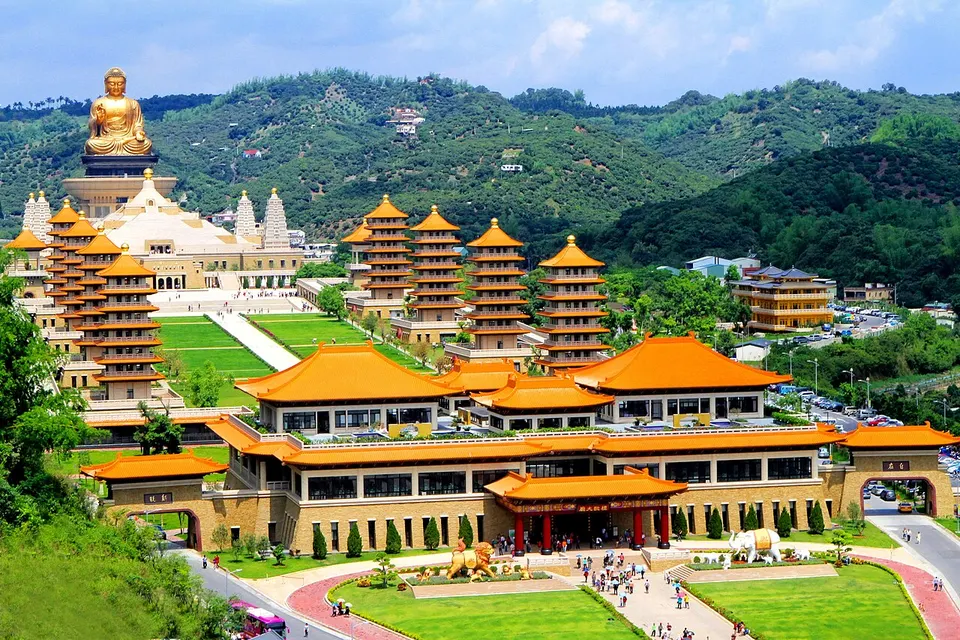
Fo Guang Shan is a large Buddhist monastery in Dashu, north-east of Kaohsiung, with the Fo Guang Shan Buddha Museum beside it. The museum's long approach, lined with eight pagodas, ends at a vast seated Buddha, and its main hall holds a relic described as a tooth of the Buddha. It is an easy, tidy day out from the city and a good way to see modern Chinese Buddhism at work.
The story
The monastery was founded in 1967 by the monk Hsing Yun, who bought more than 30 hectares here and held the groundbreaking in May that year. In 1998 a Tibetan lama gave Hsing Yun a tooth relic at Bodh Gaya, India, and the Buddha Museum built next door to house it broke ground in 2003 and opened on 25 December 2011.
What to see at Fo Guang Shan
- Front Hall and Gate 礼敬大厅: The entrance building, with a large white elephant on one side and a lion on the other, each with a cub. The elephant recalls the legend of the Buddha's conception, and the lion the 'lion's roar' of his teaching.
- Eight Pagodas 八塔: Four pagodas on each side of the Great Path, each named for a Buddhist teaching and each doing a practical job, from a children's gallery with 3D films to a bookshop, a tea rest area and exhibition space.
- Fo Guang Big Buddha 佛光大佛: A seated metal Buddha about 40 metres tall on a high base, 108 metres in all, a number that is auspicious in Buddhism. It was completed in 2011.
- Main Hall and Jade Buddha Shrine 本馆与玉佛殿: A domed, Indian-style stupa hall holding a Thousand-Armed Avalokiteshvara in glass and, at the back, a reclining white jade Buddha above the tooth relic. Galleries on Buddhist festivals and the Buddha's life are on the same floors.
- Eighteen Arhats 十八罗汉: Figures of the Buddha's disciples line the Bodhi Wisdom Concourse in front of the Main Hall, while statues of eight patriarchs of Chinese Buddhism stand along the front of the Main Hall. The set includes three women disciples.
- Fo Guang Shan Monastery 佛光山寺: The original mountain monastery, with the Great Hero Hall built in 1981 and a 36-metre Amitabha Buddha statue consecrated in 1975.
How to visit Fo Guang Shan
Most visitors come to the Buddha Museum first: walk through the Front Hall and down the Great Path between the eight pagodas to the Big Buddha, then climb back through the Main Hall and its shrines. The monastery is a short drive or bus ride away and works best as a second stop. A half day covers the museum; a full day adds the monastery and a vegetarian meal.
How to get to Fo Guang Shan
From Kaohsiung's Zuoying high-speed rail station (about 1.5–2 hours from Taipei) a direct bus reaches Fo Guang Shan and the Buddha Museum in roughly 45 minutes, or take a taxi from the station.
Where to stay
Base yourself in Kaohsiung, whose rail station, metro and high-speed rail make the day trip simple. The monastery runs a small guesthouse for pilgrims, but visitors who sleep there should expect to follow monastic routines.
What to eat
- Vegetarian buffet 素食自助餐: Fo Guang Shan is a vegetarian community, and its restaurants serve all-vegetarian buffets and set meals.
- Vegetarian Taiwanese dishes 素食台菜: The museum's lotus-pond Twin Pavilions house a teahouse serving Taiwanese dishes in vegetarian form.
- Dashu pineapple 大树凤梨: Dashu is a pineapple-growing district, and fruit stalls on the roads near the monastery sell it in season.
Tips for visiting Fo Guang Shan
- The Buddha Museum is closed every Tuesday (official museum site, 2026); plan it for another day of the week.
- Dress modestly and keep your voice down in the shrine halls; the monastery's residential and college areas are not for wandering.
- The museum and the monastery are separate sites with separate bus stops, so check which one you want before you board.
Nearby
- Tainan Old City and Anping 台南古城与安平 40 km
Dutch forts, old temples, lantern-lit lanes and a snack on every corner - Alishan 阿里山 90 km
Giant cypresses, a sunrise over Jade Mountain and a narrow-gauge forest railway - Kenting National Park 垦丁国家公园 100 km
Taiwan's southern tip: coral coast, a fortified lighthouse, beaches and a night street
Also within 30 km: Kao-Ping Hsi Bridge 高屏溪斜张桥 (under 10 km), Three Mountains King Temple, Jiuru 九如三山国王庙 (under 10 km), Pingtung Tutorial Academy 屏东书院 (10 km), Old Gaoping River Railway Bridge 下淡水溪铁桥(高屏溪旧铁桥) (10 km), Zongsheng Gong Ancestral Hall 宗圣公祠 (10 km), Agongdian Reservoir 阿公店水库 (10 km).
On the map
Open Fo Guang Shan on the illustrated map to see the terrain around it, what else is close, and to add it to a trip and plan the days.
Open Fo Guang Shan on the map