 Atlas of China
Jiuzhaigou Valley 九寨沟Jiǔzhàigōu
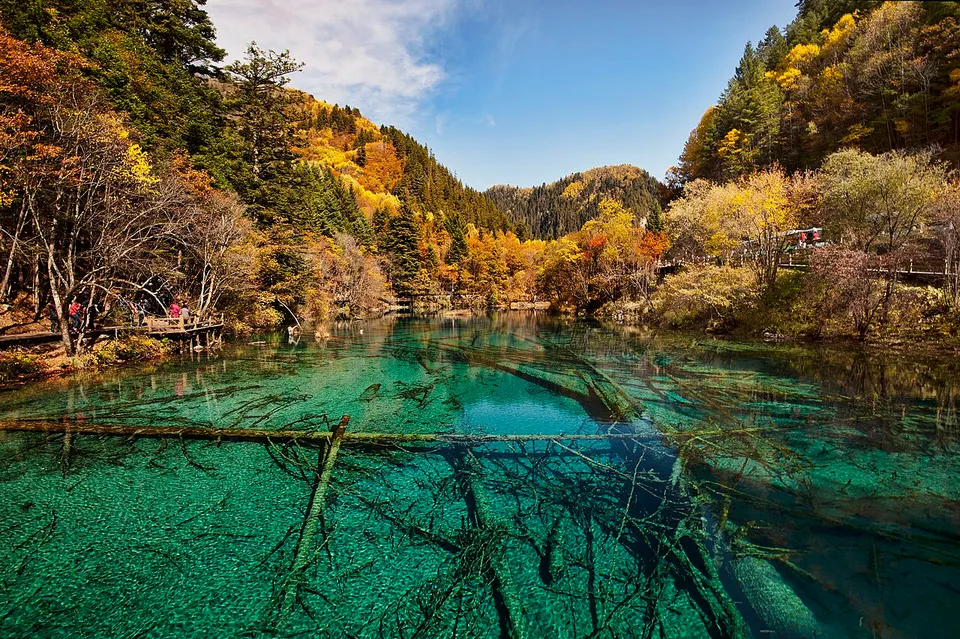
Lakes so clear you can count the fallen trees lying on their beds
- Best time
- Late Sep–Oct; also May–Jun
- Time needed
- 1–2 days
- Days to budget
- 2 days
- Stay in
- Jiuzhaigou
- Region
- Sichuan
- Type
- Nature
- Listed as
- 5A scenic area, UNESCO World Heritage
Why go to Jiuzhaigou Valley
Jiuzhaigou is a Y-shaped system of forested valleys in northern Sichuan, threaded with lakes of startling turquoise, cobalt and green. Waterfalls spill over mossy travertine terraces, and boardwalks lead from one lake to the next. Autumn, when the forests turn red and gold, is the most spectacular season.
The story
The name means 'Valley of Nine Villages', after the Tibetan settlements that still sit along it. The colours come from extremely clear water flowing over pale calcium-carbonate deposits, which also build the terraces the waterfalls tumble over.
What to see at Jiuzhaigou Valley
- Shuzheng Lakes 树正群海: A chain of more than forty lakes, about 40 per cent of the park's total, strung along the first valley after the gate and linked by short waterfalls.
- Pearl Shoal 珍珠滩: Shallow water spreads over a broad shelf of travertine and tumbles as a noisy cascade, looking from a distance like a pearl-studded shawl. A boardwalk crosses the shoal.
- Mirror Lake 镜海: A still, sheltered lake that gives the mountains and forest above it a near-perfect reflection, especially on calm mornings.
- Five Flower Lake 五花海: A shallow lake whose bottom shows fallen trees and bright algae through turquoise water. It is the visit's colour highlight and stays unfrozen, even in winter.
- Long Lake and Five-Colour Pond 长海与五彩池: At the top of the Zechawa branch, Long Lake is the park's highest and largest lake, set against snow peaks; the small Five-Colour Pond sits just below it.
How to visit Jiuzhaigou Valley
All visitors travel by park bus, which runs from the entrance up the first valley to Nuorilang, where the valley splits into two upper branches. Ride a bus to the top of one branch, then walk the boardwalks down and hop back on between lakes; one full day covers one branch well, and a second lets you do both. Hotels inside the park were closed in 2001, so you visit in a day trip from outside.
How to get to Jiuzhaigou Valley
Trains from Chengdu East reach Huanglong Jiuzhai station in about 1.5–2.5 hours, then it's roughly 1.5–2 hours by bus or taxi to the valley. Flights to Jiuzhai Huanglong Airport are another option.
Where to stay
Stay in Zhangzha, the village-town at the park gate, which is lined with hotels and restaurants for early starts. Staying outside the valley is the only option, since the park's own hotels closed in 2001.
What to eat
- Yak meat 牦牛肉: Tibetan-style yak, served boiled, stir-fried or dried in restaurants in the gateway villages.
- Butter tea 酥油茶: A salty, creamy Tibetan tea churned with yak butter, served as a warm-up in the villages and rest stops.
Tips for visiting Jiuzhaigou Valley
- Daily entry is capped and needs an advance real-name reservation with your passport; book well ahead for autumn.
- Ride the park bus to the top of a branch valley and walk down the boardwalks, hopping back on between sections.
- The valley sits above 2,000 m, so bring layers; mornings are cold even in summer.
Nearby
- Huanglong Scenic Area 黄龙 60 km
Thousands of terraced travertine pools spill down a mountain valley like a golden dragon - Songpan Ancient Town 松潘古城 80 km
A walled market town of the old tea-and-horse trade, and a base for horse treks
Trips with Jiuzhaigou Valley
- Chengdu to Jiuzhaigou and Huanglong: a week in the Aba mountains 6 days · Chengdu, Songpan and Jiuzhaigou
On the map
Open Jiuzhaigou Valley on the illustrated map to see the terrain around it, what else is close, and to add it to a trip and plan the days.
Open Jiuzhaigou Valley on the map