 Atlas of China
Louguantai 楼观台Lóuguàn Tái
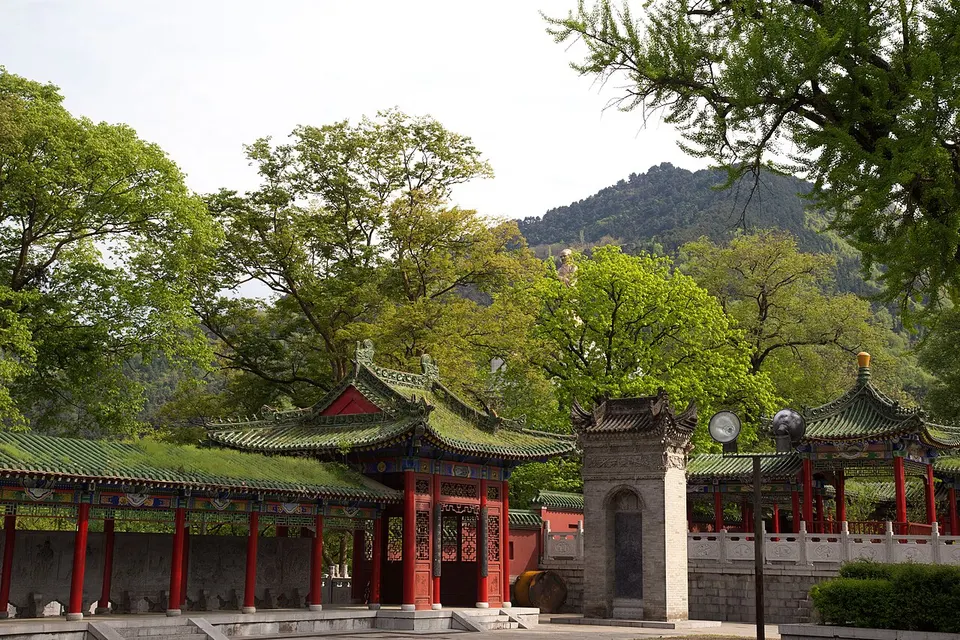
Taoist courtyards climbing to the terrace where Laozi is said to have taught
- Best time
- Apr–May, Sep–Nov
- Time needed
- Most of a day
- Days to budget
- 1 day
- Stay in
- Xi'an
- Region
- Shaanxi
- Type
- Heritage
- Listed as
- 4A scenic area
Why go to Louguantai
In Zhouzhi County at the foot of the Zhongnan range of the Qinling Mountains, about 70 km west of Xi'an, Louguantai is one of the oldest holy places of Taoism, the Chinese religion that reveres Laozi. Much of what you see is new: a temple complex of nine courtyards, opened in 2012, climbs the slope on the axis of the Shuojingtai ('Terrace for Expounding the Scripture'), whose own halls date from the Ming, Qing and later restorations. Beside it, the ruins of the Tang-era Zongsheng Palace keep old steles and ancient trees.
The story
Legend says Yin Xi, keeper of the Hangu Pass, built a thatched tower here to watch the heavens, which gave the place its name, and that Laozi, travelling west, taught him the Tao Te Ching on this spot. The Tang emperors, who claimed Laozi as their ancestor, renamed the temple Zongsheng Palace and greatly enlarged it.
What to see at Louguantai
- Shuojingtai 说经台: The 'Terrace for Expounding the Scripture', built on a ridge at about 580 metres on the slope above the Wei plain. Tradition says Laozi taught the Tao Te Ching here, and the song-dynasty poet Su Shi wrote that from this terrace the Qin plain looks small.
- Zongsheng Palace ruins 宗圣宫遗址: The remains of the great Tang-era temple beside the terrace, where the buildings are gone but old stone steles and ancient trees remain.
- The Laozi ginkgo 老子银杏: A very old ginkgo among the ruins that tradition says Laozi planted. It is a favourite in late autumn, when the leaves turn gold.
How to visit Louguantai
The core of Louguantai is the Shuojingtai and Zongsheng Palace ruins, which can be seen in a morning or an afternoon. From the temple courtyards, walk up the slope to the terrace and then on to the Zongsheng ruins and ginkgo next door. Add time only if you also walk the forest park behind.
How to get to Louguantai
Louguantai is about 70 km west of Xi'an, roughly 1–1.5 hours by taxi or hired car. A Huanshan (foothills) tourist bus from the Big Wild Goose Pagoda's North Square takes over two hours, and its timetable changes, so check before relying on it.
Where to stay
Louguantai is best done as a day trip from Xi'an. If you stay out, the town of Zhouzhi, about 15 km west of the temple, is the nearest base.
What to eat
- Zhouzhi kiwifruit 周至猕猴桃: Zhouzhi County is a major kiwifruit-growing area and has bred local varieties such as Qinmei; fresh fruit and juice are sold around Louguantai.
- Yangrou paomo 羊肉泡馍: Xi'an's signature dish of torn flatbread in mutton broth, which you will find in the gateway city and in Zhouzhi town.
Tips for visiting Louguantai
- Keep climbing through the new courtyards to the Shuojingtai at the top of the axis, the older heart of the site.
- Next door, the ruins of Zongsheng Palace keep old stone steles and a male ginkgo that local tradition says Laozi planted.
- Leave time for the forest park behind the temples, known for its bamboo groves.
Nearby
- Mount Taibai 太白山 50 km
Forest roads and a cable car climb to 3,511 metres on the Qinling range's highest peak - Famen Temple 法门寺 60 km
A Tang relic temple, the treasures of its sealed crypt and a 148-metre modern stupa - Qianling Mausoleum 乾陵 60 km
A spirit way of stone guardians climbing to the joint tomb of Gaozong and Wu Zetian - Small Wild Goose Pagoda 小雁塔 60 km
A slender Tang brick pagoda, cracked by earthquakes, in the grounds of the Xi'an Museum - Shaanxi History Museum 陕西历史博物馆 60 km
Tang gold and silver, original tomb murals and finds from Shaanxi's Zhou, Qin and Han past - Datang Everbright City 大唐不夜城 60 km
A lantern-lit, Tang-themed avenue of street performers, sculptures and evening crowds
Also within 30 km: Daqin Pagoda 大秦寺塔 (under 10 km), Qinling National Botanical Garden 秦岭国家植物园 (under 10 km), Xianyou Temple and Fawang Pagoda 仙游寺法王塔 (10 km), Zhouzhi Water Street 周至水街 (10 km), Bayun Pagoda 八云塔 (20 km), Chongyang Palace 重阳宫 (20 km).
On the map
Open Louguantai on the illustrated map to see the terrain around it, what else is close, and to add it to a trip and plan the days.
Open Louguantai on the map