 Atlas of China
Maijishan Grottoes 麦积山石窟Màijīshān Shíkū
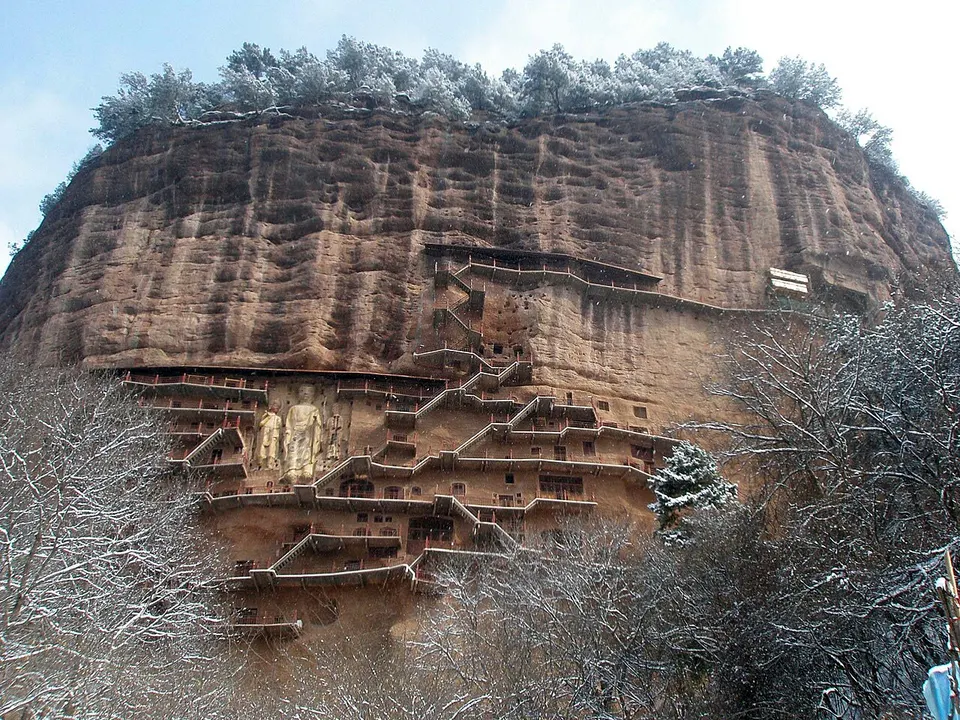
Painted clay Buddhas in caves hung high on a haystack-shaped cliff
- Best time
- Apr–May, Sep–Oct
- Time needed
- Half a day to 1 day
- Days to budget
- 1 day
- Stay in
- Tianshui
- Region
- Gansu
- Type
- Heritage
- Listed as
- 5A scenic area, National heritage site, UNESCO World Heritage
Why go to Maijishan Grottoes
A steep, haystack-shaped crag of red sandstone near Tianshui is honeycombed with nearly 200 Buddhist caves carved from the fourth century onwards and strung together by walkways clinging to the cliff face. Where Mogao is famous for murals and Longmen for stone carving, Maijishan is known for painted clay sculpture, with thousands of figures. It is part of the Silk Roads World Heritage Site, and far quieter than the big names of the Hexi Corridor.
The story
Earthquakes, including a severe one in 734, split the cliff into an east and a west face, and the caves were reached for centuries by timber walkways. The poet Du Fu visited about 25 years later, in 759, and wrote the poem 'Mountain Temple' about it; after being largely forgotten the site was brought to wider attention in the 1940s by a local scholar from Tianshui.
What to see at Maijishan Grottoes
- Cliff walkways 栈道: Staircases and galleries bolted to the cliff link the caves at heights of tens of metres, and the walk along them is part of the sight.
- Cave 3 – Thousand-Buddha Corridor 第3窟千佛廊: A long Northern Zhou gallery cut into the east cliff, lined with hundreds of small seated Buddhas in painted clay.
- Cave 4 – Sanhua Pavilion 第4窟散花楼: A grand Northern Zhou cave shaped like a columned hall, with seven Buddha niches and relief-modelled flying apsaras; the largest imitation-palace cave on the cliff.
- East and West Cliff Great Buddhas 东崖大佛与西崖大佛: Two huge seated Buddhas, in Caves 13 and 98, anchor the east and west faces and are among the first figures you see from below.
How to visit Maijishan Grottoes
Take the scenic area's transport or walk up to the cliff base, then climb the stairs and walkways round the east cliff (Caves 3, 4 and 5 and the Great Buddha of Cave 13) before crossing to the west cliff and its Great Buddha in Cave 98. The cliff itself takes a couple of hours; a half-day covers that route, while a full day lets you add the guided specially protected caves or the other sights of the wider scenic area.
How to get to Maijishan Grottoes
Tianshui South is about 1.5 hours by high-speed train from both Lanzhou and Xi'an (the fastest trains take roughly 1 h 15 min); the grottoes lie about 35 km south-east of central Tianshui, roughly an hour by taxi or bus.
Where to stay
Stay in Tianshui city, which has the main rail station and the restaurants; the grottoes are a day trip of about an hour each way from there.
What to eat
- Tianshui guagua 天水呱呱: Soft, jelly-like buckwheat starch cut into slices and dressed with chilli oil, vinegar, garlic and sesame sauce, usually eaten at breakfast.
- Pickled-vegetable noodles 浆水面: Noodles in a tangy broth made from fermented greens, a staple across southern and eastern Gansu.
- Cold skin noodles 面皮: Wide, chewy sheets of starch or wheat dough with chilli oil and vinegar, a common cold snack in Tianshui.
Tips for visiting Maijishan Grottoes
- Fifteen specially protected caves (among them Caves 127, 133 and 135) can be entered only on guided visits with a separate on-site ticket and daily caps; the standard routes already cover the best-known caves and walkways.
- The walkways are narrow and steep, with many stairs; wear shoes with grip, and expect sections to close in heavy rain or snow.
- Spring and autumn weekdays are quietest; summer is the rainy season, and holiday periods are crowded.
Nearby
- Baoji Bronze Ware Museum 宝鸡青铜器博物院 110 km
Zhou dynasty bronzes, led by the He zun and the earliest known written 'Zhongguo'
Also within 30 km: Qingjuanshan Resort 青鹃山 (30 km).
On the map
Open Maijishan Grottoes on the illustrated map to see the terrain around it, what else is close, and to add it to a trip and plan the days.
Open Maijishan Grottoes on the map