 Atlas of China
Tongwancheng Ruins 统万城遗址Tǒngwànchéng Yízhǐ
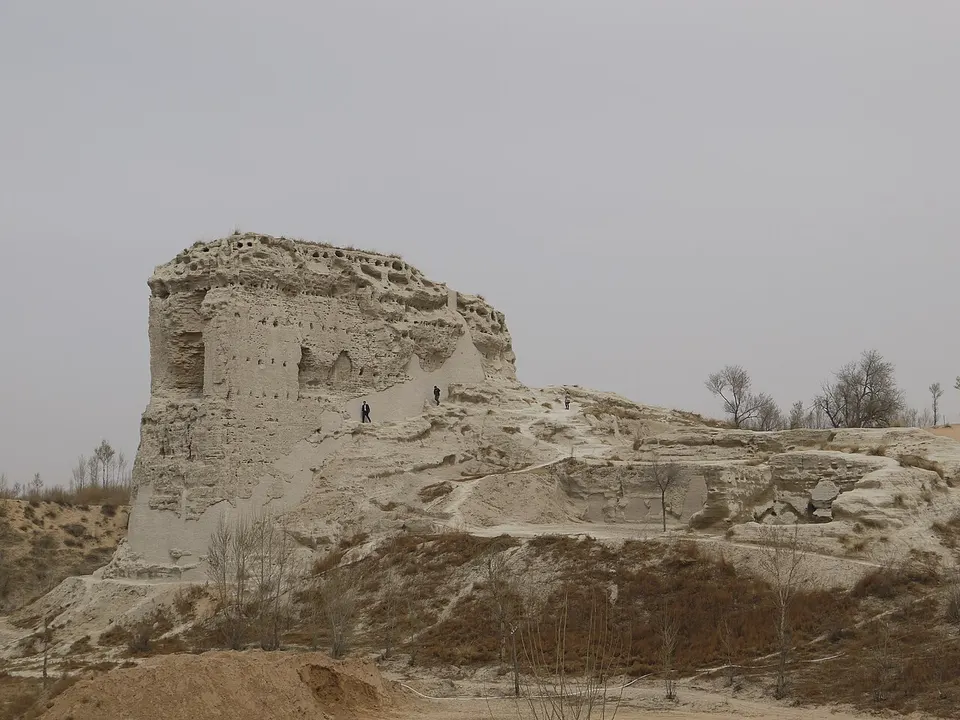
Pale rammed-earth walls of a 5th-century Xiongnu capital at the edge of the Mu Us Desert
- Best time
- May–Oct
- Time needed
- Half a day
- Days to budget
- Half a day
- Stay in
- Jingbian
- Region
- Shaanxi
- Type
- Heritage
- Listed as
- 4A scenic area, National heritage site
Why go to Tongwancheng Ruins
About 50 km north of Jingbian, on the north bank of the Wuding River at the southern edge of the Mu Us Desert, stand the walls of Tongwancheng, capital of the Xia state in the Sixteen Kingdoms period (304–439), when northern China was divided among short-lived kingdoms. Start at the site museum on the south bank, which covers the Xiongnu people and the city's history, then take the shuttle across to walk the ruins. The city later served as a regional seat under the Tang and was abandoned by the early Ming, after which drifting sand slowly buried it.
The story
Helian Bobo, a Xiongnu leader who had founded the Xia state, began the city in 413 and named it Tongwan after his vow to unite the realm and rule 'ten thousand states'. The Book of Jin says his overseer, Chigan Ali, had the earth steamed and executed workers whenever an awl could be pushed an inch into a finished wall. The hard mix of sand, clay and lime gives the walls the pale colour behind their local name, Baichengzi or 'White City'.
What to see at Tongwancheng Ruins
- Tongwancheng Site Museum 统万城遗址博物馆: The museum at Baichengze village sets out the city's story and that of the Xiongnu people. Start here to understand what you are about to see.
- West City 西城: The better-preserved of the two inner cities. Its walls, still two to ten metres high, are built of a hard, pale mixture of sand, clay and lime, and the south-west corner platform rises about 31 metres. Its four gates carried names such as Zhaowei and Pingshuo.
- Yong'an Platform 永安台: A large rammed-earth platform used to review troops and receive dignitaries, restored in recent decades. It gives a sense of the city's ceremonial scale.
- East City palace site 东城宫殿遗址: A raised platform in the north of the East City where square stone column bases and fragments of wall painting have been found. Roof tiles from here carry the inscription Yonglong.
How to visit Tongwancheng Ruins
Begin at the site museum, which is closed on Mondays, then go on to the ruins. The West City, the Yong'an Platform and the East City palace site are the main stops, and a walk round the circuit takes up most of the visit. The ground is exposed, so go early and bring water. The site museum and a loop of the ruins make a good half day.
How to get to Tongwancheng Ruins
EMU trains from Xi'an Railway Station reach Jingbian in about 5 hours via Yan'an and Suide. Public transport to the ruins is scarce, so hire a car or taxi in Jingbian for the drive of about 50 km (about an hour each way), or from Yulin (about 2 hours each way).
Where to stay
Stay in Jingbian County town, the nearest base, or in Yulin if you are linking this with the Great Wall sights; there is nothing to stay in at the ruins themselves.
What to eat
- Jingbian mutton 靖边羊肉: Lamb from the Jingbian area, a protected local product that is the usual centrepiece of a meal in the county seat.
- Jingbian millet 靖边小米: A protected local grain, cooked into porridge and used in the region's everyday cooking.
Tips for visiting Tongwancheng Ruins
- Agree a waiting time or a return pick-up with your driver before you set off, rather than counting on finding a car at the site.
- Look for the south-west corner platform of the West City, which still rises about 30 metres.
- The ground is open and exposed: bring water, sun protection and a windproof layer, and allow time to walk a circuit of the walls.
Nearby
- Yulin Old Town and Zhenbeitai 榆林古城·镇北台 90 km
A four-tier Ming watchtower on the Great Wall and an old garrison street under six towers
On the map
Open Tongwancheng Ruins on the illustrated map to see the terrain around it, what else is close, and to add it to a trip and plan the days.
Open Tongwancheng Ruins on the map