 Atlas of China
Labrang Monastery 拉卜楞寺Lābǔléng Sì
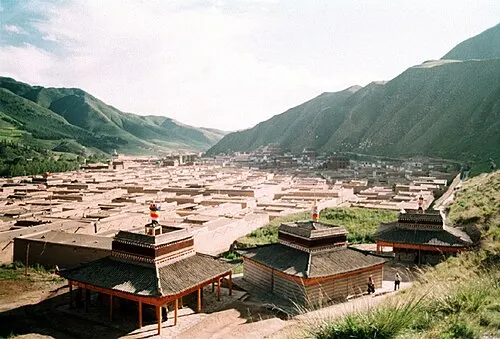
A living Tibetan Buddhist monastery town, ringed by a long corridor of prayer wheels
- Best time
- Apr–Oct
- Time needed
- Half a day to 1 day
- Days to budget
- 1 day
- Stay in
- Xiahe
- Region
- Gansu
- Type
- Culture
- Listed as
- 4A scenic area, National heritage site
Why go to Labrang Monastery
Founded in 1709 beside the Daxia River, Labrang is one of the six great monasteries of the Gelug school of Tibetan Buddhism and still a working centre of monastic study, organised in six colleges. Gilded roofs, white-walled halls and monks in maroon robes fill the valley, while pilgrims circle the whole complex along a corridor of prayer wheels. It is one of the most atmospheric places in Gansu to watch Tibetan religious life at close quarters.
The story
The monastery was founded by the first Jamyang Zhépa, and the name Labrang comes from the Tibetan word for the residence of its senior incarnate lama. Over the centuries it grew into the main religious and learning centre of the Amdo region, and it has kept a rich library of Tibetan texts and a monastic medical college.
What to see at Labrang Monastery
- Grand Sutra Hall 大经堂: The assembly hall of the main philosophy college is the largest hall in the monastery, with a front courtyard used for debate and rows of columns that once seated thousands of monks. It was rebuilt after a fire in 1985.
- Hall of Maitreya 弥勒佛殿: A six-storey hall topped by a gilded roof, known locally as the Great Golden Roof Temple; inside is a tall gilded bronze Maitreya.
- Shakyamuni Hall 释迦牟尼佛殿: Modelled on the Jokhang in Lhasa and topped by a smaller gilded roof (the 'Little Golden Roof'), it houses a revered gilded Buddha brought from central Tibet by the first Jamyang Zhépa.
- Debating Garden 菩提法苑: On the western side of the monastery, monks practise formal philosophical debate in the open air, with sharp claps and loud challenges; the sessions are a highlight when they are held.
- Gongtang Pagoda 贡唐宝塔: A gilded three-storey stupa inside the Gongtang residence compound, one of the monastery's treasured sights.
- Prayer-wheel corridor 转经长廊: The kora circuit, about 3.5 km, is lined with hundreds of prayer wheels that pilgrims spin as they walk clockwise around the monastery.
How to visit Labrang Monastery
Start at the main entrance and turn the big prayer wheel there, then visit the main halls; these are generally entered with the monastery's guided tour (English-speaking guides are usually available), and a recent visitor report says other buildings stay closed to independent wandering. If monks are practising, head west to watch the debating, and finish by joining pilgrims on the clockwise kora, which takes about an hour at a gentle pace. Allow half a day for the halls and kora; a full day lets you add Gongtang Pagoda and the lanes of Xiahe town.
How to get to Labrang Monastery
Xiahe is about four hours by road from Lanzhou, with direct buses; from Hezuo it is roughly an hour. The monastery sits on the western edge of town, within walking distance of most guesthouses.
Where to stay
Stay in Xiahe town along the road beside the monastery, where Tibetan-style guesthouses make it easy to walk the kora early in the morning or after dusk.
What to eat
- Yak butter tea 酥油茶: A salty, rich tea churned with yak butter, served in Tibetan teahouses and homes; sweet milk tea is an easy alternative.
- Tsampa 糌粑: Roasted barley flour kneaded with butter tea or butter into a dough, the everyday Tibetan staple.
- Yak yoghurt 牦牛酸奶: Thick yoghurt made from yak milk, sold in Xiahe and across Gannan and often eaten with sugar.
Tips for visiting Labrang Monastery
- Xiahe lies at around 3,200 m; take the first day gently, and bring layers because mornings and evenings are cold even in summer.
- Walk clockwise around halls, stupas and prayer wheels, keep to the edge of the path for pilgrims, and ask before photographing monks; photography is not allowed inside the halls.
- Carry your passport, as ID checks can occur on the road to and around Xiahe.
Nearby
Also within 30 km: Ganjia Grassland and Bajiaocheng 甘加秘境 (20 km).
On the map
Open Labrang Monastery on the illustrated map to see the terrain around it, what else is close, and to add it to a trip and plan the days.
Open Labrang Monastery on the map