 Atlas of China
Mount Sanqing 三清山Sānqīng Shān
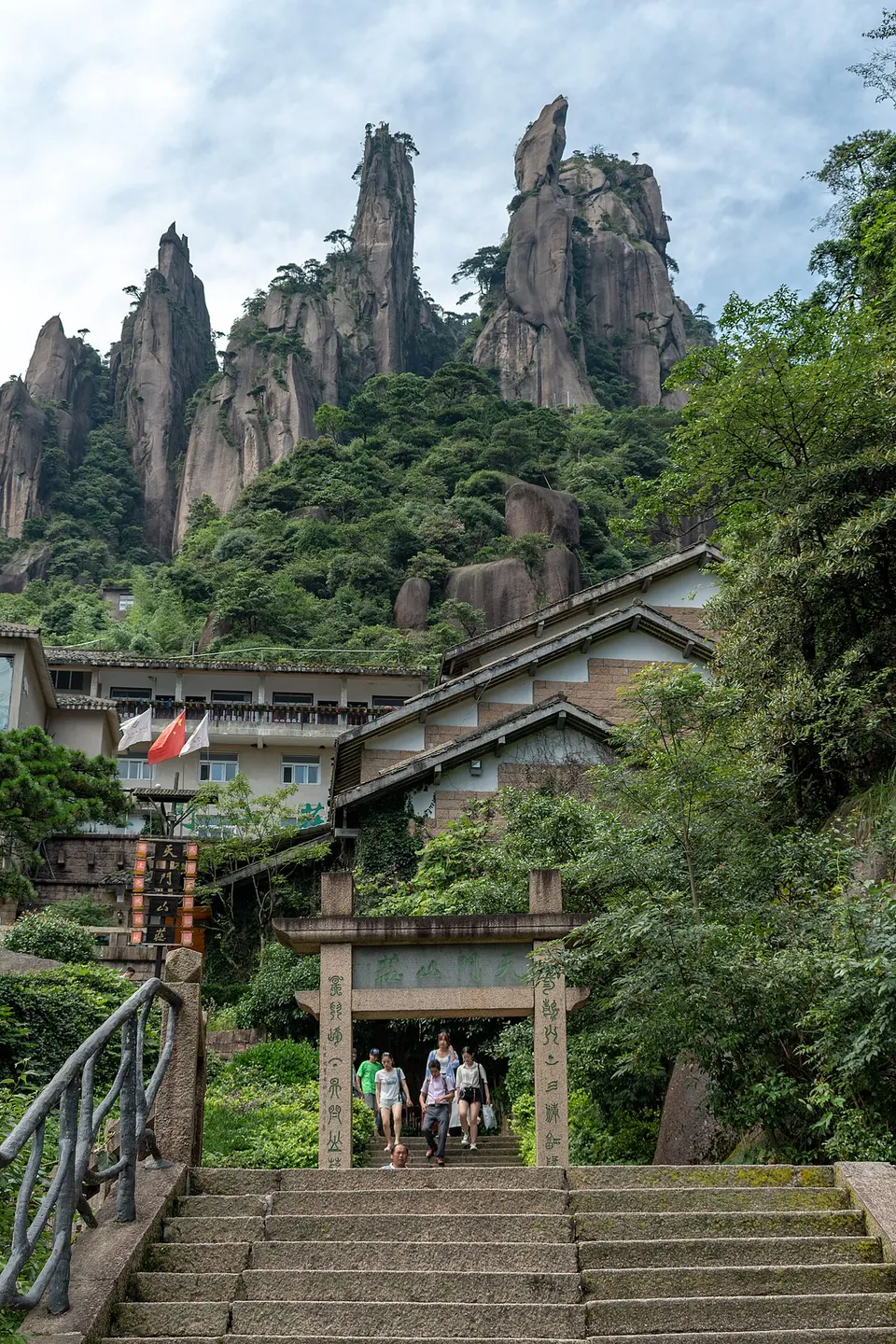
Granite pillars in cloud and pine, and cliffside plank walks to a Taoist palace
- Best time
- Mar–May, Sep–Nov
- Time needed
- 1–2 days
- Days to budget
- 1½ days
- Stay in
- Shangrao
- Region
- Jiangxi
- Type
- Nature
- Listed as
- 5A scenic area, National heritage site, UNESCO World Heritage
Why go to Mount Sanqing
Mount Sanqing in north-east Jiangxi is a World Natural Heritage site (2008) where dense clusters of granite pillars and peaks, such as the Giant Python and the Goddess of Spring, rise from forest and drifting cloud. It is also a Taoist mountain: the nationally listed group of ancient buildings around Sanqing Palace comprises more than 200 temples, pavilions, carvings, gates and bridges built from local granite, with the palace itself rebuilt in the Ming dynasty. Cable cars and cliff-hugging walkways reach the high ground, where Yujing Peak rises to about 1,820 m.
The story
Sanqing means the Three Pure Ones, the highest deities of Taoism, and the name comes from the mountain's three peaks, Yujing, Yuxu and Yuhua, said to sit like the three deities. Legend ties the alchemist Ge Hong to the mountain in the Jin dynasty, and temples were built here from the Tang dynasty onwards.
What to see at Mount Sanqing
- Nanqing Garden 南清园: The heart of the rock scenery, a loop trail through the southern part of the plateau past named stone figures such as the Goddess of Spring and the Giant Python; ancient rhododendrons here flower in May.
- West Coast walkway 西海岸: A cliffside walkway of about 4 km at roughly 1,600 m, hugging the western rim of the plateau with wide views over pillars and valleys; it lies closest to the south cable car.
- Sanqing Palace 三清宫: The Taoist core of the mountain, with a Ming-era palace and a scatter of granite halls, bridges, gates and carvings laid out around it.
- Yujing Peak 玉京峰: The highest of the three peaks at about 1,820 m; the old stone trail to the summit is unmarked and not maintained, so ask locally before attempting it.
How to visit Mount Sanqing
Most visitors go up by cable car from the south (Waishuangxi) or east (Jinsha) side; the south cable car is nearer the West Coast walkway and the east one nearer Nanqing Garden. A full day can cover Nanqing Garden and the West Coast walk and return by cable car before dusk; a two-day plan sleeps on the plateau for sunrise and takes in Sanqing Palace. The paths include long stretches of stairs.
How to get to Mount Sanqing
Take a high-speed train to Yushan South station (or to Shangrao), then a bus or taxi of roughly an hour to the hotel villages at the south (Waishuangxi) or east (Jinsha) cable-car stations. Shangrao city is about 78 km away and Yushan town about 50 km; the direct bus from Yushan is the usual choice.
Where to stay
Stay in a hotel village at the foot of the south or east cable car for easy access, or in one of the few hotels near the top of the cable cars if you want sunrise on the plateau; mountain lodging is basic and dearer. Yushan town is the easier base if you arrive late by train.
What to eat
- Shangrao fried rice noodles 上饶炒粉: Rice noodles stir-fried with vegetables, egg and meat, a staple of the Shangrao region, easy to find in Yushan town and the hotel villages.
- Dengzhan cake 灯盏粿: A local rice snack sold on Yushan town's snack street, a good stop before or after the mountain.
- Mountain stream fish 溪鱼: Small fish from the mountain streams, usually fried or stewed in farmhouse restaurants near the cable-car bases; ask for local specialities, as many menus are generic.
Tips for visiting Mount Sanqing
- Tickets, including cable cars, are bought in your own name and checked against your original ID (take your passport), and booking ahead through the official channels is advised in summer and holidays.
- Cable-car timetables change by season and the mountain is often in cloud or rain, so check the day's operations and forecast before going up, and bring a warm layer.
- Stay on the marked paths: climbing the rock pillars is prohibited, and a 2017 incident on Giant Python Peak ended in prison sentences and a heavy damages award.
Nearby
- Wuyuan Villages 婺源 40 km
White-walled villages among yellow rapeseed in spring and red chillies in autumn - Jingdezhen, Porcelain Capital 景德镇 90 km
The city that fired porcelain for China's emperors, and still has clay on its hands - Xidi 西递村 110 km
A quieter UNESCO twin of Hongcun: flagstone lanes, merchant houses and a Ming archway - Qiandao Lake 千岛湖 120 km
A drowned mountain valley of 1,078 forested islands, an hour by train from Hangzhou
Also within 30 km: Yulian Waterfalls (Sanqingshan) 三清山玉帘瀑布 (under 10 km), Pastoral Idyll (Sanqingshan) 三清山田园牧歌 (under 10 km), Fairy Valley (Sanqingshan) 三清山神仙谷 (under 10 km), Huaiyu Mountains, Yushan 怀玉山 (under 10 km), Yinju Stone Tribe, Dexing 隐居·石头部落 (10 km), Mount Damao, Dexing 大茅山 (30 km).
On the map
Open Mount Sanqing on the illustrated map to see the terrain around it, what else is close, and to add it to a trip and plan the days.
Open Mount Sanqing on the map