 Atlas of China
Cangzhou 沧州Cāngzhōu
Iron lion, acrobats and martial arts between the Grand Canal and the sea
About Cangzhou
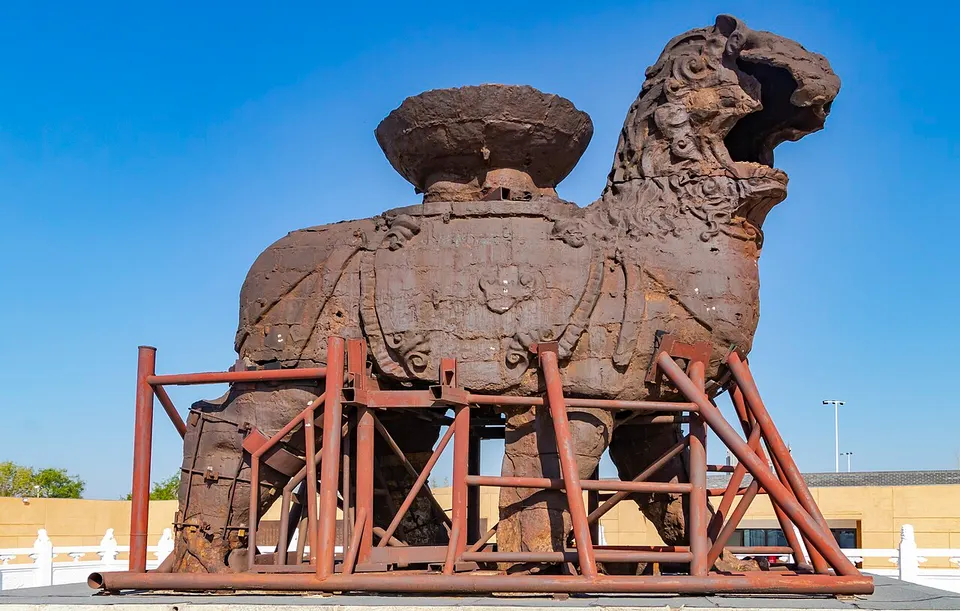
Cangzhou stretches from the Grand Canal across flat farmland to the Bohai coast, and China knows it for martial arts and acrobatics. Wuqiao County stages an international circus festival every two years and has its own Wuqiao Acrobatics World. The Iron Lion of Cangzhou, cast in 953 and weighing an estimated 40 tonnes, is the city's emblem; Botou Mosque, founded in 1404, reflects a long Hui presence, and the Nandagang Wetland is a reed marsh on the bird migration routes.
Listed sites in Cangzhou
16 sites in Cangzhou are on the official lists. Those with a page of their own link to it; the rest open as cards on the map.
- Hejian Prefectural Government Office 河间府署 4A scenic area · on the map
The seat of Hejian prefecture, first set up in 1108 under the Northern Song and rebuilt on its original site in 2010–13 after standing in ruins for decades. - Iron Buddha Temple, Dongguang 东光铁佛寺 4A scenic area · on the map
A Buddhist temple in a park on the southern edge of Dongguang town, built around a seated cast-iron Shakyamuni in the main hall that the county gives as over 8 m high and 48 tonnes, and that the city government describes as the largest seated iron Buddha in China. - Nandagang Wetland 南大港湿地 4A scenic area · on the map
A coastal marsh on the west shore of the Bohai Sea, about 90 per cent covered by reed beds, with open water, meadow and salt-tolerant plants. - Wuqiao Acrobatics World 吴桥杂技大世界 4A scenic area · on the map
A performance park opened in 1993 in Wuqiao, the county known as the home of Chinese acrobatics, covering about 36 hectares. - Botou Mosque 泊头清真寺 National heritage site · on the map
A mosque founded in 1404 under the Ming and enlarged in the Chongzhen era (1628–44), with more than twenty timber buildings in Chinese rather than domed style, split into a main mosque and a separate women's mosque. - Dan Bridge 单桥 National heritage site · on the map
A five-arch stone bridge begun in the late Ming, 69 m long and nearly 10 m wide, across an old course of the Hutuo River at Danqiao village; its arches differ in span, and the city describes it as a leading example of the Chinese multi-arch open-spandrel bridge. - Dengying Bridge 登瀛桥 National heritage site · on the map
A three-arch stone bridge, also called Dulin Bridge, built in 1594 and repaired in 1907 across an old course of the Hutuo River in the middle of Dulin town. - Guangming Theatre, Hejian 光明戏院 National heritage site · on the map
A brick-and-timber theatre of 1934, funded by five local families and modelled on the Dawutai theatre in Tianjin in a mixed Chinese and Western style, with a four-storey front, a relief 'Guangming' plaque and Baroque-style gables. - Haifengzhen Ruins and Site Museum 海丰镇遗址 National heritage site · on the map
The site of Haifengzhen, a salt-trading port town of the Jin and Yuan dynasties, spread over about 228 hectares of farmland east of Huanghua and excavated since 2000. - Han Tombs in Xian County 献县汉墓群 National heritage site · on the map
A group of Han-dynasty burials east of Xian County town, the best known being the tomb of Liu De, Prince Xian of Hejian, a son of Emperor Jing remembered for reviving Confucian scholarship, with the tombs of later Han princes of Hejian nearby. - Iron Lion of Cangzhou 沧州铁狮子 National heritage site
Cast in 953 under the Later Zhou, this hollow iron lion carries a lotus-shaped basin on its back and is among the oldest and largest surviving iron castings in China; accounts of its weight range from about 32 to 50 tonnes. - Jiedi Flood-Diversion Sluice 捷地分洪设施 National heritage site · on the map
A flood-control complex where the South Canal meets the Jiedi relief channel, one of the Hebei parts of the Grand Canal protected as a national monument. - Juguan Ancient Tribute Jujube Garden 聚馆古贡枣园 National heritage site · on the map
An orchard of about 1,000 mu (roughly 66 hectares) of winter jujube trees at Juguan village that supplied fruit to the Ming and Qing courts. - Machang Battery 马厂炮台 National heritage site · on the map
A late-Qing earth fort beside the Grand Canal, begun in 1871 when Li Hongzhang moved two battalions of the Huai Army here to guard the canal; the camp had 14 batteries on the two banks. - Tomb of Ji Xiaolan 纪晓岚墓地 National heritage site · on the map
The shared grave of Ji Yun (1724–1805), better known as Ji Xiaolan, the Qing scholar who was chief editor of the Siku Quanshu, and his wife; it is an earth mound with a stele granted by the Jiaqing Emperor. - Xiejiaba Dam 连镇谢家坝 National heritage site · on the map
A rammed-earth flood dam on the east bank of the South Canal at Lianzhen, built in the late Qing from layers of lime-soil bound with glutinous-rice mortar.
On the map
Open Cangzhou on the illustrated map to see its outline, its places and listed sites together, and to add them to a trip.
Open Cangzhou on the map