 Atlas of China
Yongzhou 永州Yǒngzhōu
Liu Zongyuan's place of exile, Shun's mountain and a script written by women
About Yongzhou
Yongzhou, the old Lingling, grew up where the Xiao River joins the Xiang. The Tang writer Liu Zongyuan spent ten years in exile here from 805 writing the Eight Records of Yongzhou about its streams and rocks; the Liuzi Temple in Lingling honours him. Writers have carved the cliffs at Wuxi since the Tang, Jiuyi Mountain in Ningyuan is the legendary burial place of the sage-king Shun, and in Jiangyong women once wrote to one another in Nüshu, a script of their own.
What to eat in Yongzhou
- Dong'an chicken (东安鸡)
Listed sites in Yongzhou
39 sites in Yongzhou are on the official lists. Those with a page of their own link to it; the rest open as cards on the map.
- Chen Shuxiang Red Culture Park 陈树湘红色文化园 4A scenic area · on the map
A memorial park at Guitou village, Meihua town, Dao County, built to commemorate Chen Shuxiang, commander of the Red Army's 34th Division, and the soldiers of his division. - Dongshan Hill & Lingling Confucian and Martial Temples 东山·零陵文武双庙 4A scenic area · National heritage site · on the map
The wooded hill inside the old city of Lingling, opened as a park in 2018, which gathers several of Yongzhou's oldest buildings: the Confucian Temple, whose double-eaved great hall with yellow glazed tiles and dragon-carved marble columns dates from 1775, and the neighbouring Martial Temple, whose opera stage is used for performances. - Goulan Yao Village 勾蓝瑶寨 4A scenic area · National heritage site · on the map
A walled Yao village in Lanxi township, Jiangyong, founded in the Ming dynasty and spread over about 6 km², defended by stone walls, watch houses and gate towers. - Huaqiangu Flower Valley & Moon Lake, Shuangpai 花千谷·月湖 4A scenic area · on the map
A modern flower-valley and lakeside leisure area at Xiadeng village on the edge of Longbo, Shuangpai's county town, created as part of the county's 'Longbo International Slow City' rural-tourism scheme. - Lianxi, Hometown of Zhou Dunyi 濂溪故里 4A scenic area · National heritage site · on the map
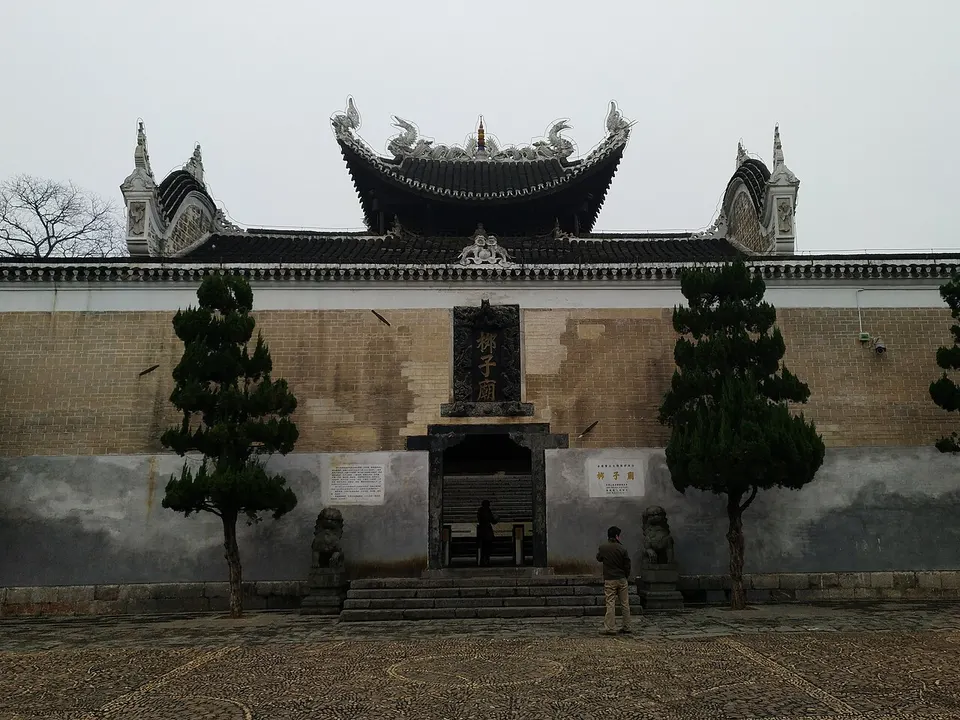
Loutian village in Qingtang town, Dao County, birthplace of the Northern Song philosopher Zhou Dunyi (1017–1073), a founder of Neo-Confucianism whose sobriquet Lianxi is the name of the stream at his home. - Liuzi Temple & Liu Zongyuan Cultural Area 柳子庙·柳宗元文化旅游区 4A scenic area · National heritage site
A riverside quarter on the west bank of the Xiao River in Lingling, the old town of Yongzhou, built around the places where the Tang writer Liu Zongyuan lived for ten years in exile from 805. - Long Family Compound 龙家大院 4A scenic area · National heritage site · on the map
A village of the Long clan at Jiantou town in Xintian County, set against hills on three sides, whose Ming-to-Republican houses follow a plan described as 'three halls, nine light wells, 24 lanes and 48 houses'. - Mausoleum of Emperor Shun, Jiuyi Mountain 九嶷山舜帝陵 4A scenic area · National heritage site · on the map
The temple-mausoleum of Shun, the legendary sage-king whom the Records of the Grand Historian say died on a tour of the south and was buried at Jiuyi, set below Shunyuan Peak in the Jiuyi Mountains. - Qianjiadong, Yao Ancestral Homeland 千家峒 4A scenic area · on the map
A group of three mountain basins north of Jiangyong county town, covering about 200 km², which Yao communities in southern China, South-East Asia and beyond know from their manuscript histories as the homeland their twelve clans were forced to leave in 1305. - Sangonglei Waterfalls 三公垒瀑布群 4A scenic area · on the map
A chain of waterfalls on a forest stream in the core of Jindong National Forest Park, in the Jindong district that holds Hunan's largest state forest farm. - Shidongyuan: Tao Zhu's Birthplace & Longxi Li Family Compound 石洞源·龙溪李家大院 4A scenic area · National heritage site · on the map
A scenic area in Panshi town, eastern Qiyang, centred on Shidongyuan, the village where the senior Communist Party leader Tao Zhu (1908–1969) was born, with his former residence, the Shidongyuan reservoir and the nearby Longxi Li Family Compound. - Shunhuang Mountain 舜皇山 4A scenic area · on the map
A forested range on Dong'an County's western border with Xinning County, protected as a national forest park, whose main peak rises to 1,882 m. - Wuxi Cliff Inscriptions (Wuxi Stele Forest) 浯溪碑林 4A scenic area · National heritage site · on the map
Cliffs on the west bank of the Xiang River where the Wuxi stream flows in, about 2 km west of Qiyang, carved since the Tang dynasty with around 500 poems, records and pieces of calligraphy by figures including Yan Zhenqing, Huang Tingjian and Mi Fu. - Xiaguan Ancient Village 下灌村 4A scenic area · on the map
A large old farming village in Wanjing town, Ningyuan, which clan records say was founded in 499 and which now spans four administrative villages along streams below the Jiuyi Mountains. - Yangmingshan National Forest Park 阳明山 4A scenic area
A mountain forest park in north-eastern Shuangpai County, a national forest park since 1992, rising to about 1,625 m. - Yaoshan Water Town (China Love Town), Shuikou 瑶山水城 4A scenic area · on the map
A tourism district in Shuikou, Jianghua, a new town built from 2016 for about 15,000 people moved from the Cengtianhe reservoir area and from poor mountain villages, which the county promotes as a Yao-themed 'China Love Town'. - Yongzhou Forest Botanical Garden 永州森林植物园 4A scenic area · on the map
Yongzhou's forest botanical garden, laid out since 2013 on the grounds of the city's forestry research institute in Yitang town, on the eastern edge of Lengshuitan district, and covering about 520 ha (7,800 mu) of mostly wooded hills. - Yunbing Mountain 云冰山 4A scenic area · on the map
A mountain scenic area at Nanfeng'ao on the Hunan–Guangdong border south of Lanshan, where a flight of 520 steps climbs to a 1,388 m pass and a viewing platform that straddles the two provinces. - Zhou Family Compound, Ganyantou 周家大院 4A scenic area · National heritage site · on the map
A village of Zhou-clan mansions at Ganyantou (also written Jianyantou) in Fujiaqiao town, Lingling, where six well-preserved Ming and Qing courtyard compounds stand together; the largest dates from the Tongzhi reign (1862–1874). - Chaoyang Rock 朝阳岩 National heritage site · on the map
A riverside cliff and cave on the west bank of the Xiao River in Lingling, named 'Facing the Morning Sun' in 765 by the Tang poet-official Yuan Jie, who wrote an inscription and a poem for it, and one of the classic Eight Views of Yongzhou. - Danyan Cave Inscriptions 淡岩石刻 National heritage site · on the map
A cave south of Lingling, also called Danshan Rock, whose walls bear some 200 recorded inscriptions, three-quarters of them from the Song dynasty, by visitors including Zhou Dunyi, Huang Tingjian and Yang Wanli. - Former Residence of Li Da 李达故居 National heritage site · on the map
The family home in Caishi town, Lengshuitan, of Li Da (1890–1966), the Marxist philosopher and educator who was one of the founders of the Chinese Communist Party and later president of Wuhan University. - General's Mansion, Xujiaqiao 许家桥将军府 National heritage site · on the map
An official-style residence in Xujiaqiao village, Shuzipu township, south-west of Lingling, begun around the end of the Yuan and the start of the Ming dynasty. - Guangli Bridge 广利桥 National heritage site · on the map
A Qing covered bridge, also called the Flower Bridge, over the Dongxi River at Zixishi town in Dong'an County, built in 1773 and repaired in 1876. - Guizailing Ritual Site 鬼崽岭遗址 National heritage site · on the map
A low hill in the south of Dao County scattered with thousands of small carved stone figures, mostly between about 30 cm and 1 m tall and including officials, soldiers and pregnant women, at a site usually described as a place of ritual. - Hanlin Ancestral Hall, Dong'antou 东安头翰林祠 National heritage site · on the map
An ancestral hall in Dong'antou village, Wanjing town, begun in 1736 to honour Li Fu, a Ming-dynasty metropolitan graduate, and covering about 6,700 m² with its forecourt. - Hanlin Ancestral Hall, Jiu'anbei 久安背翰林祠 National heritage site · on the map
The ancestral hall of the Li clan in Jiu'anbei, a village at the foot of the Jiuyi Mountains whose families all share the surname, named after the clan's Song-dynasty scholars who reached the Hanlin Academy. - He Family Mansion, Baojing 宝镜何家大院 National heritage site · on the map
A Qing-to-Republican mansion complex in Baojing village, Dayu town, in the south of Jianghua, begun in the early Qing by the He clan ancestor He Yingqi. - Hu Family Mansion, Shanmuqiao 杉木桥胡家大院 National heritage site · on the map
A clan compound in Shanmuqiao village, Youtingxu town, in the east of Lingling, begun in the early Qing. - Huang Ancestral Hall, Huxi Village 虎溪黄氏宗祠 National heritage site · on the map
The Qing-dynasty clan hall of the Huangs at the centre of Huxi, a village of about a thousand people, most of them Huangs who settled here at the end of the Ming beside an old market that straddles the Lanshan–Ningyuan county line. - Huilong Pagoda 廻龙塔 National heritage site · on the map
A brick-and-stone pagoda on a rock outcrop on the east bank of the Xiao River at the northern edge of Lingling's old town, built in 1584 by the local official Lü Huo to protect the city from floods. - Li Ancestral Hall, Shenxia 神下李氏宗祠 National heritage site · on the map
The ancestral hall of the Li clan in Shenxia village, Lengshui town, east of Ningyuan county town, begun in 1753 and finished the following year. - Ningyuan Confucian Temple 宁远文庙 National heritage site · on the map
The county Confucian temple and school of Ningyuan, founded in the Tang and moved to this site in the south-west of the county town in 965, with the present buildings dating from a rebuilding of 1873–1882. - Shanggantang Village 上甘棠村 National heritage site · on the map
A Zhou-clan village in Xiacengpu town, Jiangyong, on the site of the Han-dynasty county seat of Xiemu, where the family has lived since 828 and around 200 Ming and Qing houses survive. - Shude Villa (Former Residence of Tang Shengzhi) 树德山庄 National heritage site · on the map
A country estate at Zhaojiajing village, Luhongshi town, built in 1927 by Tang Shengzhi, the Hunan general who commanded the defence of Nanjing in 1937 and later joined the 1949 Hunan peace uprising. - Suiyuan Lou Complex, Tantian Village 岁圆楼 National heritage site · on the map
A group of Qing-dynasty courtyard houses built in the late 1830s in Tantian, a village whose families are all surnamed He and, by their genealogy, descend from a settlement founded in the early 11th century. - Xianggui Ancient Road, Yongzhou Section 湘桂古道永州段 National heritage site · on the map
Part of the old overland route between the Xiang River basin and Lingnan, also called the Xiao–He road, which leaves Dao County on two branches, through Jianghua and through Jiangyong, to Fuchuan and Hezhou in Guangxi. - Yanghua Rock Inscriptions 阳华岩摩崖 National heritage site · on the map
A south-facing limestone cliff and cave below Huishan hill at Zhuyuanzhai village, just east of Jianghua county town, carved with some 40 inscriptions from the Tang to the Qing, 38 of them still legible. - Yuchanyan 玉蟾岩遗址 National heritage site · on the map
A small limestone cave at Baishizhai in Shouyan town, Dao County, known locally as Toad Cave, where excavations in 1993–1995 and 2004–2005 found pottery dated to about 18,000 years ago, among the oldest known anywhere, and rice grains that Chinese archaeologists regard as some of the earliest cultivated rice.
On the map
Open Yongzhou on the illustrated map to see its outline, its places and listed sites together, and to add them to a trip.
Open Yongzhou on the map