 Atlas of China
Yantai 烟台Yāntái
Treaty-port consulates, China's first winery and a pavilion of immortals
- Type
- City
- Region
- Shandong
- Featured places
- 1
- Listed sites
- 311 rated 5A · 21 rated 4A · 13 national heritage
About Yantai
Yantai's name means 'smoke platform', after a beacon tower raised on a seaside hill in 1398 against pirates; the port opened to foreign trade in 1861, and consulates rose around Yantai Hill. Changyu, China's first winery company, was founded here in 1892 and runs the Changyu Wine Culture Museum. At Penglai, the Penglai Pavilion and Water City look over the sea where the Eight Immortals are said to have crossed, and the Changshan Islands lie offshore.
What to eat in Yantai
- Changyu wine (张裕葡萄酒)
- Penglai small noodles (蓬莱小面)
- Fried starch jelly (烟台焖子)
Featured places in Yantai
-
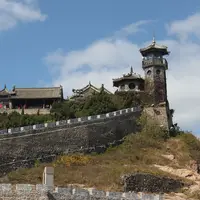
Penglai Pavilion and Water City 蓬莱阁与蓬莱水城
A cliff-top tower of immortals and a Ming sea fortress on the Bohai shore
Listed sites in Yantai
31 sites in Yantai are on the official lists. Those with a page of their own link to it; the rest open as cards on the map.
- Nanshan Scenic Area, Longkou 龙口南山旅游景区 5A scenic area · on the map
Nanshan is a large scenic area run by the Nanshan Group in the hills south of Longkou, best known for a seated tin-bronze Buddha of about 380 tonnes that stands above a long flight of 360 steps. - Aishan Hot Spring Resort 艾山温泉度假村 4A scenic area · on the map
Aishan Hot Spring Resort is a hot-spring complex beside the village of Aishantang, at the foot of Mount Ai north of Qixia town, with open-air pools and resort accommodation. - Changdao: South and North Changshan Islands 长岛南北长山 4A scenic area · on the map
Nanchangshan and Beichangshan, two linked islands in the Bohai Strait, make up the main sightseeing area of the Changdao archipelago. - Changyu International Wine City 张裕国际葡萄酒城 4A scenic area · on the map
Changyu International Wine City is the winery-tourism area of Changyu, which began making wine in Yantai in 1892, in the Yantai Economic-Technological Development Area. - Changyu Wine Culture Museum 张裕酒文化博物馆 4A scenic area · National heritage site · on the map
The museum stands on the original premises of Changyu, founded in Yantai in 1892 by the overseas Chinese businessman Zhang Bishi and regarded as the start of modern winemaking in China. - Cishan Hot Spring Town 磁山温泉小镇 4A scenic area · on the map
Cishan Hot Spring Town is a hot-spring resort on the lower slopes of Cishan hill in the western part of the Yantai development zone, with hot-spring bathing, accommodation, restaurants and meeting rooms. - Daheishan Island 大黑山岛 4A scenic area · National heritage site
Daheishan is a volcanic island at the western end of the Changshan Islands in the Bohai Strait, about 70 minutes by ferry from Penglai. - Daji Mountain, Laizhou 大基山 4A scenic area · on the map
Daji Mountain is a forested valley and peak (478 m) on the south-east edge of Laizhou that has long been a Taoist retreat associated with the Quanzhen master Qiu Chuji, and temple halls around Daji Lake, including the Taiqing Palace, were rebuilt from the early 2000s. - Haichang Fisherman's Wharf 海昌渔人码头 4A scenic area · on the map
Despite its name, Haichang Fisherman's Wharf is a modern waterfront leisure development on a small land-tied island in Laishan district, with the sea on three sides and buildings in Victorian and Georgian-inspired style. - Haiyang Tourist Resort 海阳旅游度假区 4A scenic area · on the map
Haiyang Tourist Resort stretches along the seafront south-east of Haiyang town, centred on a long sandy beach backed by pine woodland, hotels and villas. - Jinshatan (Golden Sand Beach) Seaside Park 金沙滩海滨公园 4A scenic area · on the map
A long seaside park on Bajiao Bay (also called Taozi Bay) in Yantai's Development Zone, with a wide bathing beach of fine pale sand backed by a belt of coastal woodland. - Junding Winery 君顶酒庄 4A scenic area · on the map
Junding Winery is a winery estate that settled in Penglai in 2007 and is named by the Shandong tourism department among Yantai's leisure wineries for wine tourism. - Kunlong Hot Spring 崑龙温泉 4A scenic area · on the map
Kunlong Hot Spring is a hot-spring resort in Longquan town, on the northern foot of Mount Kunyu, with indoor and outdoor pools, a spa, a hotel and water-play areas. - Laiyang Cretaceous National Geopark 莱阳白垩纪国家地质公园 4A scenic area · on the map
This national geopark south of Laiyang protects Cretaceous rocks about 140 to 65 million years old that have yielded dinosaurs, dinosaur eggs, pterosaurs and large numbers of insects, which is why Laiyang is known as the home of Chinese dinosaurs. - Luoshan Gold Culture Tourist Area, Zhaoyuan 罗山黄金文化旅游区 4A scenic area · on the map
The Luoshan Gold Culture Tourist Area is built around the Zhaoyuan Gold Museum, at the foot of Luoshan in a city whose gold-mining history local media put at about 2,000 years. - Mou's Manor 牟氏庄园 4A scenic area · National heritage site · on the map
Mou's Manor is a clan estate of three groups of linked courtyard houses in the Jiaodong style, with more than 480 rooms on over 20,000 m², built by the Mou family from the Yongzheng reign of the early Qing dynasty to the 1930s. - Mount Kunyu 昆嵛山 4A scenic area
Mount Kunyu is a forested granite range at the eastern end of the Shandong peninsula, rising to 923 m at Taibo Peak and regarded as the birthplace of Quanzhen Daoism in the 12th century. - Ole Bao Dream World, Penglai 蓬莱欧乐堡梦幻世界 4A scenic area · on the map
A theme park on the Penglai coast that opened in the mid-2010s, built in a European style and laid out in seven themed zones with more than 40 rides and attractions. - Penglai Polar Ocean World 蓬莱海洋极地世界 4A scenic area · on the map
A marine park close to Penglai Pavilion, run by the same tourism group as the Eight Immortals and Sanxian Mountain parks. - Taixu Palace, Qixia 太虚宫 4A scenic area · on the map
Taixu Palace is a large Daoist temple complex on the shore of Changchun Lake, built on the former home of Qiu Chuji, the Daoist master born in Qixia who founded the Dragon Gate branch of Quanzhen Daoism. - Yangma Island 养马岛 4A scenic area · on the map
Yangma Island is a low island of about 14 km² off the north coast of Muping, linked to the mainland by a bridge, with sandy and rocky shores and a long coastal park along its rocky edge. - Yantai Hill 烟台山 4A scenic area · National heritage site
Yantai Hill is a small hill on the waterfront in the city centre, named after the beacon tower built on it in 1398 to warn of pirate raids, which gave the city its name. - Ding Family Residence, Longkou 丁氏故宅 National heritage site · on the map
A Qing-dynasty courtyard compound built by the Ding family of Huang County, nicknamed 'Ding Baiwan' (Ding the Millionaire) and once counted among Shandong's richest families. - Fujian Guild Hall, Yantai 烟台福建会馆 National heritage site · on the map
The Fujian Guild Hall, also called the Tianhou Palace, is a Qing-dynasty guild hall and temple to the sea goddess Mazu (Tianhou) built by merchants from Fujian, in southern Fujian style with a gate hall, main hall, rear hall and opera stage, and richly carved in wood and stone. - Houji Island Lighthouse 猴矶岛灯塔 National heritage site · on the map
Built in 1882 under a British engineer on a small uninhabited island in the Bohai Strait, this is the first lighthouse in the Miaodao (Changshan) archipelago and, according to the national heritage administration, the first modern lighthouse around the Bohai Sea. - Muping Museum (Former Charity Home) 牟平区博物馆(恤养院旧址) National heritage site · on the map
The former Muping Charity Home, a complex dating from 1933 that was listed as a national heritage unit in 2019, is now the main building of Muping District Museum. - Qi Jiguang's Hometown and Ancestral Temple, Penglai 戚继光故里 National heritage site · on the map
Qi Jiguang, the Ming general famed for defending the coast against raiders, came from Dengzhou, now Penglai, and this 19,000 square metre compound in the old city centre preserves his family's quarter: the family residence, a weapons hall and the three-courtyard ancestral temple, built in 1635 as the Biaogong Temple and open to the public since 1985. - Wulin Christian Church, Penglai 武霖基督教圣会堂 National heritage site · on the map
Built in 1872 by the American Southern Baptist missionary Tarleton Crawford, this brick-and-timber chapel with an attached bell tower is described as the oldest surviving church in Shandong. - Yantai West Battery 烟台西炮台 National heritage site · on the map
A Qing-dynasty coastal fort on the summit of Tongshen Hill, begun in 1876, enlarged in 1887 and fitted with Krupp guns in 1899 under German engineers; the guns were removed after the 1901 Boxer Protocol. - Yunfengshan and Tianzhushan Cliff Inscriptions 云峰山、天柱山摩崖石刻 National heritage site · on the map
A group of Northern Wei cliff inscriptions by the calligrapher Zheng Daozhao and his son, which mark the shift of Chinese script from clerical to regular style. - Zhaotuan Landmine Warfare Site 赵疃地雷战遗址 National heritage site · on the map
Zhaotuan is a hill village in Haiyang where, during the Second Sino-Japanese War, local militia used home-made stone and iron mines against Japanese and puppet-regime troops stationed nearby, a campaign that the 1962 film Landmine Warfare drew on.
Getting to Yantai
Train, flight and driving times from the cities most visitors come from, with stations, fares and how many run a day; each opens the full comparison.
- Shenyang 沈阳 high-speed train 8 h 56 min, 2 a day, from ¥684; 2 nonstop flights a day, 1 h 25 min in the air
On the map
Open Yantai on the illustrated map to see its outline, its places and listed sites together, and to add them to a trip.
Open Yantai on the map