
 An illustrated travel map
Travel guide · Updated 2026-11-06
Can I come to China for medical treatment?
This guide is not medical advice and does not recommend any hospital, doctor or treatment. It restates official rules and lists. Make treatment decisions with your doctor.
Many hospitals accept patients from abroad, mostly through an international department or an official pilot for international patients. But no visa is named for medical treatment, and organ transplants for foreigners, surrogacy, and stem cell treatment outside approved research are not allowed. The medical map lists the hospitals and clinics on official lists.
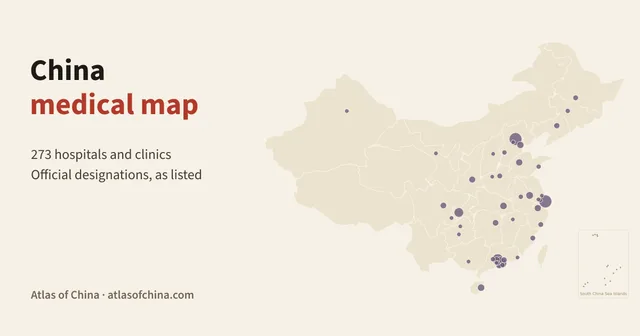 China medical mapThe 273 hospitals and clinics on official lists, filtered by designation and specialty.
Is China a fit for your treatment?
Most hospitals in China are public, graded I to III by the health authorities; the national designations and ranking lists cluster in the large grade III hospitals of the big cities. The government sets and publishes the prices of public hospitals' basic services. Many large hospitals also run an international or "special needs" department, with its own appointments and higher prices.
Cancer, cardiovascular disease, children's health and stomatology are among the fields with a national medical centre. Traditional Chinese medicine has its own public hospitals and national key specialties.
What you cannot do in China
- Organ transplants: a 2007 notice of the Ministry of Health's General Office bars hospitals from transplanting organs for foreigners who travel to China for one. Donation and transplantation are governed by the Regulation on Human Organ Donation and Transplantation, in force since 1 May 2024.
- Surrogacy: banned. The Ministry of Health's 2001 measures on assisted reproduction forbid hospitals and their staff from performing any form of surrogacy.
- Assisted reproduction: the national technical rules require the hospital to check the couple's identity documents and marriage certificate before treatment.
- Stem cell and other cell therapies: outside the Boao Lecheng zone, only as clinical research approved under the 2015 national measures, not as paid routine treatment. In the zone, Hainan's 2020 regulation lets institutions research and apply stem cell, immune cell and gene therapies.
Cosmetic surgery, weight-loss surgery and fertility treatment are not covered by this guide or the map's specialty filters.
Visas
- No Chinese visa is named for medical treatment. The Chinese embassy page we read puts treatment, and accompanying a patient, under the S2 private-affairs visa (stays of up to 180 days), with proof from the hospital.
- The 30-day visa-free entry is for business, tourism, visiting family and friends, exchanges and transit; medical treatment is not among the purposes listed. See visas and visa-free entry.
- Hainan's visa-free entry, for 61 nationalities, lists medical treatment among its purposes, for up to 30 days on the island.
We restate the rules and give no legal advice: confirm with the National Immigration Administration (its line is 12367) or a Chinese embassy.
Finding a hospital
An international department is a separate service inside a hospital, with its own appointment line and prices and, at some, English-speaking staff; the general clinics book through Chinese apps. A ranking does not mean a hospital has one: the medical map marks only the departments stated on a hospital's own website, and the pilot hospitals named by its city or province.
Before you travel, ask the international department what to send (records, imaging, current medicines) and for a written estimate. We list no interpreters, escorts or agencies. Beijing lists hospitals with foreign-language services in its medical guide.
China's basic medical insurance covers people enrolled in it, including foreigners employed in China, not visitors. Guangdong's 2026 notice on its international pilot hospitals says those services are paid by the patient or by commercial insurance.
Costs and paying
This guide gives no prices. Expect a deposit on admission and itemised bills; international departments set their own prices, above the government-set prices of the general clinics. The map marks the hospitals that state direct billing with international insurers on their website.
For Alipay, WeChat Pay and cards, see paying in China. Keep itemised receipts and invoices for your insurer.
Around the treatment
- Staying on, for a long treatment or recovery: the long-stay map has cities for a month or more.
- Records: before you leave, ask for copies of your records, imaging and discharge summary, and whether they come in English.
- Medicines: what you may take home depends on your own country's import rules; carry the prescription.
If something goes wrong
The Regulation on the Prevention and Handling of Medical Disputes, in force since 1 October 2018, sets five routes: the two sides negotiate; people's mediation, through the local medical dispute mediation committee; administrative mediation by the health authority; a lawsuit; or another route set by law. Complaints about a hospital go to the local health commission; the national health hotline is 12320. We take no side and give no legal advice.
By specialty
Official designations by field; each field's name opens the map filtered to it.
- Chinese medicine: public Chinese medicine hospitals, national key specialties in Chinese medicine (acupuncture, tuina, bone setting and more), and the national centre for integrated Chinese and Western medicine at the China-Japan Friendship Hospital, Beijing.
- Cancer: the National Cancer Center, hosted by the Cancer Hospital of the Chinese Academy of Medical Sciences, Beijing, and the proton and heavy-ion centres reported in operation.
- Heart: the National Center for Cardiovascular Diseases, hosted by Fuwai Hospital, Beijing.
- Eyes: no national medical centre; eye specialties on the key specialty and ranking lists.
- Dentistry: national medical centres for stomatology in Beijing, Shanghai and Chengdu.
- Bones, joints and rehabilitation: national medical centres for orthopaedics in Beijing and Shanghai, and for trauma in Beijing.
- Health check-ups: the Fudan ranking's health management list.
- Children: national medical centres for children's health in Beijing, Shanghai, Shenyang and Guangzhou.
The Boao Lecheng pilot zone
The Boao Lecheng International Medical Tourism Pilot Zone, in Qionghai on Hainan island, is where hospitals may use drugs and medical devices approved abroad but not yet in China, when clinically urgent and under the zone's rules (Hainan's 2020 regulation). It suits a patient who needs a specific drug or device not approved in China, and the treatment happens inside the zone. The map lists the institutions on the zone authority's 2020 list; more have opened since.
From neighbouring countries, Hong Kong and Macau
- Russia, Central Asia, Mongolia and Southeast Asia: the nearest large hospitals are in border provincial capitals such as Harbin, Urumqi, Hohhot, Kunming and Nanning. Their own websites say which languages they work in.
- Hong Kong and Macau: hospitals in the nine mainland Greater Bay Area cities designated under the Hong Kong and Macau drugs and devices scheme may use urgently needed drugs and devices sold there (on the map). Hong Kong residents aged 65 and over can use Elderly Health Care Vouchers at The University of Hong Kong-Shenzhen Hospital and other institutions in the Greater Bay Area pilot.
Official sources
The rules above change; these are the pages to check before you travel, and the ones this guide was checked against on 2026-11-06.
- Embassy of China in Pakistan: visa types and documents the S2 visa for medical treatment, October 2024
- Consulate-General of China in Auckland: visa-free entry notice the purposes of the 30-day visa-free entry, May 2026
- Embassy of China in Thailand: Hainan visa-free entry medical treatment among the purposes, February 2024
- Hainan Provincial Government: visa-free entry to Hainan 61 nationalities
- State Council: Regulation on Human Organ Donation and Transplantation Order 767, in force 1 May 2024, in Chinese
- Hainan Provincial People's Congress: Boao Lecheng pilot zone regulation 2020; articles 19 (cell and gene therapies) and 24 (imported drugs and devices), in Chinese
- State Council: Regulation on the Prevention and Handling of Medical Disputes Order 701, article 22 (the routes), in Chinese
- Beijing Municipal Government: medical guide hospitals with foreign-language services, English booking
- Hong Kong Department of Health: Elderly Health Care Voucher Greater Bay Area pilot mainland institutions accepting the vouchers
- National Immigration Administration (English) entry, visas and residence permits; 12367 service line
Related guides
- Visas and visa-free entry
Can I visit China without a visa? Updated November 2026 - Paying for things
How do I pay for things in China without a Chinese bank account? Updated October 2026 - Long stay in China
Can I live in China for a few months? Updated November 2026
Start planning
Pick the places you want to see on the illustrated map, add them to a trip, and the planner lays out the days and the trains between them.
Open the mapCite this page
- APA
- Atlas of China. (2026, November 6). Can I come to China for medical treatment? https://www.atlasofchina.com/guides/medical-treatment-in-china/
- MLA
- “Can I come to China for medical treatment?” Atlas of China, 6 Nov. 2026, www.atlasofchina.com/guides/medical-treatment-in-china/.