 Atlas of China
Drum and Bell Towers 钟鼓楼Zhōnggǔlóu
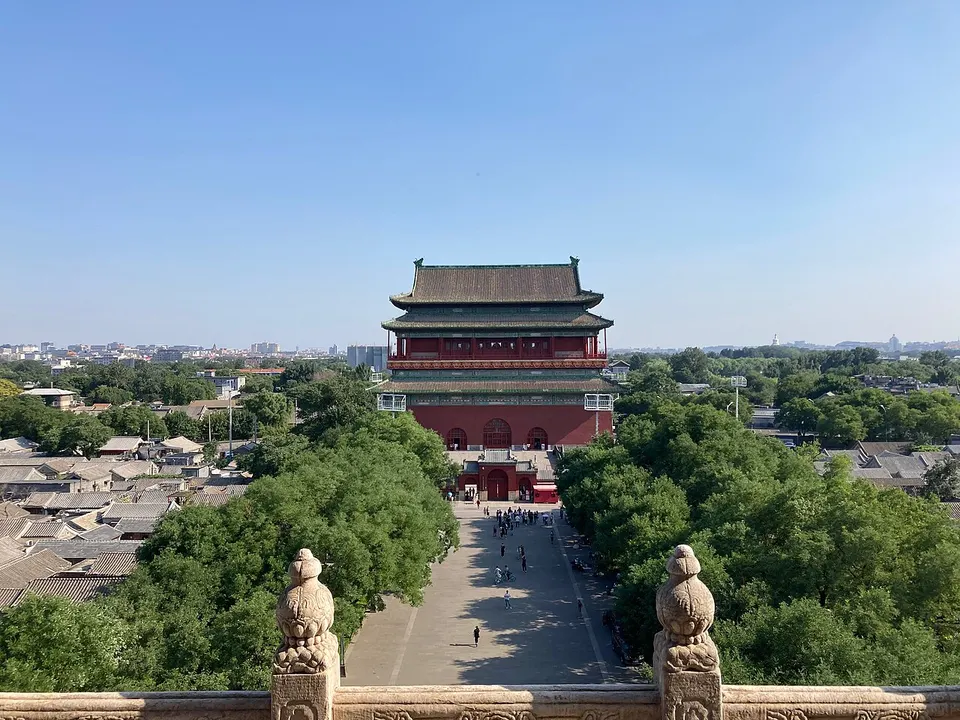
Beijing's old timekeeping towers, with drum performances and views over the hutong roofs
- Best time
- Apr–May, Sep–Oct
- Time needed
- 1–2 hours
- Days to budget
- Half a day
- Stay in
- Beijing
- Region
- Beijing
- Type
- Heritage
- Listed as
- National heritage site, UNESCO World Heritage
Why go to Drum and Bell Towers
At the northern end of Beijing's historic central axis, the Drum Tower and the grey-walled Bell Tower face each other across a small square in the hutongs, the old lanes of courtyard houses. Climb the Drum Tower to see its great drum, catch a drumming performance and look out over the rooftops of central Beijing, then cross to the Bell Tower for its 63-tonne bronze bell, cast in the reign of the Ming Yongle Emperor.
The story
Until 1924 the two towers kept Beijing's official time. At nightfall the drums were always beaten before the bell was struck, and when the bell followed the drum, the city gates were closed for the night.
What to see at Drum and Bell Towers
- Drum Tower 鼓楼: A 47 m two-storey wooden tower rebuilt under the Ming Yongle Emperor, with the surviving main drum on the upper floor and a view over the rooftops.
- Bell Tower 钟楼: A 33 m tower with grey walls and a green glazed roof, standing just behind the Drum Tower and reached by a steep stair.
- Tower Square 钟鼓楼广场: The small open square between the two towers, where locals gather and the lanes of the old hutongs begin.
How to visit Drum and Bell Towers
Start at the Drum Tower, watch a drumming performance, then cross the square to the Bell Tower; both climbs are steep. The two towers take about one to two hours together; you could add a half day in the surrounding hutongs and Shichahai.
How to get to Drum and Bell Towers
Take Metro Line 8 to Shichahai and walk a few minutes north along Di'anmen Outer Street, or Line 2 or Line 8 to Gulou Dajie, about 10 minutes' walk north of the towers.
Where to stay
Stay in the hutongs around Gulou, Nanluoguxiang or Shichahai, which put the towers on your doorstep.
What to eat
- Soybean milk and fried ring 豆汁焦圈: A sour fermented mung-bean drink paired with a crisp fried ring, an acquired taste that locals love.
- Quick-boiled tripe 爆肚: Strips of tripe blanched in boiling water and dipped in sesame sauce, a traditional Beijing street food.
Tips for visiting Drum and Bell Towers
- Buy tickets through the 'Beijing's Bell and Drum Towers' WeChat account; a combined ticket covers both towers.
- Drummers perform several times a day on the Drum Tower's upper floor, so time your climb to catch a performance.
- The Drum Tower's ground-floor exhibition hall is closed on Mondays except public holidays.
Nearby
- Shichahai 什刹海 under 10 km
Three linked lakes ringed by hutongs and lakeside bars, with open-air skating in winter - Prince Gong's Mansion 恭王府 under 10 km
A Qing courtyard mansion and rock garden, home first to a corrupt minister, then a prince - Temple of Confucius and Imperial Academy 孔庙和国子监 under 10 km
Courtyards of stone steles naming imperial exam graduates, beside the old Imperial Academy - Beihai Park 北海公园 under 10 km
A former imperial lake garden crowned by a white Tibetan-style stupa on its island - Lama Temple 雍和宫 under 10 km
Incense-filled courtyards and an 18-metre sandalwood Buddha in a working monastery - Forbidden City 故宫 under 10 km
Six centuries of imperial power behind vermilion walls in the heart of Beijing
Also within 30 km: Guo Moruo Residence 郭沫若故居 (under 10 km), Former Residence of Soong Ching-ling 宋庆龄故居 (under 10 km), Wen Tianxiang Temple 文天祥祠 (under 10 km), Mei Lanfang Memorial Museum 梅兰芳纪念馆 (under 10 km), Zhizhu Temple 智珠寺 (under 10 km), Deshengmen Arrow Tower 德胜门箭楼 (under 10 km).
On the map
Open Drum and Bell Towers on the illustrated map to see the terrain around it, what else is close, and to add it to a trip and plan the days.
Open Drum and Bell Towers on the map