 Atlas of China
Shennongjia 神农架生态旅游区Shénnóngjià Shēngtài Lǚyóuqū
Primeval forest and alpine meadow on the roof of central China, a UNESCO forest reserve
- Best time
- May–Oct
- Time needed
- 1–2 days
- Days to budget
- 2 days
- Stay in
- Shennongjia
- Region
- Hubei
- Type
- Nature
- Listed as
- 5A scenic area, UNESCO World Heritage
Why go to Shennongjia
Shennongjia is a vast forested massif in north-western Hubei, listed as a UNESCO World Heritage Site in 2016 for its primary forests and rich wildlife. The main visitor area has two parts: Shennongding, with boardwalks through primeval forest, alpine meadow and rock forests below the 3,106 m summit, and Guanmenshan, an 8 km river gorge with natural-history museums. The wider district is also home to wild golden snub-nosed monkeys, which live in protected forest and are not guaranteed sightings.
The story
The district is named for Shennong, the legendary farmer-god said to have tasted wild herbs to find medicines, and it has long been rumoured to hide a tall, ape-like "wild man" that nobody has ever caught. The reality is just as striking: UNESCO says the site protects the largest primary forests left in central China, and the district's golden snub-nosed monkey population was reported to have grown from about 500 to over 1,200 between 1990 and 2005.
What to see at Shennongjia
- Guanmenshan 官门山: An 8 km river gorge near Muyu with natural-history museums, a rare-plant garden, giant pandas and cliff-side beehives.
- Shennong Altar 神农坛: A ceremonial site near Muyu honouring the legendary Shennong, set among the trees and usually combined with Guanmenshan.
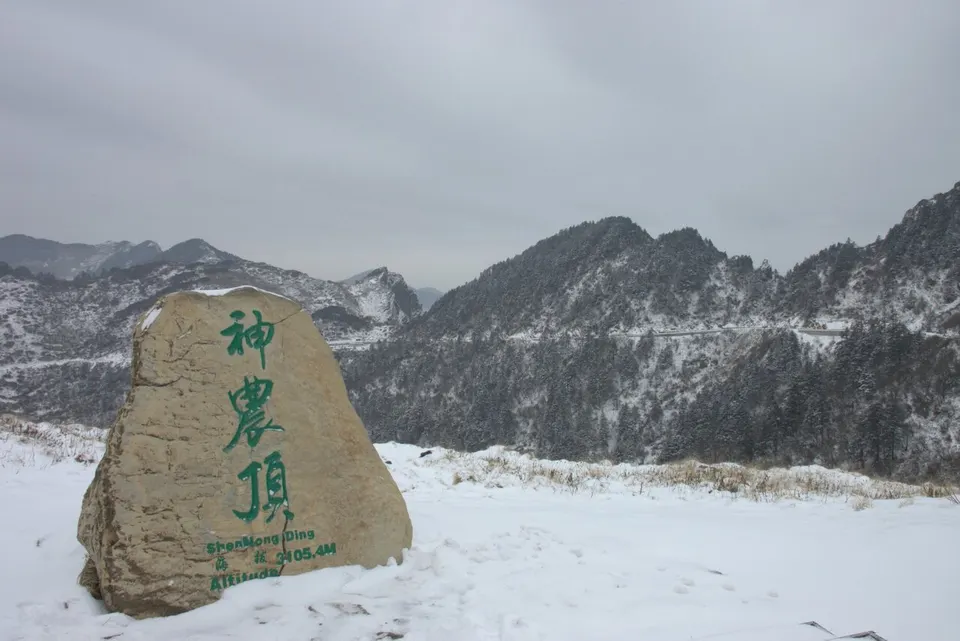
- Shennongding 神农顶: The main mountain section, with boardwalks through forest, alpine meadow, rock forests and rhododendrons below the 3,106 m summit, which is billed as the highest in central China.
- Dajiuhu 大九湖: A high-altitude marshland basin in the west of the district, listed under the Ramsar wetlands convention, with boardwalks over the meadows; it is usually visited as a separate leg.
- Tianyan 天燕: A forested scenic area in Hongping town, on the north-western side of the district, with a small ski area in winter.
How to visit Shennongjia
Muyu town is the hub; scenic-area shuttles and buses run from there to the individual areas. Do Guanmenshan and the Shennong Altar on one day, and give Shennongding most of another. Dajiuhu and Tianyan are further out, so add them only if you have a third day.
How to get to Shennongjia
Muyu town is the base. From Wuhan, the usual route is a high-speed train to Xingshan station (about 2 to 2.5 hours), then a bus or taxi of around an hour or more to Muyu; Shennongjia station, on the eastern edge of the district, is much further from the main sights. Visitors from Yichang come by road along the Yichang–Shennongjia route, and Hongping airport has flights from Wuhan and some other cities.
Where to stay
Stay in Muyu town, where services are best and the road to the main areas starts. Dajiuhu has some guesthouses if you want to be near the wetland.
What to eat
- Cured pork trotter hotpot 腊猪蹄火锅: Smoked local pork trotters simmered with mountain potatoes in a hotpot, the district's best-known dish and on most Muyu menus.
- Pan-baked mountain potatoes 炕土豆: Small highland potatoes slow-fried in an iron pan until crisp outside and soft inside.
- Lazy tofu 懒豆腐: Ground soybeans cooked with greens without straining, a rustic highland dish, often eaten with maize rice.
Tips for visiting Shennongjia
- Shennongding stands at about 3,100 m, so nights and mornings are cold even in summer; pack layers and rain gear.
- Stay on the boardwalks and marked roads, since the primeval forest and the monkey reserve are protected; the true summit is not part of the normal visitor route.
- The sights are spread over a large area linked by road, so plan one or two areas per day; the core Shennongding and Dajiuhu areas are reached by scenic-area shuttle, and food and water are scarce inside, so bring your own.
Nearby
- Yangtze Three Gorges 长江三峡 90 km
Cliffs closing in on the Yangtze along China's most storied river passage - Three Gorges Dam 三峡大坝 90 km
The Yangtze's mega-dam, seen from hilltop lookouts and a ship lift that raises whole boats - Wudang Mountains 武当山 120 km
Taoist palaces strung along forested ridges, and the legendary birthplace of tai chi
Also within 30 km: Hongping Gallery 红坪画廊 (20 km).
On the map
Open Shennongjia on the illustrated map to see the terrain around it, what else is close, and to add it to a trip and plan the days.
Open Shennongjia on the map