
 An illustrated travel map
Yunhe Rice Terraces 云和梯田Yúnhé Tītián
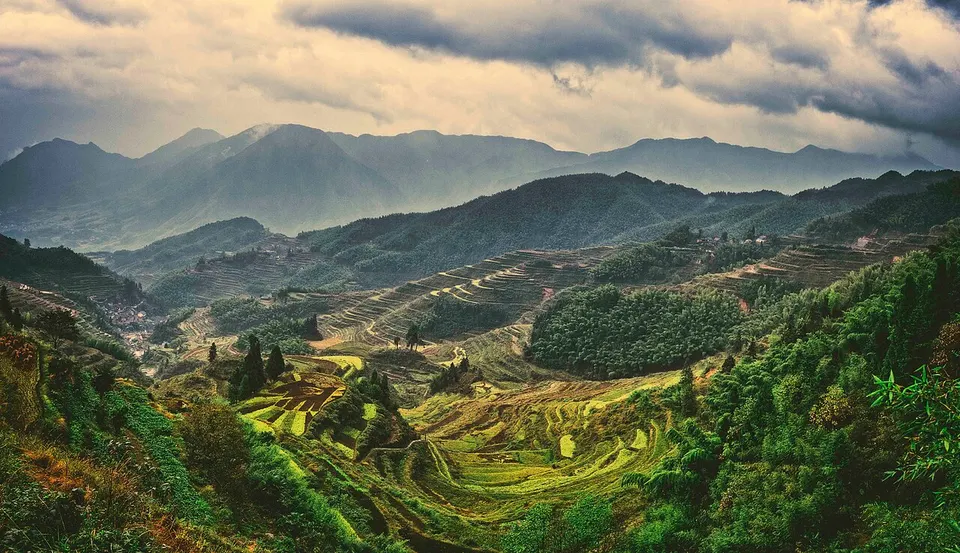
Terraces stacked up a mountain in hundreds of layers, with a cable car and a stone village
- Best time
- Apr–Jun, Sep–Oct
- Time needed
- 1 day
- Days to budget
- 1 day
- Stay in
- Lishui
- Region
- Zhejiang
- Type
- Nature
- Listed as
- 5A scenic area
Why go to Yunhe Rice Terraces
The Yunhe terraces climb from about 200 m to around 1,400 m above sea level around Chongtou, in layers that reach several hundred in places. A 3.9 km cableway rises over the fields, viewpoints look over sea-of-cloud mornings, and the old stone stockade village of Kenggen sits in the valley. The area became a 5A scenic area in February 2024.
The story
Terracing began in the Tang dynasty and spread in the Yuan and Ming, when rice farming grew alongside local silver mining; She families moved in during the late Ming and early Qing. Local custom opens the ploughing season with a ritual to the field god, and the Meiyuan Mangzhong ploughing festival, held at Grain in Ear (early June), is on the national intangible heritage list.
What to see at Yunhe Rice Terraces
- Jiuqu Yunhuan viewpoints 九曲云环: The core viewing area, with the densest layers and the classic sunrise and sea-of-cloud vantage points.
- Guanyun cable car 观云索道: A cableway of about 3.9 km from the visitor centre over the fields to the upper viewpoints, with a vertical drop of roughly 800 m; it saves the steep climb.
- Qixingdun viewpoint 七星墩: A viewing platform at the upper end of the cable car, looking over the slope.
- Kenggen stone village 坑根石寨: A village of stone houses and flagstone lanes at a lower altitude, reached by the park's shuttle line, with the terraces rising behind it.
How to visit Yunhe Rice Terraces
Start at the visitor centre and ride the cable car up to the upper viewpoints, then work back down through the terraces. The park is split into the Jiuqu Yunhuan, Qixingdun and Baiyin Valley areas, and a park shuttle serves Kenggen village at the lower altitude. A day covers the viewpoints and the village; for sunrise stay locally.
How to get to Yunhe Rice Terraces
Take a train to Lishui station on the Jinhua–Wenzhou high-speed railway, then a bus or taxi via Yunhe town to the visitor centre at Chongtou, about 10 km from the county seat; allow an hour or a little more for the road, and check current bus links before travelling.
Where to stay
Stay in a guesthouse in the villages near the terraces for sunrise access, or in Yunhe town or Lishui city for more choice.
What to eat
- Loach stew with rice-wine lees 米酒糟泥鳅煲: A traditional Yunhe stew of loach from the terrace paddies, white local cucumber and red-yeast rice-wine lees.
- Black glutinous rice 乌米饭: A She-minority speciality of rice dyed with a leaf juice, eaten around the spring festivals.
- Yunhe snow pear 云和雪梨: A local pear with white, juicy flesh, sold in the county in autumn.
Tips for visiting Yunhe Rice Terraces
- Sunrise and early morning give the best light and the mist; it is cool and often foggy on the hill, so bring a jacket.
- Cable car operation varies by season and weather, so check locally and plan your descent in good time.
- Looks differ by season: flooded mirror-like fields in spring, green in summer and gold in early autumn.
Nearby
- Mount Jianglang & Nianbadu 江郎山·廿八都 110 km
Three red cliffs, a sky-thin gorge and a border-road town of 140-plus surnames - Baishuiyang and Yuanyang Stream 白水洋·鸳鸯溪 110 km
Wade across a flat bedrock riverbed, then walk a mandarin-duck gorge
Also within 30 km: Yunhe Silver Mine Site 云和银矿遗址 (under 10 km), Window of She Culture, Dajun 畲乡之窗 (10 km), Yunzhong Daji Scenic Area 云中大漈 (30 km), Shisi Temple 时思寺 (30 km).
On the map
Open Yunhe Rice Terraces on the illustrated map to see the terrain around it, what else is close, and to add it to a trip and plan the days.
Open Yunhe Rice Terraces on the map