 Atlas of China
Ma'anshan 马鞍山Mǎ’ānshān
Li Bai's moonlit river cliff, his grave and Neolithic jade across the Yangtze
About Ma'anshan
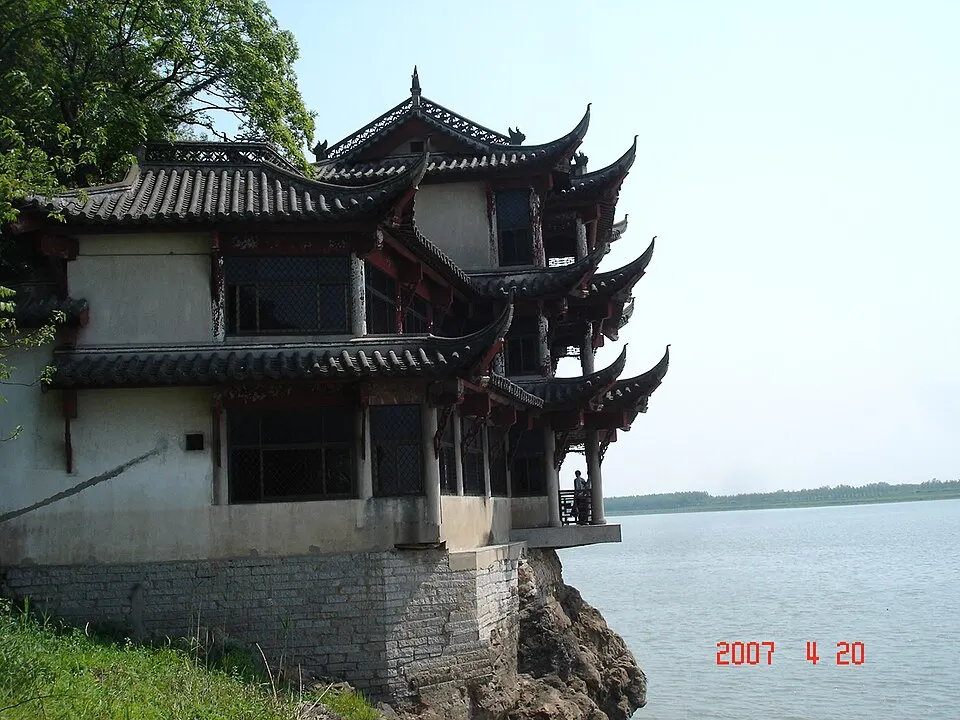
Ma'anshan is a steel city on the Yangtze just upstream of Nanjing, named, legend says, after the saddle of the warlord Xiang Yu's horse. Its gentler side is Caishi Rock, first of the river's three famous rocks, where the Tang poet Li Bai is said to have drowned trying to embrace the moon's reflection; the Tomb of Li Bai lies below Green Hill in Dangtu. Across the river in Hanshan County, the Lingjiatan Site has yielded jade figures over 5,000 years old.
What to eat in Ma'anshan
- Caishi dried tofu (采石矶茶干)
- Dangtu pork noodles (当涂大肉面)
Listed sites in Ma'anshan
11 sites in Ma'anshan are on the official lists. Those with a page of their own link to it; the rest open as cards on the map.
- Caishi Rock 采石矶 5A scenic area · National heritage site
Caishi Rock is the cliff-bound foot of Cuiluo Hill where it juts into the Yangtze on the south-western edge of Ma'anshan, counted first of the river's three famous rocks and long a strategic crossing, where Song forces led by Yu Yunwen defeated an invading Jin army in 1161. - Baochan Mountain 褒禅山 4A scenic area · on the map
Baochan Mountain, a wooded hill north-east of Hanshan county town, was once called Hua Shan and took its present name from the Tang monk Huibao, who built a hermitage at its foot and was buried here. - Daqingshan Wildlife World 大青山野生动物世界 4A scenic area · on the map
Daqingshan Wildlife World is a commercial zoo and theme park of more than 2,000 mu in Taibai town, rated 4A in 2023, keeping over 3,000 animals of more than 200 species. - Dehuatang Chinese Antique Bed Museum 德化堂古床博物馆 4A scenic area · on the map
The Dehuatang museum in Ma'anshan's Yushan district is a private museum of traditional Chinese beds, displaying carved wooden beds, most of them from the Qing dynasty and the Republican era, with other old furniture in period room settings. - Jilong Mountain and Banyue Lake 鸡笼山 4A scenic area · on the map
Jilong Mountain is a forested hill of about 240 m in western He County, an outlier of the Dabie range with some 20,000 mu of woodland. - Lingjiatan Site 凌家滩遗址 4A scenic area · National heritage site · on the map
Lingjiatan, on the north bank of the Yuxi River, was a large late-Neolithic settlement of about 3800–3300 BC with double moats, a ritual altar platform and a cemetery rich in jade. - Putang National Holiday Park 濮塘 4A scenic area · on the map
Putang is an area of about 20 km² of wooded hills on Ma'anshan's eastern edge, now run as the Putang National Holiday Park, with 49 peaks, 53 small valleys and eight reservoirs. - Taihu Mountain 太湖山 4A scenic area · on the map
Taihu Mountain in southern Hanshan County is a wooded upland made up of the Taihushan National Forest Park, about 1,800 ha with 95% forest cover, and a deer park. - Tomb of Li Bai 李白墓 4A scenic area · National heritage site
The Tang poet Li Bai, who died in Dangtu in 762, was reburied in 817 at the western foot of Qingshan (Green Hill), where his grave mound lies in a memorial garden with the Taibai Shrine. - Xiangquan Hot Springs 香泉 4A scenic area · on the map
Xiangquan is a small hot-spring town in He County whose warm spring has been used for bathing for centuries; legend says the Liang-dynasty crown prince Xiao Tong was cured of a skin complaint here. - Tomb of Zhu Ran 朱然墓 National heritage site · on the map
This is the family burial ground of Zhu Ran (182–249), a general of the Eastern Wu state in the Three Kingdoms period, whose brick tomb, found in 1984, was the highest-ranking Wu burial excavated up to 2013.
On the map
Open Ma'anshan on the illustrated map to see its outline, its places and listed sites together, and to add them to a trip.
Open Ma'anshan on the map