 Atlas of China
Longyan 龙岩Lóngyán
The 'king of tulou', a 'Hakka capital' and cliffs rising sheer from the plain
About Longyan
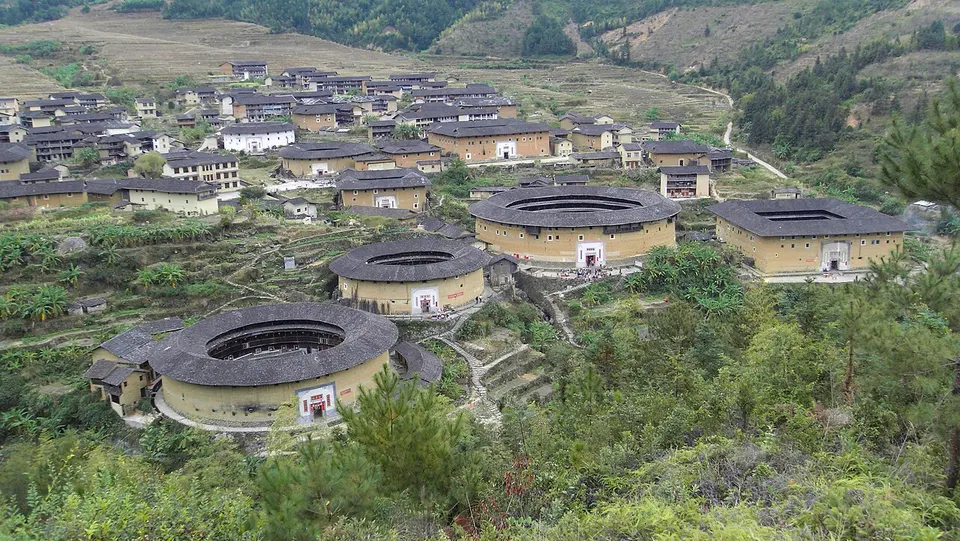
Longyan, in the hills of south-western Fujian, is the heartland of the Fujian Hakka, whose forebears migrated south from northern China. In Yongding they built tulou, huge round and square earthen houses; the Chuxi, Hongkeng and Gaobei clusters, with the four-ringed Chengqi Lou of 1709, belong to the Fujian Tulou World Heritage Site. Changting, the old prefectural city of Tingzhou, is called the 'Hakka capital', and Liancheng has the sheer cliffs of Guanzhai Mountain and the Hakka mansions of Peitian Ancient Village.
What to eat in Longyan
- White-cut Hetian chicken (白斩河田鸡)
- Liancheng dried sweet potato (连城地瓜干)
Listed sites in Longyan
22 sites in Longyan are on the official lists. Those with a page of their own link to it; the rest open as cards on the map.
- Guanzhai Mountain 冠豸山 5A scenic area
A cluster of sheer cliffs and rock pillars rising straight out of the plain just east of Liancheng town, named after a boulder said to resemble the head of the xiezhi, a mythical horned beast. - Gutian Congress Site 古田会议会址 5A scenic area · National heritage site
The Liao clan ancestral hall in Gutian town, built in 1848 and later used as a school, where the Fourth Red Army held its ninth party congress on 28–29 December 1929 and adopted a resolution drafted by Mao Zedong that set the principle of party control over the army. - Changting Revolutionary Sites 长汀革命旧址 4A scenic area · National heritage site
Six buildings in Changting's old town used by the Communist movement in 1929–33, when Changting was a key part of the Central Soviet Area. - Liangye Mountain 梁野山 4A scenic area · on the map
A forested mountain near Wuping county town, protected as a national nature reserve, with gorges, cliffs, deep pools and a chain of waterfalls. - Longkong Cave 龙硿洞 4A scenic area · on the map
A limestone show cave in Longkang village, Yanshi town, with passages on three levels, large chambers full of stalactites and other formations, and an underground river. - Mao Zedong's Caixi Investigation Sites 毛泽东才溪乡调查旧址 4A scenic area · National heritage site · on the map
Buildings in Xiacai village, Caixi town, linked with Mao Zedong's third visit to Caixi in 1933, when he carried out a social survey of the township and wrote it up as 'The Caixi Township Investigation'. - Meihuashan South China Tiger Park 梅花山华南虎园 4A scenic area · on the map
A breeding and rewilding centre for the South China tiger, a critically endangered subspecies found only in China, on the southern slopes of the Meihuashan National Nature Reserve near Gutian. - Peitian Ancient Village 培田古村 4A scenic area · National heritage site
A Hakka village of the Wu clan in Xuanhe, Liancheng, founded in the late Yuan and early Ming, whose present buildings date from the Ming and Qing, many of them rebuilt in the late Qing. - Qianlu Lake Wetland 千鹭湖 4A scenic area · on the map
A wetland of hill ponds, small lakes and marshes among wooded valleys in Chengxiang town, just outside Wuping county town, forming part of the Zhongshan River National Wetland Park. - Shiyan Cave and Junqing Temple 狮岩 4A scenic area · on the map
A limestone cave whose mouth looks like the open jaws of a lion, joined to Junqing Temple, the founding temple of Dingguang Buddha, the deified monk Zheng Ziyan from Tong'an whom Hakka communities honour as their protector. - Tianzi Hot Spring Resort 天子温泉 4A scenic area · on the map
A hot-spring resort in Dongxi village just outside Yongding town, with a large number of open-air thermal pools set in gardens styled after South-East Asia and a children's water play area. - Tingjiang National Wetland Park 汀江国家湿地公园 4A scenic area · on the map
A river wetland park on the Ting River at Sanzhou, in a part of Changting that was once among the worst-eroded red-soil areas of southern China, its bare hills nicknamed the 'Flaming Mountain'. - Caigai Ancestral Hall 采陔公祠 National heritage site · on the map
A large late-Qing Hakka ancestral hall in Miaoshang village, Miaoqian town, dedicated to Jiang Caigai, a 14th-generation ancestor of the local Jiang clan. - Central Red Communication Line Sites 中央红色交通线旧址 National heritage site · on the map
Relay stations on the secret route that in the early 1930s linked the Communist Party's underground headquarters in Shanghai with the Central Soviet Area, running via Hong Kong, Shantou and Dabu into western Fujian and on to Ruijin. - Former Minxi Workers' and Peasants' Bank 闽西工农银行旧址 National heritage site · on the map
The building on Xiajing Lane in central Longyan where the West Fujian (Minxi) Soviet Government opened the Minxi Workers' and Peasants' Bank in September 1930 to counter the Nationalist economic blockade of the base area. - Guantian Li Ancestral Hall 官田李氏大宗祠 National heritage site · on the map
The ancestral temple of Li Huode, regarded as the first of the Li clan to settle in Fujian, built in 1836 in Guantian village, Rentian town, and restored in 1909 and 1984. - Linjiang Lou 临江楼 National heritage site · on the map
A late-Qing brick and timber house on the north bank of the Ting River in Shanghang town, built as a paper merchant's warehouse and villa, with arched stone verandas on its ground and top floors. - Long March Starting Point of the Red Ninth Corps 红九军团长征出发地 National heritage site · on the map
Guanshou Hall, an early-Qing ancestral hall in Zhongwu village, Nanshan town, served in September 1934 as the headquarters of the Red Army's Ninth Corps, which with the 24th Division and local forces covered the main Red Army's withdrawal after the Nationalist attack on Songmaoling. - Sibao Woodblock Printing Buildings 四堡书坊建筑 National heritage site · on the map
Sibao, in the hills of northern Liancheng, was one of China's four main centres of woodblock printing in the Ming and Qing dynasties, and many of its family printing and bookselling workshops survive in the villages of Wuge, Zhongnan, Siqiao and Tiancha. - Tingzhou City Wall 汀州城墙 National heritage site · on the map
The wall of the old Tingzhou prefectural city was first built of rammed earth in 769, faced with brick and stone in 1371 and partly rebuilt in modern times, and long stretches survive along the Ting River. - Xibei Tianhou Palace 西陂天后宫 National heritage site
A temple to the sea goddess Mazu in Xibei village, Gaobei town, begun in 1542 and completed in 1662 by the local Lin clan, many of whose members had emigrated to South-East Asia. - Zhixi Ancestral Halls 芷溪宗祠建筑 National heritage site
Zhixi village in Miaoqian town is packed with Qing-dynasty Hakka ancestral halls, most of them combined halls and family homes built on the 'nine halls and eighteen courtyards' plan and fronted by finely made gatehouses.
On the map
Open Longyan on the illustrated map to see its outline, its places and listed sites together, and to add them to a trip.
Open Longyan on the map