 Atlas of China
Zhangzhou 漳州Zhāngzhōu
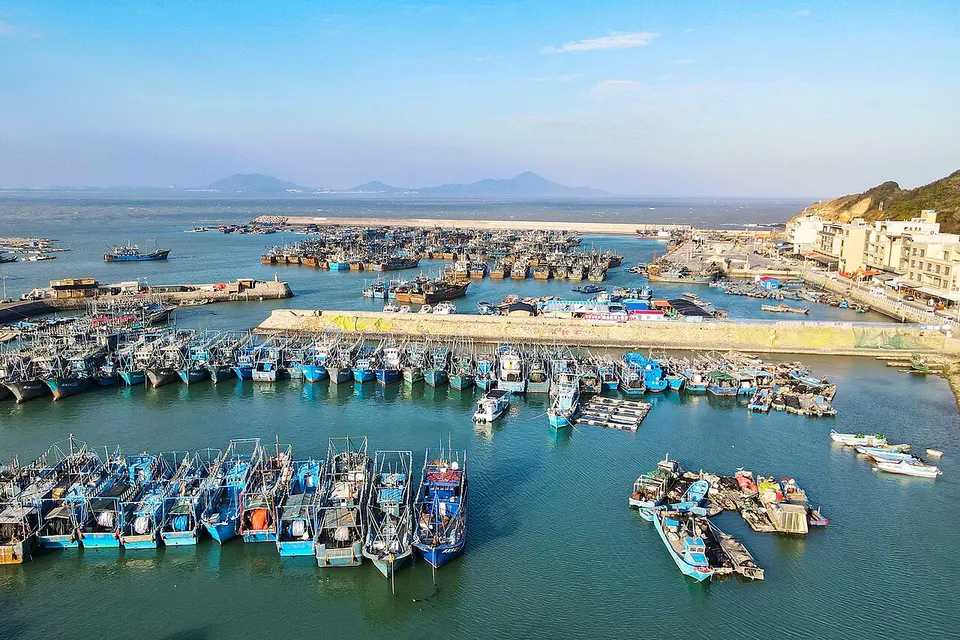
Earthen tulou in the hills and a seaside boulder that seems to rock in the wind
About Zhangzhou
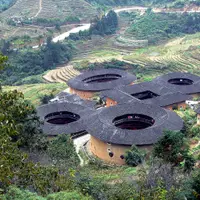
Zhangzhou reaches from tulou country in its hills down the Jiulong River to a coast of basalt headlands and sandy bays. The Nanjing County clusters around Tianluokeng and the Dadi cluster of the Hua'an Tulou belong to the Fujian Tulou World Heritage site, inscribed in 2008. In 1567 the Ming court made Yuegang, at today's Haicheng, Fujian's one legal port for overseas trade, and on Dongshan Island the Wind-Moved Rock perches by the walls of a Ming coastal garrison town.
What to eat in Zhangzhou
- Lor mee (卤面)
Featured places in Zhangzhou
-
Fujian Tulou 福建土楼
Round earthen fortresses where whole clans lived behind a single gate
Listed sites in Zhangzhou
31 sites in Zhangzhou are on the official lists. Those with a page of their own link to it; the rest open as cards on the map.
- Baitang Bay 白塘湾 4A scenic area · on the map
Baitang Bay, on the coast of Longjiao She Ethnic Township facing Xiamen across the water, has a 3.2-km crescent of sandy beach and the ancient volcanic crater at Niutou Shan, whose rows of basalt columns are nicknamed the 'terracotta warriors of the sea'. - Gaofeng Valley 高峰谷 4A scenic area · on the map
Gaofeng Valley is a mountain tea-garden resort near Guanfeng village in Xiazhai town, western Pinghe, run by a Zhangzhou state-owned group around some 1,000 mu (about 67 hectares) of tea gardens. - Guanshe She Village 官畲 4A scenic area · on the map
Guanshe is a She ethnic village in the hills of Xinxu town, Hua'an County, promoted as 'Colourful Guanshe' for its brightly painted houses. - Hua'an Tulou (Dadi Cluster) 华安土楼 4A scenic area · National heritage site
The Hua'an tulou tourist area centres on the Dadi cluster in Xiandu town: three large earthen houses, Eryi Lou, Nanyang Lou and Dongyang Lou, built by the Jiang family in the Qing dynasty and inscribed in 2008 as part of the Fujian Tulou World Heritage Site. - Jintang Bay 金汤湾 4A scenic area · on the map
Jintang Bay is a seaside hot-spring resort at Chendai town on the coast of Yunxiao County, built around a natural seawater hot spring with a high mineral content. - Lukai Eco-Manor 鹭凯生态庄园 4A scenic area · on the map
Lukai Eco-Manor is a farm resort at Zhouzai village in the Shuangdi Overseas Chinese Farm, a state farm founded in 1960 to resettle Chinese returnees from Indonesia, Myanmar, Vietnam, Malaysia and other South-East Asian countries. - Malan Bay 马銮湾 4A scenic area · on the map
Malan Bay is a broad sandy bay in Kangmei town on the east coast of Dongshan Island, run as a public beach resort area. - Sanping Temple 三平寺 4A scenic area · on the map
Sanping Temple, in the hills of Wenfeng town in eastern Pinghe, grew from the retreat where the Tang Chan monk Yizhong (781–872), revered as the Sanping Patriarch, preached from the 820s. - Shili Lanshan 十里蓝山 4A scenic area · on the map
Shili Lanshan is a hillside leisure park in the Mayangxi Eco-Tourism Zone of Changtai, on the boundary with Xiamen, with flower fields, walking trails and a campsite that looks out over the lights of Xiamen after dark. - Southeast Flower Capital Expo Park 东南花都 4A scenic area · on the map
This flower park at Xiban village in Zhangpu's Guanxun town is the showground of Zhangzhou's annual flower expo, held here since 1999 and long known as the Cross-Strait Flower Expo; in 2025 it took place as the Southeast Modern Agriculture Expo and Flower Expo. - Tianfu 'Crossing to Taiwan' Stone Carving Park 天福“唐山过台湾”石雕园 4A scenic area · on the map
Opened in 2003 beside the Tianfu service area on the coastal expressway, this sculpture park was paid for by Li Ruihe, the Taiwan-born founder of the Tianfu tea group, whose ancestors sailed to Taiwan from Zhangpu. - Tianfu Tea Museum 天福茶博物院 4A scenic area · on the map
Built by the Tianfu tea group as a non-profit cultural project, this museum complex at the company's tea estate covers about 130 mu (8.7 ha). - Tianzhushan Happy World 天柱山欢乐大世界 4A scenic area · on the map
This theme park and resort inside the Tianzhu Mountain National Forest Park in Changtai was developed from 2011 and opened in 2017–18. - Wind-Moved Rock and Guandi Temple, Dongshan 东山风动石 4A scenic area · National heritage site
On the seaside rocks by the east gate of Tongshan, the stone-walled town built in 1387 to guard the coast against pirates, the Wind-Moved Rock is a huge boulder resting on a tiny base that seems to rock in the wind. - Yundongyan 云洞岩 4A scenic area · on the map
Yundongyan ('Cloud Cave Rock') is a hill of small caves and boulders on the eastern edge of Zhangzhou city whose rocks carry more than 200 inscriptions from the Five Dynasties to the Qing, among them the characters 'Xishan Diyi' ('first among streams and hills') attributed to the Song philosopher Zhu Xi, who lectured here. - Zhangzhou Coastal Volcano National Geopark 漳州滨海火山国家地质公园 4A scenic area · on the map
This national geopark protects the volcanic coast of southern Zhangzhou, shaped by eruptions millions of years ago; this scenic area covers its Zhangpu section between Qianting and Fotan. - Former Tianyi Remittance Bureau 天一总局旧址 National heritage site · on the map
The Tianyi bureau was founded in 1880 by Guo Youpin, an Overseas Chinese merchant in the Philippines, in his home village of Liuchuan to carry letters and money ('qiaopi') between emigrants and their families. - Jiangdong Bridge 江东桥 National heritage site
Also known as the Hudu ('Tiger Crossing') Bridge, this crossing of the North Jiulong River began as a pontoon bridge in 1190, became a timber bridge on stone piers in 1210 and was rebuilt in stone after a fire in 1237. - Lin Ancestral Hall (Bigan Temple), Zhangzhou 漳州林氏宗祠 National heritage site
Built jointly by the Lin clans of Zhangzhou's seven counties, this ancestral hall on Zhencheng Lane is also called the Bigan Temple, because the Lins honour the ancient Shang-dynasty noble Bigan as their founding ancestor. - Lin Family Charitable Estate 林氏义庄 National heritage site · on the map
This charitable estate was built in 1819–21 by Lin Pinghou, a native of the old Longxi County who made his fortune in Taiwan and founded the Lin Ben Yuan family of Banqiao, to support his clansmen at home. - Nanshan Palace, Hua'an 南山宫 National heritage site · on the map
Nanshan Palace, on the eastern slope of Nanshan at Qinling village just south of Hua'an town, is a folk temple to the deities Shengzu Daxian and Dutong Sheren, founded in 1275 and rebuilt in 1505. - Pinghe City God Temple, Jiufeng 平和城隍庙 National heritage site · on the map
This Qing-dynasty City God temple stands in Jiufeng, which was the seat of Pinghe County from its founding in 1518 until 1949 and is now listed as a national historic and cultural town. - Wugengliao Backyard Blast Furnaces 五更寮土高炉群 National heritage site · on the map
Eight cylindrical red-brick blast furnaces, each about 5 m tall, stand in a north–south row at Wugengliao in Shangtian village, the remains of an ironworks set up during the 1958 Great Leap Forward steel campaign. - Xianzitan Rock Carvings 仙字潭摩崖石刻 National heritage site · on the map
Xianzitan, the 'Pool of the Immortals' Writing', at Tainei village near Shajian in southern Hua'an, is named after the ancient carved marks on its cliff face, rock art that the national heritage listing dates to between the Neolithic and the Zhou dynasty. - Zeng Family 'Fanzai Lou', Dongmei 东美曾氏番仔楼 National heritage site · on the map
Completed in 1911 for the Zeng family of Dongmei, this compound of 13 buildings and 99 rooms mixes Chinese and Western styles: a front row of traditional southern Fujian houses, a central block in 'Nanyang Gothic' style and a rear row of red-brick arcaded buildings. - Zhangpu Confucian Temple 漳浦文庙 National heritage site · on the map
Zhangpu's Confucian temple was founded in the Song dynasty and rebuilt in 1369, at the start of the Ming; only its Dacheng Hall survives. - Zhangzhou Confucian Temple 漳州府文庙 National heritage site · on the map
Founded in 1139 and rebuilt in 1482, Zhangzhou's prefectural Confucian temple keeps its ceremonial gate, Dacheng Gate, side halls, terrace and Dacheng Hall in a south-facing compound of about 2,600 m². - Zhangzhou Stone Memorial Arches 漳州石牌坊 National heritage site
Four carved stone memorial archways stand in Zhangzhou's old town: two from the Ming Wanli reign (1605 and 1619) at Shuangmending on Hong Kong Road, honouring the officials Lin Shizhang and Jiang Mengyu, and two from the Qing Kangxi reign on Xinhua East Road, raised for the generals Lan Li (1707) and Xu Feng (1722). - Zhaojiabao and Yi'anbao Fortified Villages 赵家堡—诒安堡 National heritage site · on the map
Zhaojiabao is a walled village built from 1600 by Zhao Fan, a Ming official descended from the Southern Song imperial prince Zhao Ruohe, and enlarged by his son in 1634; its layout and features such as the Bianpai Bridge are said to imitate the Song capital Bianjing (Kaifeng), and Zhao descendants still live inside. - Zhenhai Wei Garrison Town 镇海卫城 National heritage site · on the map
Zhenhai Wei was a Ming coastal garrison town founded in 1387; abandoned during the early Qing coastal evacuation, it was restored in 1681 as a garrison fort. - Zhishan Red Building (Former Headquarters of the East Route Red Army) 芝山红楼 National heritage site · on the map
This three-storey Western-style brick building on the southern slope of Zhishan hill was built as the American trustees' house of the Xunyuan Middle School, a Reformed Church in America school that moved here from Gulangyu in 1925.
On the map
Open Zhangzhou on the illustrated map to see its outline, its places and listed sites together, and to add them to a trip.
Open Zhangzhou on the map