 Atlas of China
Pingdingshan 平顶山Píngdǐngshān
A colossal Buddha below Mount Yao, pale blue Ru ware and a storytellers' fair
About Pingdingshan
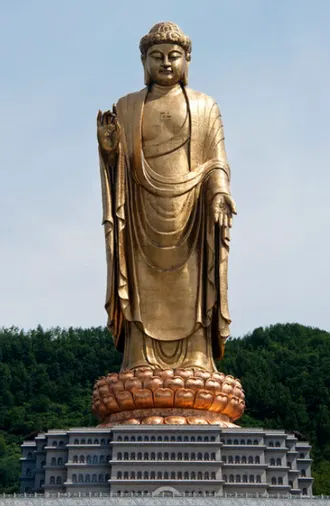
Pingdingshan was founded in 1957 as a coal city where the Funiu Mountains meet the Huai plain. Below Mount Yao in Lushan stands the Spring Temple Buddha, 128 metres tall with its lotus throne and the world's tallest statue until 2018. Baofeng holds the Qingliang Temple site of the Ru kilns, which made pale blue wares for the Song court around 1100, and each year from the 13th of the first lunar month storytellers gather at Majie for a fair said to date from 1315.
What to eat in Pingdingshan
- Baofeng baijiu (宝丰酒)
Listed sites in Pingdingshan
26 sites in Pingdingshan are on the official lists. Those with a page of their own link to it; the rest open as cards on the map.
- Mount Yao and Spring Temple Buddha 尧山-中原大佛 5A scenic area
This 5A area joins two separate sights in western Lushan County. - Baiguihu National Urban Wetland Park 白龟湖湿地公园 4A scenic area · on the map
A wetland park on the north shore of Baiguishan Reservoir, a lake built in 1958–66 on the south-western edge of Pingdingshan, designated a national urban wetland park in 2009. - Dengtaijia Scenic Area, Wugang 灯台架 4A scenic area · on the map
A hill area in southern Wugang named after its 808 m main peak, said to resemble an old lamp stand. - Erlang Mountain, Wugang 二郎山 4A scenic area · on the map
A forested hill on the south shore of Shimantan Reservoir, part of the Shimantan National Forest Park and named after the legend of the god Erlang carrying mountains to chase the suns. - Fengxue Temple 风穴寺 4A scenic area · National heritage site
A hillside temple north-east of Ruzhou that keeps about 140 bays of buildings dating from the Tang to the Qing, laid out like a garden among streams and cliffs. - Huamei Valley 画眉谷 4A scenic area · on the map
A wooded valley beside national road G311 near Mount Yao, named after the hwamei songbirds that nest there and opened to visitors in 2004. - Jiufeng Mountain, Ruzhou 九峰山 4A scenic area · on the map
A range of low forested peaks in south-western Ruzhou, named for nine summits that legend links to the Jade Emperor's daughters; the highest, Dazhai, reaches 895 m. - Majie Storytelling Fair Site 马街书会 4A scenic area · on the map
The home of the Majie Storytelling Fair, at which folk storytellers and ballad singers from across China gather every year on the 13th day of the first lunar month, a custom said to date back to 1315 and listed as national intangible heritage in 2006. - Mozi Culture Tourism Area 墨子文化旅游区 4A scenic area · on the map
A themed visitor area opened in 2016 at the foot of Mount Yao, built around the Warring States philosopher Mozi, whom Lushan claims as a native. - Pingdingshan Museum 平顶山博物馆 4A scenic area · on the map
Pingdingshan's main history museum, opened in 2012 in a building designed by Tsinghua University's architectural design institute, with walls modelled on bundles of bamboo slips. - Three Su Tombs, Jia County 三苏园 4A scenic area · National heritage site
The burial ground of the Song dynasty writer Su Shi (Su Dongpo) and his brother Su Zhe, with a cenotaph for their father Su Xun added in the Yuan dynasty, at the foot of Xiao Emei hill. - Xianglong Valley, Wugang 祥龙谷 4A scenic area · on the map
A canyon scenic area in the hills of southern Wugang with waterfalls, cliffs, forest and a small lake, rising to Longwangzhuang (866 m), which the city's tourism bureau gives as the highest point in Wugang. - Xiangshan Temple, Pingdingshan 香山寺 4A scenic area · National heritage site · on the map
A Buddhist temple on Daxiang Shan north-west of Pingdingshan, revered as the place where, in a legend recorded here in the Song dynasty, the bodhisattva Guanyin attained enlightenment. - Yaoshan Grand Canyon Rafting 尧山大峡谷漂流 4A scenic area · on the map
A commercial rafting run on a mountain river in the Mount Yao area, where visitors paddle inflatable boats down a winding channel with drops, rapids and calmer stretches. - Yaozhuang Tourism Area 姚庄旅游区 4A scenic area · on the map
A rural tourism area covering six villages of Yaozhuang Hui Township in southern Jia County, where just over half of the roughly 10,000 residents are Hui Muslims. - Ye County Yamen 叶县县衙 4A scenic area · National heritage site · on the map
The county government compound of Ye, founded in 1396 under the Ming and often described as the only Ming county yamen surviving in China; it is now run as a museum. - Faxing Temple Pagoda 法行寺塔 National heritage site
A brick multi-eaved pagoda about 30 m tall on Tasi Street in Ruzhou, standing on the site of the former Faxing Temple. - Jia County Confucian Temple 郏县文庙 National heritage site
A Confucian temple and county school founded in 1206 under the Jin dynasty and rebuilt many times, with 22 surviving buildings laid out with the school on the left and the temple on the right. - Jia County Shanxi–Shaanxi Guild Hall 郏县山陕会馆 National heritage site · on the map
A guild hall founded in 1693 by merchants from Shanxi and Shaanxi in the western suburb of Jia County town, used for lodging, trade, gatherings and worship. - Linfengzhai 临沣寨 National heritage site · on the map
A village enclosed by walls of red sandstone, built in 1862 by the Zhu family, local salt merchants, to replace an earlier earth wall. - Longquan Li River Stone Bridge 龙泉澧河石桥 National heritage site
A flat stone-slab bridge of 33 spans across the Li River, also called Cuihua Bridge, recorded in the Ming dynasty and long the main crossing on the north–south road here. - Qingliangsi Ru Kiln Site 清凉寺汝官窑遗址 National heritage site
The village site where archaeologists in 2000 confirmed the kilns of Ru ware, the rare duck-egg blue stoneware made for the Northern Song court around 1100, after surveys and excavations that began in 1987. - Ruzhou Confucian Temple 汝州文庙 National heritage site · on the map
The Confucian temple and prefectural school of Ruzhou, converted in 1370 from a Yuan shrine and enlarged in 1811. - Taishan Temple, Houwan 侯湾泰山庙 National heritage site · on the map
A village temple to the god of Mount Tai at Houwan in eastern Ruzhou, with Ming and Qing buildings around a courtyard. - Western Henan Revolution Memorial Hall, Lushan 豫西革命纪念馆 National heritage site · on the map
The former base of the Communist Party's Henan–Shaanxi–Hubei front and rear committees, which made Lushan their seat in 1947–48, in the town's former county Party committee compound. - Yeyi Ancient City Ruins 叶邑故城 National heritage site · on the map
The remains of a walled town of the Spring and Autumn and Warring States periods at Jiuxian village, once a capital of the small state of Xu and the fief of Shen Zhuliang, Lord of She under the state of Chu.
On the map
Open Pingdingshan on the illustrated map to see its outline, its places and listed sites together, and to add them to a trip.
Open Pingdingshan on the map