 Atlas of China
Shaoyang 邵阳Shàoyáng
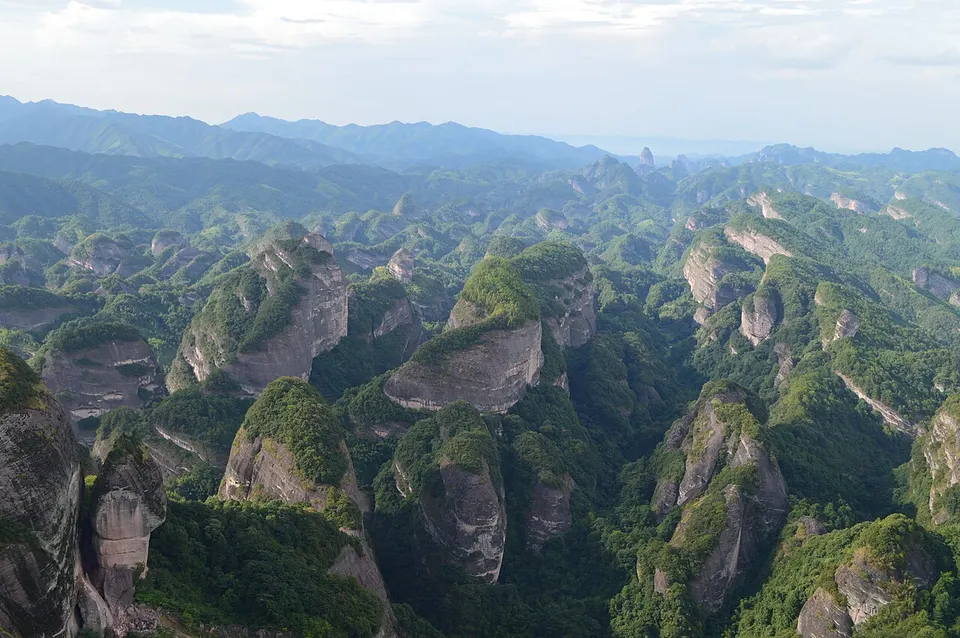
Red Danxia cliffs at Langshan and the old walls of Wugang
About Shaoyang
Shaoyang, once called Baoqing, fills the hills of south-western Hunan where the Zi River gathers its tributaries below the Xuefeng Mountains. Its great sight is Langshan in Xinning County, red sandstone cliffs, pillars and gorges inscribed in 2010 as part of the China Danxia World Heritage Site. Wugang keeps stretches of its old city walls and the site of a branch of the Whampoa Military Academy, and the Huxingshan uplands of Longhui are home to the Huayao, a branch of the Yao people.
What to eat in Shaoyang
- Pork blood tofu balls (猪血丸子)
Listed sites in Shaoyang
18 sites in Shaoyang are on the official lists. Those with a page of their own link to it; the rest open as cards on the map.
- Mount Langshan 崀山 5A scenic area
A 108 km² area of red Danxia sandstone in Xinning County, with flat-topped mesas, free-standing pillars and walls of rock, sheer red cliffs and narrow slot canyons above the clear Fuyi River. - Baishuidong Scenic Area 白水洞 4A scenic area · on the map
A national scenic area in Yantang Town, Xinshao County, with two main sections: Bailong Cave, known for its towering 'Southern Sky Pillar', a curtain of flowstone and an 'undersea world' chamber, and a walk through the Baishuidong gorge. - Cai E's Former Residence 蔡锷故居 4A scenic area · National heritage site · on the map
The farmhouse in Cai'e Township, Daxiang District, where Cai E, the general who led the 1915–16 National Protection War against Yuan Shikai's attempt to restore the monarchy, was born in 1882. - Huangsang Ecotourism Area 黄桑 4A scenic area · on the map
A forested area in south-western Suining County around the Huangsang National Nature Reserve, where forest covers more than 90% of the land. - Huxingshan Huayao Villages 虎形山花瑶 4A scenic area · on the map
A high mountain township in north-western Longhui, averaging about 1,350 m above sea level, that is home to the Huayao ('Flowery Yao'), a Yao group known for their cross-stitch embroidery and bright costumes. - Tangtian Wartime Lecture Institute 塘田战时讲学院旧址 4A scenic area · National heritage site · on the map
A late-Qing country villa built in 1877 for the official Xi Baotian at Tangtianshi in Shaoyang County, where in June 1938 the historian Lü Zhenyu, sent by the Communist educator Xu Teli, opened the Tangtian Wartime Lecture Institute; the Nationalist authorities closed it in April 1939. - Xiangjiao Liquor Culture Park 湘窖生态文化酿酒城 4A scenic area · on the map
The distillery and visitor park of Hunan Xiangjiao Liquor, a baijiu maker that grew out of the Shaoyang wine factory founded in 1957. - Yulong Caves 玉龙洞 4A scenic area · on the map
A group of limestone show caves in Chengbu County made up of five connected caves (Yulong, Baiyun, Hongxi, Yangjiao and Biyun) and a natural shaft called Luosi Well, with varied stalactite formations. - Yunshan National Forest Park 云山国家森林公园 4A scenic area · on the map
A mountain forest park just south of Wugang, an outlier of the Xuefeng range with seventy-one peaks rising to Zixiao Peak at 1,372.5 m, known for drifting cloud and cool summers. - Baoqing Prefecture City Wall 宝庆府古城墙 National heritage site · on the map
The surviving north side of the walls of old Baoqing, today's Shaoyang, with the Qingfeng (north) gate, the Linjin gate and about 1.3 km of wall. - Dankou Miao Script Stone Carvings 丹口苗文石刻群 National heritage site · on the map
Stones carved with an old Miao script, other symbols and pictures, found in 2011 during a national heritage survey scattered over the field banks and hillsides around Douchongtou in Xian'e village, Dankou Town, Chengbu. - Dongkou Ancestral Halls 洞口宗祠建筑群 National heritage site · on the map
A group of ten clan ancestral halls and the Marshal Zhong Temple scattered across Dongkou County, built between the Ming dynasty and the Republican era, among them the halls of the Yang clans of Jintang and Qutang and of the Tan, Wang, Huang, Liao and Xiao families. - Former Command Post of the Seventh Red Army 中国工农红军第七军指挥所旧址 National heritage site
The Long clan ancestral hall in Zhaishi, then the seat of Suining County, which the Seventh Red Army under Deng Xiaoping, Li Mingrui and Zhang Yunyi used as its headquarters after taking the town on 21 December 1930. - Former Site of the Whampoa Military Academy Second Branch 黄埔军校第二分校旧址 National heritage site · on the map
Buildings used by the second branch of the Whampoa Military Academy after it moved to Wugang in autumn 1938, during the war against Japan. - Shaoyang North Pagoda 邵阳北塔 National heritage site · on the map
A seven-storey brick-and-stone pagoda on the north bank where the Zi and Shao rivers meet, built between 1573 and 1582 to improve the city's fengshui. - Wei Yuan's Former Residence 魏源故居 National heritage site · on the map
The birthplace of Wei Yuan (1794–1857), the late-Qing scholar whose Illustrated Treatise on the Maritime Kingdoms (Haiguo Tuzhi) urged China to learn from Western technology after the First Opium War and influenced reformers in Japan. - Wugang City Wall 武冈城墙 National heritage site · on the map
Surviving stretches of the old walls of Wugang, about 1.45 km of an original circuit of nearly 5.9 km, unusual for being built of large stone blocks on both faces rather than earth faced with brick. - Yinjiatang Mansion 荫家堂 National heritage site · on the map
A vast family mansion in Qingshui village, Yangqiao Town, Shaodong, begun in 1823 by the rice-trading Shen brothers and known locally as 'the 108 rooms'.
On the map
Open Shaoyang on the illustrated map to see its outline, its places and listed sites together, and to add them to a trip.
Open Shaoyang on the map