 Atlas of China
Weinan 渭南Wèinán
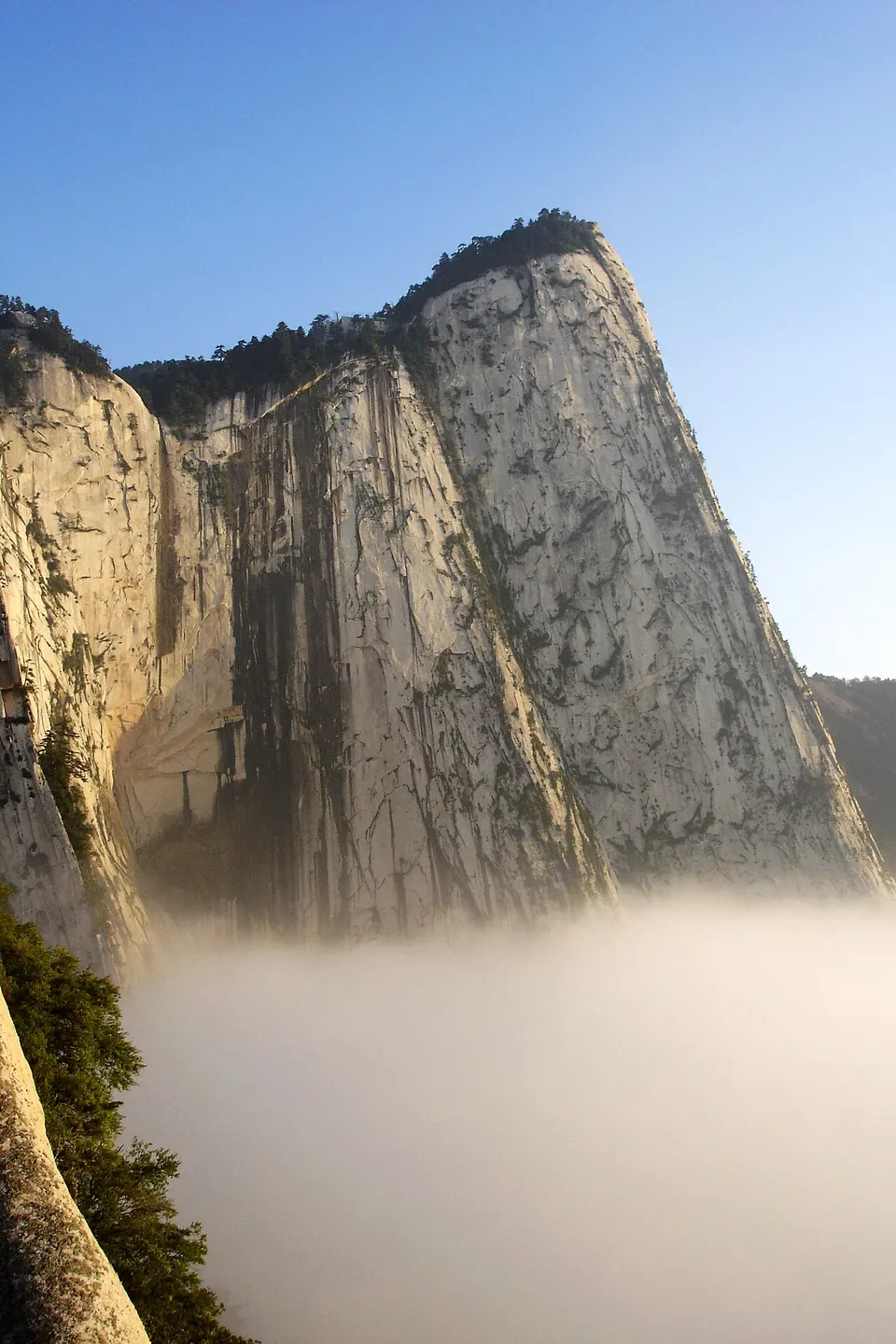
Steps cut up Mount Hua's granite and a courtyard village by the Yellow River
About Weinan
Weinan fills the eastern end of the Guanzhong plain, where the Wei joins the Yellow River at Tong Pass, the old gateway to Xi'an. Its main draw is Mount Hua, the Western Mountain of China's Five Great Mountains, a granite massif whose trails climb near-vertical cliffs, with Xiyue Temple at its foot. Farther north, Hancheng keeps an old town and the Ming and Qing courtyard houses of Dangjia Village, and the historian Sima Qian, born here, is honoured at his hillside temple and tomb.
What to eat in Weinan
- Shuipen yangrou mutton soup (水盆羊肉)
Featured places in Weinan
-
Mount Hua 华山
Sheer granite peaks, stairways cut into cliffs and a notorious plank walk
-
Hancheng Old Town and Dangjia Village 韩城古城·党家村
Ming temples in an old county town and a village of grey-brick Ming–Qing courtyard houses
Listed sites in Weinan
37 sites in Weinan are on the official lists. Those with a page of their own link to it; the rest open as cards on the map.
- Fengtu Charity Granary 丰图义仓 4A scenic area · National heritage site · on the map
A walled charity granary at Chaoyi, begun in 1882 at the urging of the Qing minister Yan Jingming, a native of the town, after the Guanzhong famine of 1877, and still used to store state grain. - Fuping Ceramic Art Village (FLICAM) 富平陶艺村 4A scenic area · on the map
A ceramics-themed village on the northern edge of Fuping town, built around the FuLe International Ceramic Art Museums (FLICAM). - Liangdai Village Rui State Site Museum 梁带村芮国遗址博物馆 4A scenic area · National heritage site · on the map
The site museum of the cemetery of Rui, a small Zhou-dynasty state on the Yellow River conquered by Qin in the 7th century BC, where excavations from 2004 found more than 1,300 tombs and 64 chariot-and-horse pits. - Lingao Lake 林皋湖 4A scenic area · on the map
A reservoir lake of about 2,200 mu (150 ha) in the loess uplands of northern Weinan, designated a national wetland park and promoted by Baishui county as the 'Lingao Lake International Slow City'. - Longmen Iron and Steel Works 龙门钢铁景区 4A scenic area · on the map
The working plant of Shaanxi Longmen Iron and Steel at Longmen, opened to visitors as an industrial tourism site on the theme of how steel is made. - Qiachuan Scenic Area 洽川 4A scenic area · on the map
A national scenic area of reed beds, lotus ponds and warm springs on the Yellow River floodplain east of Heyang. - Qiaoling Mausoleum 桥陵 4A scenic area · National heritage site
The mausoleum of the Tang emperor Ruizong (Li Dan), whose burial chamber was cut into Feng Mountain north-west of Pucheng, with a walled precinct built around the hill. - Shaohua Mountain National Forest Park 少华山国家森林公园 4A scenic area · on the map
A national forest park on the northern slopes of the Qinling Mountains south-east of Huazhou, named Shaohua ('Lesser Hua') as the smaller neighbour of Mount Hua further east. - Sites of the Weihua Uprising 渭华起义旧址 4A scenic area · National heritage site · on the map
Sites of the Weihua Uprising, an armed rising led by the Chinese Communist Party in Weinan and Hua counties in 1928 and put down by Nationalist forces that June. - Temple and Tomb of Cangjie 仓颉庙 4A scenic area · National heritage site
A temple and tomb honouring Cangjie, the legendary inventor of Chinese writing, laid out with the temple in front and his walled tomb mound behind. - Temple and Tomb of Sima Qian 司马迁祠 4A scenic area · National heritage site
The shrine and tomb of Sima Qian, the Western Han historian who wrote the Records of the Grand Historian, on a ridge above the old Xiayang ferry on the west bank of the Yellow River at Zhichuan. - Tong Pass 潼关古城 4A scenic area · National heritage site
Tongguan, the fortified pass first built in 196 AD where the Wei River flows into the Yellow River, guarded the eastern approach to the Guanzhong plain and its capitals. - Weinan Grape Industrial Park 渭南葡萄产业园 4A scenic area · on the map
A large table-grape estate at Xiagui in northern Linwei district, run as a farm park with a 10,000 m vine-covered arcade, rain-shelter vineyards, big greenhouses, a winery and a European-style garden. - Weinan Museum 渭南市博物馆 4A scenic area · on the map
The city museum of Weinan, rated a national second-grade museum, on Letian Street in the west of the city. - Weinan Taohuayuan Folk Culture Park 渭南桃花源 4A scenic area · on the map
A folk-culture park built in the Linghe river valley south of Weinan, laid out in Ming–Qing Guanzhong style with timber courtyard houses, a gate tower, pavilions, a pagoda and a group of temples. - Yaotou Kilns 尧头窑 4A scenic area · National heritage site · on the map
An old pottery village in Yaotou town whose folk kilns, traced by the Ming county gazetteer to the Tang dynasty and at their height under the Ming and Qing, made everyday black-glazed stoneware such as bowls, jars and basins, a craft potters still practise here. - Zhonghuajun Cultural Tourism Area 中华郡 4A scenic area · on the map
A culture-themed leisure park on the Jingshan plateau on the Fuping–Yanliang border, built around the legend that the Yellow Emperor cast his bronze tripods at Jingshan. - Chongshou Temple Pagoda 崇寿寺塔 National heritage site · on the map
A 13-storey square brick pagoda with close-set eaves, 45 m tall, built in 1096 and known in Pucheng as the North Pagoda. - Daxiang Temple Pagoda 大象寺塔 National heritage site · on the map
A solid Song-dynasty brick pagoda with 13 close-set eaves, 28 m tall, at Yangjiawa village south-east of Heyang town; locals also call it the Longwang Temple Pagoda. - Fawang Temple, Hancheng 法王庙 National heritage site · on the map
A temple in Xizhuang town founded in 1022 for Fang Yin, a local healer who by legend used acupuncture to bring about the birth of the future emperor Renzong, treated Emperor Zhenzong and was given the title Fawang. - Former Residence of Yang Hucheng 杨虎城旧居 National heritage site · on the map
The house that General Yang Hucheng, commander of the Northwestern Army, built in his home county in 1934, two years before he and Zhang Xueliang detained Chiang Kai-shek in the Xi'an Incident. - Great Wall of Wei (Huayin section) 魏长城 National heritage site · on the map
Remains of the rammed-earth wall that the Warring States kingdom of Wei built from the 350s BC along its western border with Qin, running from the foot of Mount Hua north through Dali, Chengcheng and Heyang to the Yellow River in Hancheng. - Guandi Temple, Liuzhi 柳枝关帝庙 National heritage site · on the map
A temple to Guan Yu, the deified Three Kingdoms general, in Liuzhi village, founded in 1535 and rebuilt in 1619, 1699 and 1787. - Heyang Confucian Temple 合阳文庙 National heritage site · on the map
The Confucian temple of Heyang county town, of which three main buildings survive: the five-bay Dacheng Hall, rebuilt in 1369, the Minglun Hall and the Zunjing Pavilion of 1610. - Huayan Temple, Mazhuang 马庄华严寺 National heritage site · on the map
A small Buddhist temple in Mazhuang village, Longmen town, rebuilt in the Ming and Qing and later used as a primary school. - Jingjin Temple Pagoda 精进寺塔 National heritage site · on the map
A nine-storey square brick pagoda, 33 m tall, in the courtyard of the county cultural centre on East Street in Chengcheng town. - Luoshan Temple Pagoda 罗山寺塔 National heritage site · on the map
A square brick pagoda on the eastern peak of Ruluo Hill above Dongma village, which its style places in the Tang dynasty. - Pucheng Examination Hall 蒲城考院 National heritage site · on the map
A Qing-dynasty examination hall in the Huaiyuanli old-lanes district of Pucheng, where candidates from the county sat the imperial civil-service examinations. - Puzhao Temple, Hancheng 普照寺 National heritage site · on the map
A village Buddhist temple at the south corner of the old Wucun fort, founded in 1316 under the Yuan and restored in 1823. - Qiaoshangqiao (Bridge on a Bridge) 桥上桥 National heritage site · on the map
A two-tier stone arch bridge over the Chishui River at Chishui town. - Qing'an Temple Pagoda 庆安寺塔 National heritage site · on the map
A nine-storey square brick pagoda, 30 m tall, in Jiaoxie town north-east of Weinan, also called the Laihua Pagoda. - Sanqing Hall of Ziyun Temple 紫云观三清殿 National heritage site · on the map
The main hall of Ziyun Temple, a Taoist temple founded in 1270, which was moved in 2001–03 from a middle-school campus in Hancheng into the compound of Puzhao Temple in the old fortified village of Wucun. - Shenlou of Chengcheng City God Temple 澄城城隍庙神楼 National heritage site · on the map
The only surviving building of Chengcheng's City God Temple: a Ming tower, also called the music tower, rebuilt in 1582 on a high terrace. - Tailing Mausoleum 唐泰陵 National heritage site · on the map
The mausoleum of the Tang emperor Xuanzong (Li Longji), who chose the site himself and was buried here in 763 with Empress Yuanxian, its burial chamber cut into Jinsu Mountain north-east of Pucheng. - Temple of Yu the Great, Hancheng 韩城大禹庙 National heritage site
A small village temple to Yu the Great, the legendary tamer of floods, at Zhouyuan on the eastern edge of Hancheng, founded in 1301 according to an inscription on its offering-hall pillars and rebuilt in 1579. - Xiyue Temple 西岳庙 National heritage site
The temple where emperors sacrificed to the god of Mount Hua, the Western Sacred Peak, founded under the Western Han in 134 BC near the mountain and moved to this site in the Eastern Han. - Yuhuang Houtu Temple, Hancheng 玉皇后土庙 National heritage site · on the map
A village temple at Xiyuan in Longmen town dedicated to the Jade Emperor and the earth goddess Houtu, founded in the Yuan dynasty and rebuilt in 1463 and 1820.
On the map
Open Weinan on the illustrated map to see its outline, its places and listed sites together, and to add them to a trip.
Open Weinan on the map