 Atlas of China
Mount Jiuhua 九华山Jiǔhuá Shān
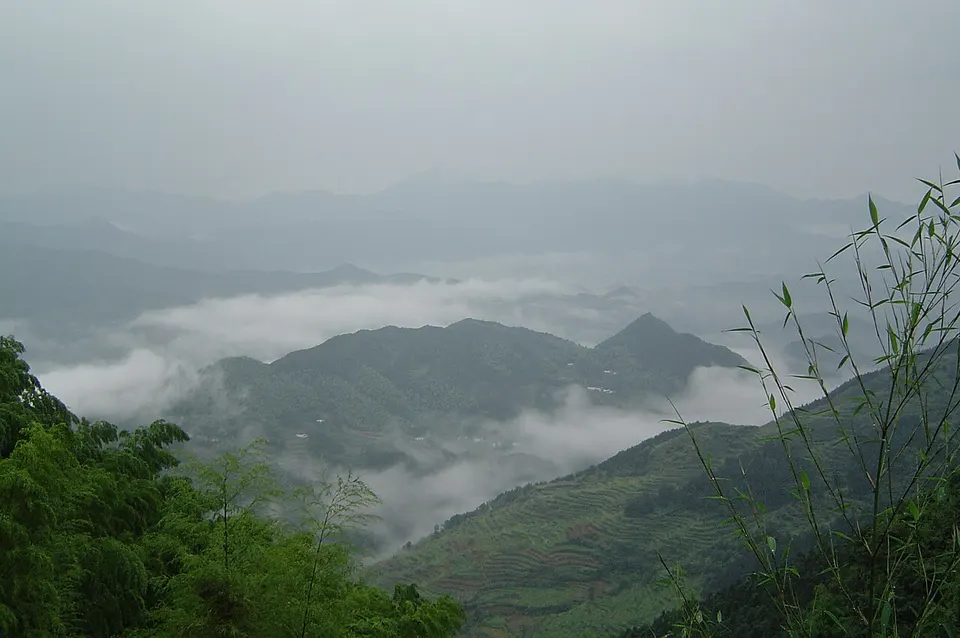
A Buddhist sacred mountain where 99 temples cling to granite peaks and mist
- Best time
- Mar–May, Sep–Nov
- Time needed
- 1–2 days
- Days to budget
- 1½ days
- Stay in
- Chizhou
- Region
- Anhui
- Type
- Culture
- Listed as
- 5A scenic area
Why go to Mount Jiuhua
Mount Jiuhua is one of the four sacred mountains of Chinese Buddhism and the holy site of Ksitigarbha (Dizang), the bodhisattva who vowed to save beings from hell. Some 99 temples survive, clustered around the monastery village of Jiuhua Street and scattered over granite peaks linked by stone paths, cable cars and a funicular. It is a working pilgrimage mountain, so the incense, chanting and mountain views come together in a way few scenic areas manage.
The story
In 719 the Silla prince-monk Kim Gyo-gak crossed the sea from Korea, meditated here for 75 years and died aged 99; his followers took him to be an incarnation of Ksitigarbha, and the mountain became the bodhisattva's seat. The Tang poet Li Bai, who gave the mountain its present name of 'Nine Glories' after its lotus-like peaks, is among the many writers who climbed it. Several temples still enshrine the preserved bodies of revered monks.
What to see at Mount Jiuhua
- Huacheng Temple 化城寺: The oldest and holiest temple on the mountain, standing in the middle of Jiuhua Street, with a richly carved main hall and a small museum of sutras and relics.
- Incarnation Hall 肉身宝殿: A hall on Shenguang Ridge above the village that enshrines the preserved body of Kim Gyo-gak, the Korean monk revered as Ksitigarbha's incarnation; it is the main stop for pilgrims.
- Baisui Palace 百岁宫: A temple perched on a cliff, reached by cable car, built around the preserved body of the Ming monk Wuxia, whom tradition says lived to 126.
- Tiantai Peak 天台: The best-known viewpoint, with temples at the top and long views over the peaks and cloud, particularly good at sunrise; a cable car runs up from the Fenghuangsong station.
- Dayuan Cultural Garden 大愿文化园: A modern complex on the edge of the village with a 99-metre bronze statue of Ksitigarbha and a broad circular pool known as the Buddha's Light Pool.
How to visit Mount Jiuhua
Base the day around Jiuhua Street: walk to Huacheng Temple and the Incarnation Hall first, then use the shuttle to the cable-car stations for Baisui Palace or Tiantai. The cable cars take most of the climbing out of the mountain, but the stone paths between temples are worth walking. A day covers the village, Baisui Palace and one peak; a second day lets you walk the quieter temples and stay for sunrise.
How to get to Mount Jiuhua
Take a high-speed train to Chizhou (then a bus of about 30–60 minutes to the mountain) or to Jiuhuashan station on the Chizhou–Huangshan line (opened April 2024), about 6 km from the visitor centre at Kecun; Hefei South to Jiuhuashan is under two hours by train. The mountain is about 40 km south-east of Chizhou, Chizhou Jiuhuashan Airport is close by, and direct coaches also run from Hefei and Nanjing in about three hours.
Where to stay
Stay in Jiuhua Street, the monastery village in the middle of the mountain, to be among the temples at dawn and dusk; Chizhou city and the villages at the northern foot are easier bases for a short visit.
What to eat
- Jiuhua huangjing 九华黄精: Polygonatum rhizome, a protected local product, sold dried, steamed and in tea and sweets.
- Vegetarian temple meals 素斋: Meat-free meals of tofu, mushrooms and mountain vegetables, served at temples and restaurants around Jiuhua Street, as befits a Buddhist mountain.
- Jiuhua Buddha tea 九华佛茶: A local tea named after the mountain and often sold in the temple village.
Tips for visiting Mount Jiuhua
- Dress modestly and keep your voice down in the halls; this is a living pilgrimage site.
- The summit area is noticeably cooler than the village below, and Tiantai is a favourite sunrise spot, so bring a warm layer and start early.
- Temple-fair periods and public holidays bring large pilgrim crowds to Jiuhua Street; weekdays are far quieter.
Nearby
- Huangshan (Yellow Mountain) 黄山 50 km
Granite spires, wind-bent pines and a sea of clouds straight out of an ink painting - Hongcun Village 宏村 60 km
A merchant village planned in the shape of an ox, mirrored in its own pond - Xidi 西递村 70 km
A quieter UNESCO twin of Hongcun: flagstone lanes, merchant houses and a Ming archway
Also within 30 km: Baisui Palace 百岁宫 (under 10 km), Zhiyuan Temple 祇园寺 (under 10 km), Huacheng Temple 化城寺 (under 10 km), Shrine of Living Buddha 肉身宝殿 (under 10 km), Dayuan Cultural Park 大愿文化园 (under 10 km), Jiuhua Shenlong Valley 九华神龙谷 (under 10 km).
On the map
Open Mount Jiuhua on the illustrated map to see the terrain around it, what else is close, and to add it to a trip and plan the days.
Open Mount Jiuhua on the map