 Atlas of China
Chizhou 池州Chízhōu
Jiuhua's pilgrim temples, Li Bai's river and masked village theatre
About Chizhou
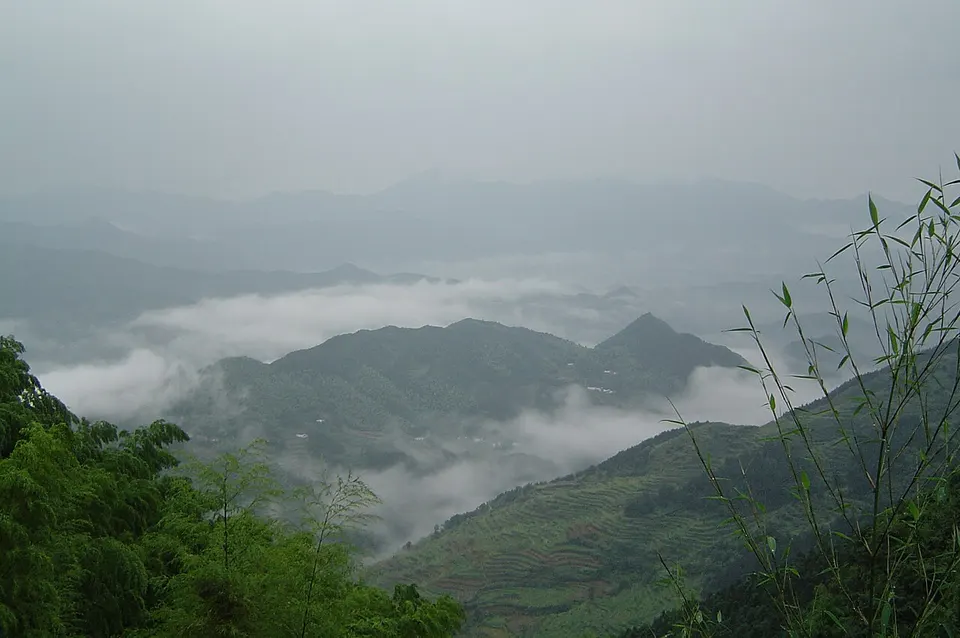
Chizhou runs from the south bank of the Yangtze into forested hills, and its great draw is Mount Jiuhua, one of the four sacred mountains of Chinese Buddhism. Pilgrims come to the shrine of Kim Gyo-gak, a Silla prince who came to meditate here in 719 and was revered as the bodhisattva Ksitigarbha. The Tang poet Du Mu governed the town, Li Bai wrote seventeen 'Songs of Qiupu', the district's old name, and villages around Guichi still perform Nuo, a masked ritual theatre.
What to eat in Chizhou
- Jiuhua Buddha tea (九华佛茶)
Featured places in Chizhou
-
Mount Jiuhua 九华山
A Buddhist sacred mountain where 99 temples cling to granite peaks and mist
Listed sites in Chizhou
26 sites in Chizhou are on the official lists. Those with a page of their own link to it; the rest open as cards on the map.
- Dawang Cave 大王洞 4A scenic area · on the map
A 10 km² karst scenic area in Paifang town on the south bank of the Yangtze, Chizhou's first 4A site, built around the Dawang Cave, whose name was written by the calligrapher and Buddhist leader Zhao Puchu. - Dayuan Cultural Park 大愿文化园 4A scenic area · on the map
A Buddhist-themed park at Kecun, the northern foot of Mount Jiuhua, built around a 99-metre bronze statue of Ksitigarbha, the bodhisattva of the mountain; the height stands for Jiuhua's 99 peaks and the 99 years of Kim Gyo-gak, the monk revered as his incarnation. - Guaitan Rafting 怪潭 4A scenic area · on the map
A whitewater rafting run of about 4.5 km on a mountain river, taking around an hour and a half through three sets of rapids, six river bends and five clear pools between forested hills. - Guniujiang Longmen Scenic Area (Shitai side) 牯牛降龙门景区 4A scenic area · on the map
The Shitai-county side of Guniujiang, a 6,700-hectare forest that has been a national nature reserve since 1988, Anhui's first forest-ecosystem reserve of that rank; its main summit, Guniu Dagang (1,727.6 m), is the third-highest peak in southern Anhui. - Jiuhua Shenlong Valley 九华神龙谷 4A scenic area · on the map
A wooded gorge about 3 km long on the southern side of Mount Jiuhua, cut by streams from Pusatou and Loutai hills and known locally as 'nine drops and eighteen bends'. - Jiuhua Tianchi 九华天池 4A scenic area · on the map
A mountain scenic area in south-eastern Guichi, developed from 2007 around the Siling Reservoir, a lake high in the hills known as the 'heavenly pool'. - Jiuziyan 九子岩 4A scenic area · on the map
A rocky mountain area on the eastern side of the Jiuhua range that gave Mount Jiuhua its old name, Jiuzi ('Nine Sons') Mountain, and is regarded as the cradle of Buddhism there: among its relics is the spot where Kim Gyo-gak, later venerated as Ksitigarbha, first practised. - Lianfeng Yunhai 莲峰云海 4A scenic area · on the map
A scenic area on Lianhua (Lotus) Peak (1,048 m) at the northern foot of the Jiuhua range, named for the seas of cloud often seen from the summit; the peak's shape also earns it the name Brush-Rest Mountain. - Penglai Cave 蓬莱仙洞 4A scenic area · on the map
A large limestone cave more than 3,000 m long near Ducun, the home village of the late-Tang poet Du Xunhe, formed on four levels: upper, middle and lower caves and an underground river. - Qishan Hill and Pingtian Lake 齐山·平天湖 4A scenic area · National heritage site · on the map
A 40 km² scenic area on the eastern edge of Chizhou that joins Qishan, a hill whose rocks carry cliff inscriptions left by visitors from the Tang dynasty to the Republic, among them a line attributed to the Song general Yue Fei, with Pingtian Lake and the wetland park on its southern shore. - Qiupu River Scenic Area 秋浦河 4A scenic area · on the map
A stretch of the Qiupu River near Shitai, the 'river of poems' where Li Bai stayed on five occasions and wrote his seventeen 'Songs of Qiupu'. - Xianyu Mountain and the Jugen Pass Ancient Hui Road 仙寓山·榉根关古徽道 4A scenic area · National heritage site · on the map
A mountain area in Xianyu town on the western arm of the Huangshan range, rising to 1,376 m, whose centrepiece is the Jugen Pass Ancient Hui Road: a 7.5 km stone-paved trade route of Tang origin by which Huizhou merchants carried tea and scholars' supplies, lined with old rest pavilions, inscribed steles and a stone-slab bridge of 1802. - Xinghua Village (Apricot Blossom Village) 杏花村 4A scenic area · on the map
A landscaped park on the western edge of Chizhou on the site that local tradition links to the 'apricot blossom village' of 'Qingming', the poem Du Mu wrote while prefect of Chizhou in the Tang dynasty; a Qing gazetteer of the village was included in the imperial Siku Quanshu collection. - Xiushan Gate Museum 秀山门博物馆 4A scenic area · on the map
A private museum of traditional Chinese building crafts, opened in 2006 in the gate tower and walls of Xiushan Gate, the west gate of old Chizhou, which took its present name in 1235 in memory of Xiao Tong, the Liang-dynasty Crown Prince Zhaoming. - Yulong Cave 鱼龙洞 4A scenic area · on the map
A limestone cave in Qidu town named for the way it winds under the hill like a coiled dragon; its mouth, about 8 m wide and 5 m high and shaped like a crocodile's open jaws, is hung with stalactites above a clear pool that never dries. - Zuishanye (Huangya Gorge and Ciyun Cave) 醉山野 4A scenic area · on the map
A scenic area in Yuanxi village just outside Shitai town with two parts. - Baisui Palace 百岁宫 National heritage site
A ridge-top monastery above Jiuhua Street that grew from a Ming hermitage where the monk Wuxia (Haiyu) lived in the Wanli era and died aged 110; his body did not decay and, gilded, is still enshrined in the temple, and in 1630 the Chongzhen Emperor honoured him as a 'Bodhisattva of the Manifested Body'. - Baiyashan Pagoda 百牙山塔 National heritage site · on the map
A seven-storey, six-sided brick pagoda on the eastern foot of Baiya Hill in central Chizhou, built in 1538 under the prefect Lu Gang with money raised by the city's river-trade brokers, who gave it its name. - Huacheng Temple 化城寺 National heritage site
The oldest and leading temple of Mount Jiuhua, in the middle of Jiuhua Street: tradition dates it to 401, and the Silla monk Kim Gyo-gak lived here in the 8th century, after which it was dedicated to Ksitigarbha and called the head of all the mountain's temples. - Hualong Cave 华龙洞 National heritage site
A Palaeolithic cave site on the southern slope of Meiyuan Hill where excavations since 2006 have recovered human fossils about 300,000 years old, including the skull known as 'Dongzhi Man', together with stone tools and the bones of giant pandas, stegodons and other animals. - Jiyang Cao Ancestral Hall (Qingyang Museum) 济阳曹氏宗祠 National heritage site · on the map
Two Ming–Qing clan halls that were taken down in villages near Lingyang and rebuilt in Qingyang town between 1991 and 1995, where they house the county museum: the Cao ancestral hall, with its gate tower, Minglun Hall and rear shrine, and the Chen clan's Xiaosi Hall. - Li Ancestral Hall, Shangzhang 上章李氏宗祠 National heritage site · on the map
A Huizhou-style clan temple in Shangzhang village whose present buildings date from a rebuilding of 1781–1799, with a front hall, the Xulun ancestral hall and a two-storey rear shrine set one behind another. - Qingxi Pagoda 清溪塔 National heritage site · on the map
A seven-storey octagonal brick pagoda, originally named Miaoyin Pagoda, built between 1601 and 1612 under a succession of Chizhou prefects where the old course of the Qingxi River meets the Yangtze, on the north-eastern side of the city. - Shrine of Living Buddha 肉身宝殿 National heritage site
The hall on Shenguang Ridge above Jiuhua Street that houses the remains of Kim Gyo-gak, the Silla prince-monk who died in 794 and was venerated as Ksitigarbha; his body was placed in a stone stupa, around which the hall was later built. - Taiping Shanfang 太平山房 National heritage site · on the map
A village school building in Suo village on the south side of Mount Jiuhua, first a hall of the Chen clan and turned into a school in 1771; it is one of the best-preserved old school buildings in Anhui. - Zhiyuan Temple 祇园寺 National heritage site
One of the four great monasteries of Mount Jiuhua, a few minutes' walk from Huacheng Temple on Jiuhua Street, founded in the Jiajing era of the Ming as a small hermitage and named after the Jetavana grove where the Buddha taught.
On the map
Open Chizhou on the illustrated map to see its outline, its places and listed sites together, and to add them to a trip.
Open Chizhou on the map