
 An illustrated travel map
Gushan (Drum Mountain) 鼓山Gǔ Shān
Fuzhou's forested hill of Song carvings, pottery pagodas and a hillside Chan temple
- Best time
- Mar–May, Oct–Nov
- Time needed
- Half a day
- Days to budget
- Half a day
- Stay in
- Fuzhou
- Region
- Fujian
- Type
- Nature
- Listed as
- 4A scenic area, National heritage site
Why go to Gushan (Drum Mountain)
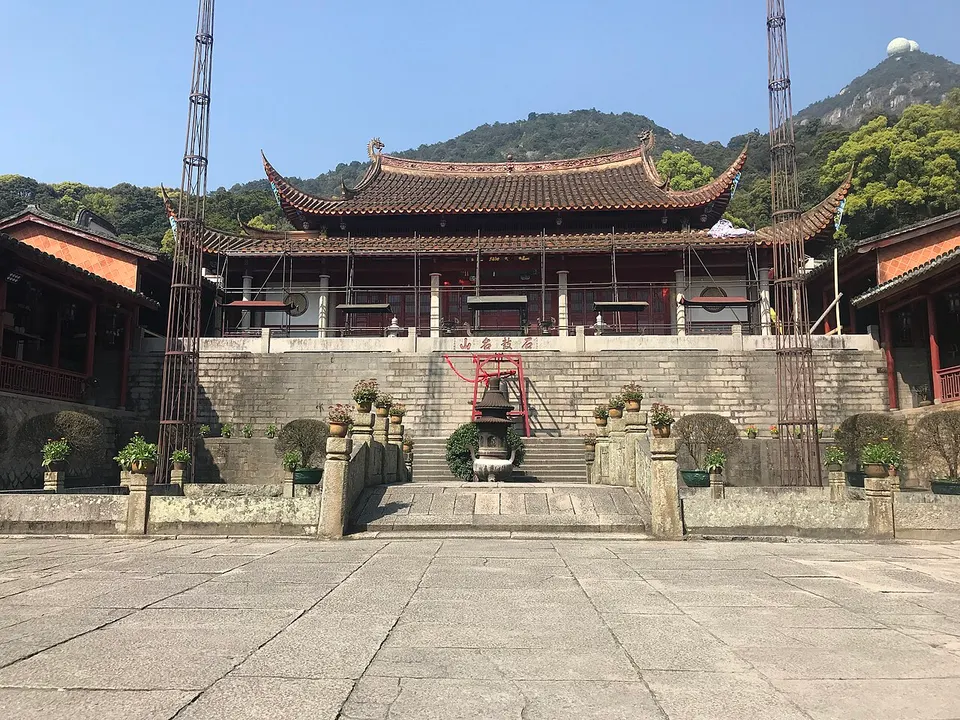
A forested mountain on Fuzhou's eastern edge, rising to 919 m, whose slopes hold Yongquan Temple, founded in 783, and more than 300 inscriptions carved into the rock from the Song dynasty onwards, among them calligraphy by Cai Xiang and Zhu Xi. Two Northern Song pottery pagodas stand in front of the temple, and paths link it with viewpoints and scenic spots such as Heshui Rock. It is the easiest real mountain day from Fuzhou's centre.
The story
The mountain is said to be named for a drum-shaped boulder on its summit, and legend adds that on stormy days drumbeats echo out of a cave. Yongquan Temple began in 783 as a Tang-dynasty foundation, was rebuilt in 908 under the Min king Wang Shenzhi and named Yongquan Chan Temple after a spring, and took its present name in 1407; most of what stands today dates from the Ming. It remains a working monastery.
What to see at Gushan (Drum Mountain)
- Ancient stone path 鼓山古道: The old pilgrim stairway, opened in 908 by the Min king Wang Shenzhi, climbs about 2,600 steps (2,633 by Xinhua's count) past seven rest pavilions through forest to the temple.
- Yongquan Temple 涌泉寺: A national key Buddhist temple halfway up the mountain, with over 25 halls laid out in tiers; the Mahavira Hall enshrines the Three Life Buddhas and Eighteen Arhats.
- Song Pottery Pagodas 陶塔: A pair of nine-storey glazed-clay pagodas of 1082 in the temple, each about 6.8 m tall and carved with more than a thousand small Buddha figures.
- Heshui Rock 喝水岩: A cliff area of Song-dynasty and later inscriptions, named for the legend of the monk Shenyan, who is said to have shouted at a stream to change its course; the huge character 'shou' (longevity) cut here is credited to Zhu Xi.
- Lingyuan Cave 灵源洞: A deep, shady gorge of stacked cliffs and boulders with more than 200 carved inscriptions, among them calligraphy by Cai Xiang.
How to visit Gushan (Drum Mountain)
The classic route is to climb the old stone stairway to Yongquan Temple, which takes a sturdy walker around an hour and a half or more, or ride the cable car, which runs towards the viewpoint area higher up. Spend an hour in the temple and its pagoda courtyard, then continue to Heshui Rock and Lingyuan Cave for the inscriptions. A half-day covers the temple and one carved-rock site; a full day lets you add the trails along the upper slopes.
How to get to Gushan (Drum Mountain)
About 10 km east of central Fuzhou; a road climbs to Yongquan Temple, roughly 30 minutes by taxi from the city centre. Local buses and tourist shuttles also serve the mountain; check the current route before you set out.
Where to stay
Stay in central Fuzhou, around Nanhou Street or the Gulou district, then take a taxi or bus out to the mountain for the day.
What to eat
- Fuzhou fish balls 福州鱼丸: Bouncy fish-paste balls with a minced pork filling, served in broth at noodle counters in the city.
- Guangbing 光饼: Hard, round baked buns from Fuzhou, often split and filled with meat or egg, eaten as a street snack.
- Dingbianhu 鼎边糊: Rice-batter ribbons in a savoury broth with shrimp, clams and mushrooms, a typical Fuzhou breakfast.
Tips for visiting Gushan (Drum Mountain)
- Yongquan Temple is an active monastery, so dress modestly and keep voices low in the halls.
- The cable car and the last return runs can stop earlier than the temple's own hours, or pause for maintenance, so check the last descent before you decide to walk up.
- Mist often wraps the mountain, so bring a light jacket and non-slip shoes, since the stone steps are slick when wet.
Nearby
- Sanfang Qixiang 三坊七巷 10 km
Fuzhou's walled-ward old quarter of scholars' courtyards, lanes and ancestral halls - Fujian Museum 福建博物院 10 km
Fujian's provincial museum: maritime porcelain, opera and a tulou-shaped nature hall - Meizhou Mazu Temple 湄洲妈祖祖庙 110 km
The island birthplace of Mazu, the sea goddess worshipped along the Chinese coast - Baishuiyang and Yuanyang Stream 白水洋·鸳鸯溪 120 km
Wade across a flat bedrock riverbed, then walk a mandarin-duck gorge
Also within 30 km: Shangxiahang Historic District 上下杭 (under 10 km), Mawei Shipyard Heritage Area (Foochow Arsenal) 船政文化景区 (under 10 km), Fuzhou Confucian Temple 福州文庙 (under 10 km), Black Pagoda (Wuta) 乌塔 (under 10 km), Lin Zexu Memorial Hall 林则徐纪念馆 (10 km), Wushan and Yushan Hills 乌山、于山 (10 km).
On the map
Open Gushan (Drum Mountain) on the illustrated map to see the terrain around it, what else is close, and to add it to a trip and plan the days.
Open Gushan (Drum Mountain) on the map