 Atlas of China
Mount Lushan 庐山Lú Shān
Misty peaks, waterfalls and a hill station of stone villas above the Yangtze
- Best time
- Apr–Jun, Sep–Oct
- Time needed
- 1–2 days
- Days to budget
- 1½ days
- Stay in
- Jiujiang
- Region
- Jiangxi
- Type
- Nature
- Listed as
- 5A scenic area, National heritage site, UNESCO World Heritage
Why go to Mount Lushan
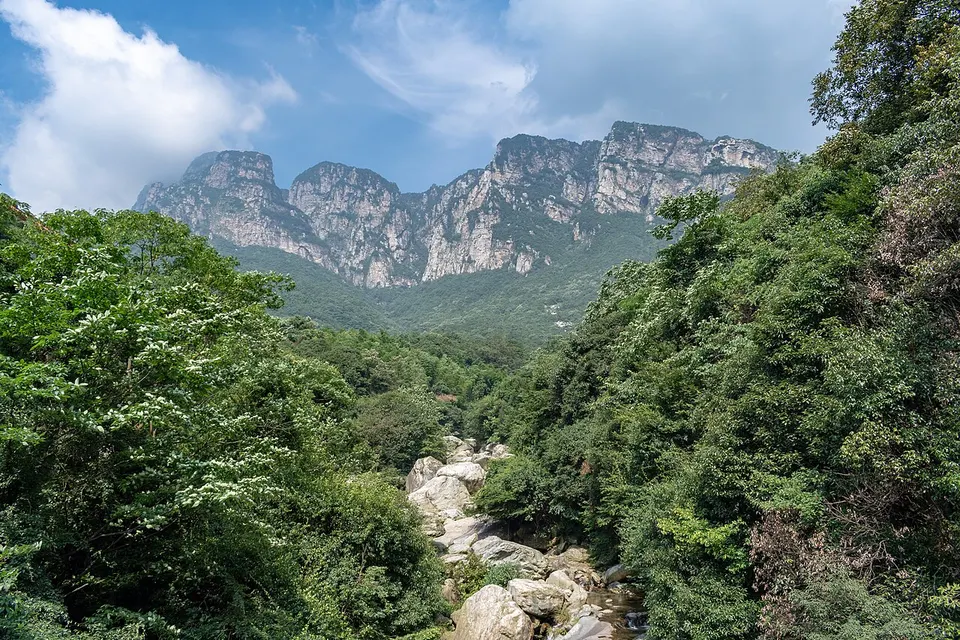
Mount Lu rises abruptly from the plains between the Yangtze River and Poyang Lake, its summit often wrapped in cloud. Up top, the resort town of Guling is full of stone villas built by missionaries and foreign families escaping the summer heat, and trails lead out to waterfalls, temples and cliff-edge viewpoints.
The story
Li Bai wrote one of China's best-loved poems about a waterfall here, comparing it to the Milky Way spilling from the sky. Su Dongpo's line that you cannot see Mount Lu's true face because you are standing on it became a proverb about perspective, and novelist Pearl Buck spent childhood summers in Guling.
What to see at Mount Lushan
- Guling town 牯岭: The hill-station village on the plateau, above 1,000 m, where missionary-era stone villas line the lanes between small parks and viewpoints.
- Jinxiu Valley 锦绣谷: A stone-step path of about 1.5 km through a valley beneath cliffs, with views of rock faces and cloud.
- Sandiequan Falls 三叠泉: A three-tier waterfall dropping about 155 m in a deep canyon, reached by a long flight of steps down from the plateau or from the foot of the mountain at the east entrance.
- Five Old Men Peak 五老峰: Five summits in a row on the mountain's south-east side, named for resembling elderly men; the second-highest peak of the massif at about 1,360 m.
- Donglin Temple 东林寺: A Buddhist temple at the north-west foot of the mountain, founded in 384 and central to the Pure Land school.
- White Deer Grotto Academy 白鹿洞书院: A Song-dynasty centre of Confucian learning at the southern foot of Five Old Men Peak, where the scholar Zhu Xi taught, in a quiet wooded setting.
How to visit Mount Lushan
Base yourself in Guling and explore on foot and by park bus, bringing your ID for tickets. Jinxiu Valley and the cliff paths around Guling take a morning; Sandiequan needs half a day because of its steep stairs, and the outlying temples and the academy fit a second day. The cliff-path loop past the botanical garden takes about four hours.
How to get to Mount Lushan
Jiujiang has high-speed trains from Nanchang, Wuhan and beyond. From Jiujiang or Lushan station, scenic-area buses wind up to Guling on the summit plateau in about 1–1.5 hours, or a cable car near the South Gate makes the climb in about 10 minutes.
Where to stay
Stay in Guling town on the plateau, within walking distance of the villas, cafés and several trails, and cool in summer. Jiujiang at the foot is the alternative for train links.
What to eat
- Lushan Cloud and Mist tea 庐山云雾茶: A green tea grown on the misty slopes and one of the mountain's best-known products, served in teahouses in Guling.
- Stone ear fungus 石耳: An edible mountain product, one of Lushan's 'three stones' alongside stone fish and stone chicken, sold in Guling.
- Stone fish 石鱼: A tiny stream fish, only 3–4 cm long, found in Lushan's brooks and waterfalls and cooked in local restaurants.
Tips for visiting Mount Lushan
- Stay overnight in Guling for the morning mist and quiet evening walks after the day-trippers leave.
- The mountain has been a summer heat escape for over a century; aim for weekdays in July and August.
- Bring a rain jacket: the summit is in cloud on many days of the year.
Nearby
Also within 30 km: Guanyin Bridge 观音桥 (under 10 km), White Deer Grotto Academy 白鹿洞书院 (under 10 km), Virtuous Mothers Park, Jiujiang 中华贤母园 (10 km), Xiufeng Scenic Area 秀峰 (10 km), Balihu Lake Scenic Area 八里湖 (10 km), Nanshan Park, Jiujiang 南山公园 (10 km).
On the map
Open Mount Lushan on the illustrated map to see the terrain around it, what else is close, and to add it to a trip and plan the days.
Open Mount Lushan on the map