 Atlas of China
Yellow Crane Tower 黄鹤楼Huánghè Lóu
A tower rebuilt many times over, made immortal by a single Tang poem
- Best time
- Mar–May, Oct–Nov
- Time needed
- Half a day
- Days to budget
- Half a day
- Stay in
- Wuhan
- Region
- Hubei
- Type
- Heritage
- Listed as
- 5A scenic area, National heritage site
Why go to Yellow Crane Tower
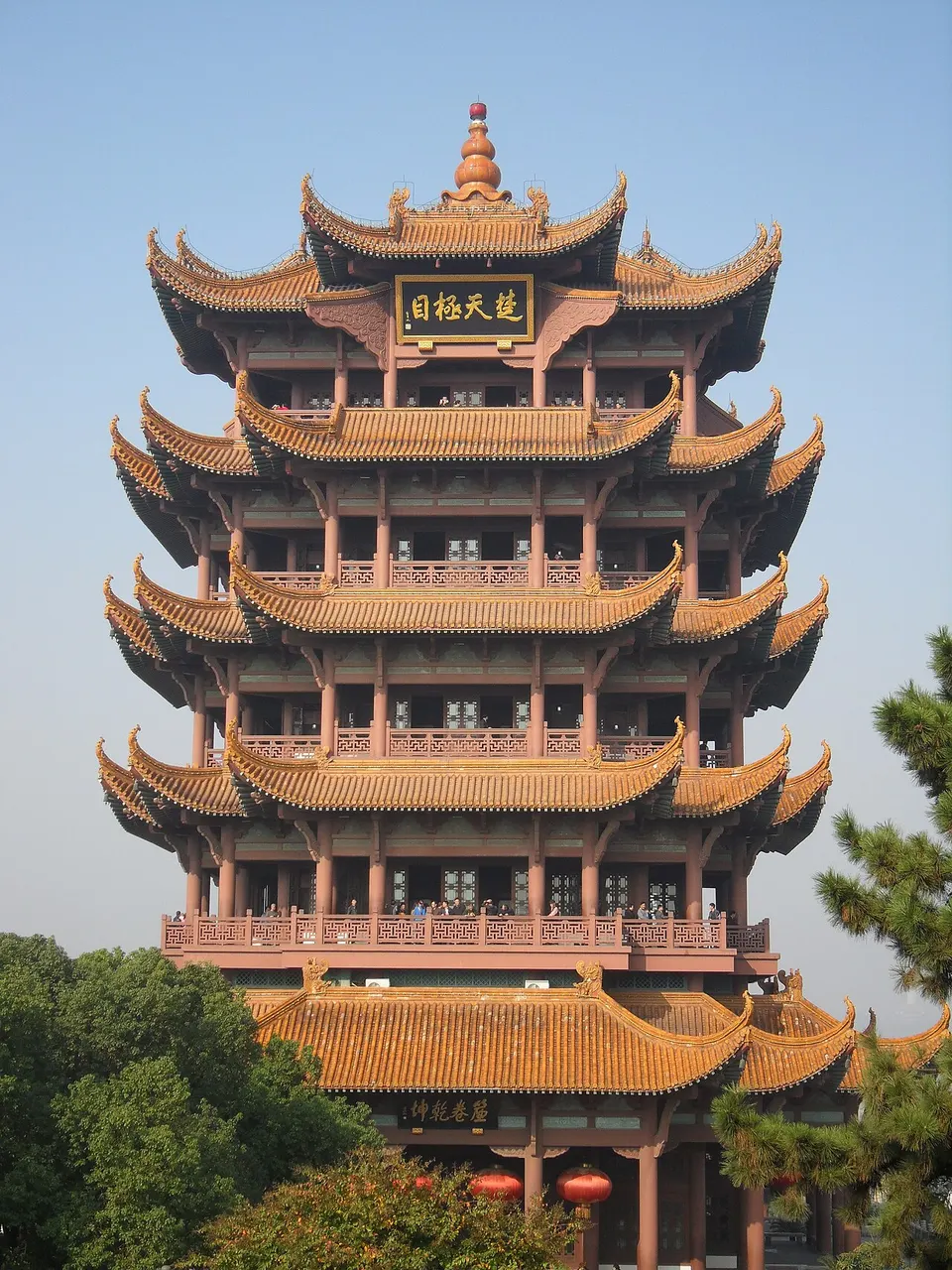
Yellow Crane Tower stands on Snake Hill above the Yangtze in central Wuhan, its five tiers of yellow-tiled eaves visible across the city. The present tower dates from 1985, but the view from the top, over the river, the first Yangtze bridge and the three historic towns that make up Wuhan, is the real reward.
The story
A tower has stood near here, burned and been rebuilt many times since about the third century. Its fame rests on Cui Hao's Tang poem about an immortal who flew off on a yellow crane, leaving only the empty tower and drifting clouds; Li Bai is said to have put down his brush, saying Cui Hao had already said it all, though his own farewell poem set at the tower is just as loved.
What to see at Yellow Crane Tower
- Tower interior 黄鹤楼内: Floors with a giant ceramic mural of white clouds and a yellow crane, a stone-carved history of the tower, and portrait murals of Tang and Song poets with their verses.
- Upper floors 楼顶观景: A view over the Yangtze, the first Wuhan Yangtze bridge and the city.
- Sacred Stupa 胜像宝塔: A small white Tibetan-style stupa, the oldest surviving building on the tower's former site.
- Yue Fei statue 岳飞铜像: A bronze statue of the Song-dynasty general in the park around the tower.
How to visit Yellow Crane Tower
Walk up through the park on Snake Hill, past the Sacred Stupa and the memorial archway inscribed with the phrase "one tower of the Three Chu", before climbing the tower itself. Allow an hour or two for the tower and park; with more time, walk down to the river and the old bridge, or return after dark for the lit tower.
How to get to Yellow Crane Tower
Wuhan is a major high-speed rail hub linked to Beijing, Shanghai, Guangzhou and Xi'an. The tower is in Wuchang, a short taxi or metro ride from any of the city's main stations.
Where to stay
Stay in Wuchang, where the tower, Hubu Alley and the riverside are close. Hankou, across the river, has more shopping and nightlife.
What to eat
- Hot dry noodles 热干面: Alkaline noodles coated in sesame paste, Wuhan's signature breakfast, sold on Hubu Alley.
- Doupi 豆皮: A pan-fried sheet of glutinous rice, beans and meat.
- Steamed Wuchang fish 武昌鱼: A freshwater fish from the Wuhan area, usually steamed, and a banquet favourite.
Tips for visiting Yellow Crane Tower
- Come in the late afternoon to see the river by daylight, then stay to see the tower lit up after dark.
- Walk onto the 1957 Wuhan Yangtze River Bridge, the first to span the Yangtze, for a classic view back to the tower.
- Nearby Hubu Alley is the place to try Wuhan's breakfast staple, hot dry noodles (reganmian).
Nearby
- Hubei Provincial Museum 湖北省博物馆 under 10 km
Marquis Yi's ancient bronze bells, played live, and the sword of King Goujian
Also within 30 km: Xinhai Revolution Museum (Wuchang Uprising Memorial) 辛亥革命博物院 (under 10 km), Site of the 5th National Congress of the Chinese Communist Party 中共五大会址 (under 10 km), Wuhan Peasant Movement Institute 武汉农民运动讲习所旧址 (under 10 km), Uprising Gate 起义门 (under 10 km), Wuhan Yangtze River Bridge 武汉长江大桥 (under 10 km), Qingchuan Pavilion 晴川阁 (under 10 km).
On the map
Open Yellow Crane Tower on the illustrated map to see the terrain around it, what else is close, and to add it to a trip and plan the days.
Open Yellow Crane Tower on the map