
 An illustrated travel map
She 歙Shè
Stone archways, ancestral halls and the old seat of Huizhou prefecture
- Type
- County
- City
- Huangshan
- Region
- Anhui
- Featured places
- 2
- Listed sites
- 172 rated 4A · 16 national heritage
- Intangible heritage
- 4 items on the national list
About She
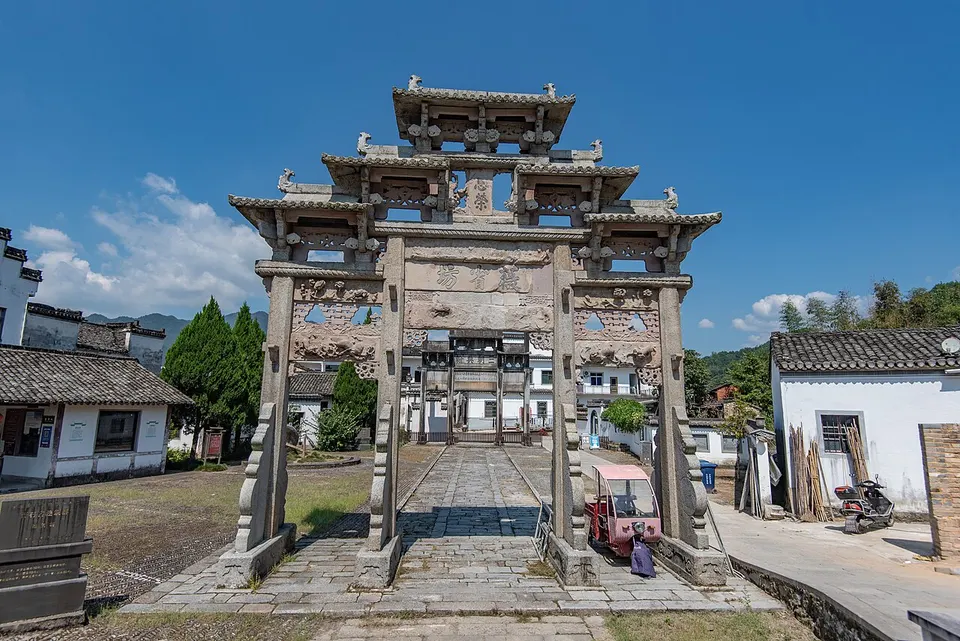
She is the easternmost county of Huangshan city and was the seat of Huizhou prefecture in the Ming and Qing dynasties, when merchants left stone archways, covered bridges and carved ancestral halls. Huizhou Ancient City, the old county town, keeps its gate towers and stretches of Ming wall and is a 5A scenic area, sometimes counted among China's four renowned ancient towns. The seven Tangyue archways stand in Tangyue village; Xucun, Xiongcun and Yuliang keep old lanes and halls, and Yuliang a historic dam.
Featured places in She
-
Huizhou Ancient City (Shexian) 徽州古城
Seat of Huizhou prefecture, with a Ming eight-pillar archway and merchant lanes
-
Tangyue Memorial Archways 棠樾牌坊群
Seven stone archways in a row, honouring filial piety, chastity, charity and office
Listed sites in She
17 sites in She are on the official lists. Those with a page of their own link to it; the rest open as cards on the map.
- Xin'an River Scenic Gallery 新安江山水画廊 4A scenic area · on the map
A stretch of the Xin'an River of roughly 50 km through southern Shexian, between steep green hills dotted with Huizhou villages and old wharves, usually seen on boat trips from Shendu. - Xiongcun Village and Zhushan Academy 雄村 4A scenic area · National heritage site · on the map
A village of the Cao clan on the Jian River in southern Shexian, listed as a national historic and cultural village in 2014. - Bao Ancestral Hall, Fancun 歙县鲍氏宗祠 National heritage site · on the map
The ancestral hall of the Bao clan in Fancun village, Shangfeng township, completed in 1787 in the Qianlong era of the Qing. - Bei'an Covered Bridge and Wu Ancestral Hall 北岸廊桥 National heritage site · on the map
Bei'an village in eastern Shexian has two national heritage sites side by side: a mid-Qing covered bridge of three stone arches, 33 m long, roofed over with an eleven-bay gallery with benches, window openings and a small shrine, and the Wu clan's Zhide Hall. - Changqing Temple Pagoda 长庆寺塔 National heritage site
A seven-storey square brick-and-timber pagoda 23.1 m high, built in 1119 in the Northern Song at the foot of Xigan Hill on the south bank of the Lian River, facing the old town of Shexian; it is regarded as the oldest surviving pagoda in old Huizhou. - Changxi Village 昌溪村 National heritage site · on the map
An old village in south-eastern Shexian, founded in the Tang and home to the Wu clan since the Southern Song, which in Ming and Qing times was known as the first village of southern She and was filled with buildings paid for by its merchants. - Choushu Memorial Archways 稠墅牌坊群 National heritage site · on the map
Four stone memorial archways at the entrance to Choushu, a village of the Wang clan of merchants in Zhengcun town, built between 1628 and the 1770s. - Hong Ancestral Hall (Jingben Hall), Yecun 洪氏宗祠(敬本堂) National heritage site · on the map
The Jingben Hall, a branch ancestral hall of the Hong clan in Yecun village, Sanyang, founded in 1554 and repaired in 1807 and 1897. - Hong Ancestral Hall, Sanyang 三阳洪氏宗祠 National heritage site · on the map
A large Ming and Qing ancestral hall of the Hong clan, a lineage of merchants, in Sanyang town in the hills of north-eastern Shexian. - Pan Ancestral Hall, Dafu 大阜潘氏宗祠 National heritage site · on the map
The ancestral hall of the Pan clan in Dafu village, Bei'an town, built in 1585 in the late Ming and preserved intact. - Taiping Bridge, Shexian 歙县太平桥 National heritage site
A 16-arch stone bridge 268 m long across the Lian River outside the west gate of the old Huizhou prefectural town, described as the largest old stone bridge in Anhui. - Wu Ancestral Halls, Shitan 石潭吴氏宗祠 National heritage site · on the map
Two ancestral halls of the Wu clan in Shitan, a hillside village of Xiakeng town in eastern Shexian: the Xulun Hall, a Ming hall rebuilt in the Qing with five bays, three halls and a 'hundred-beam' hall, and the Qing-dynasty Chunhui branch hall. - Xu Ancestral Hall (Dunmu Hall), Jincun 歙县许氏宗祠 National heritage site · on the map
The Dunmu Hall, ancestral hall of the Xu clan in Jincun village, Xucun town, built in 1536 in the Ming dynasty. - Xucun Old Village 许村 National heritage site · on the map
A large old village of the Xu clan in north-western Shexian, where close to 200 Ming and Qing buildings, among them memorial archways, pavilions, a covered bridge, ancestral halls and houses, line an old street about 1.5 km long. - Yuliang Dam and Old Street 渔梁坝 National heritage site
An ancient stone weir about 140 m long across the Lian River just south-east of Shexian town, first built in the Tang and rebuilt in 1605 from massive blocks locked together with stone dowels. - Zheng Ancestral Hall, Zhengcun 郑氏宗祠 National heritage site · on the map
The ancestral hall of the Zheng clan in Zhengcun town, founded in the Chenghua era (around 1466) in memory of the late-Yuan recluse and Neo-Confucian scholar Zheng Yu. - Zhou Ancestral Hall, Changxi 昌溪周氏宗祠 National heritage site · on the map
The ancestral hall of the Zhou clan, also called Liushun Hall, in the hamlet of Zhoubangtou on the edge of Changxi in south-eastern Shexian.
Intangible heritage in She
4 items on China's national list of intangible cultural heritage are filed for She.
- Traditional art: Penjing craft (Hui school)
- Traditional craftsmanship: Hui ink making, Shexian inkstone making
- Traditional medicine: Chinese medicine diagnosis and therapy (Xiyuan laryngology)
Getting to Huangshan
Train, flight and driving times from the cities most visitors come from, with stations, fares and how many run a day; each opens the full comparison.
On the map
Open She on the illustrated map to see its outline, its places and listed sites together, and to add them to a trip.
Open She on the map