 Atlas of China
Anyang 安阳Ānyáng
Oracle bones of the Shang kings and a canal hung on the Taihang cliffs
About Anyang
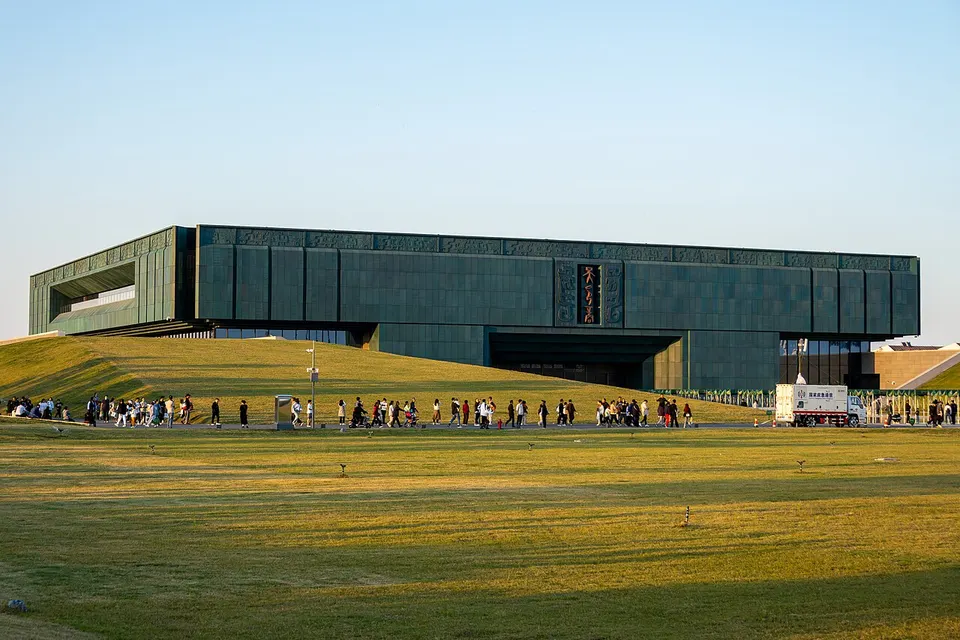
Anyang stands on Yin, capital of the late Shang kings from around 1300 BC, where oracle bones carry the earliest known Chinese writing; the ruins at Yinxu became a UNESCO site in 2006, and the city also has the National Museum of Chinese Writing. In the Taihang Mountains to the west, the Red Flag Canal was cut by hand along sheer cliffs at Linzhou in the 1960s, near the Taihang Grand Canyon. Tangyin, Yue Fei's birthplace, keeps a Ming temple to the Song general.
What to eat in Anyang
- Daokou braised chicken (道口烧鸡)
Featured places in Anyang
-
Yinxu 殷墟
The last Shang capital, where China's earliest writing and Fu Hao's tomb came to light
Listed sites in Anyang
28 sites in Anyang are on the official lists. Those with a page of their own link to it; the rest open as cards on the map.
- Red Flag Canal 红旗渠 5A scenic area · National heritage site
An irrigation canal cut along the cliffs of the Taihang Mountains by the people of Lin County (now Linzhou) between 1960 and 1969 to bring water from the Zhang River; the trunk canal is 70.6 km long and the whole network of branches about 1,500 km. - Taihang Grand Canyon 太行大峡谷 5A scenic area · on the map
A national geopark of sheer cliffs, terraced fields and gorges on the eastern escarpment of the Taihang Mountains west of Linzhou, covering 89 km² and stretching about 50 km from north to south, with peaks up to 1,739 m and more than 1,000 m of relief. - Cao Cao Mausoleum 曹操高陵 4A scenic area · National heritage site
The tomb of Cao Cao (155–220), the statesman, general and poet of the late Eastern Han, at Xigaoxue village, excavated from 2008 and confirmed by archaeologists in 2009. - Chinese Ancient Chestnut Park 中华古板栗园 4A scenic area · on the map
A forest park at the eastern foot of the Linlü Mountains, west of Sangyuan village in Huanghua town, laid out around a grove of old Chinese chestnut trees. - Daokou Ancient Town 道口古镇 4A scenic area · on the map
An old canal town on the Wei River, the Hua County stretch of the Grand Canal, which grew up in the Sui and Tang era of grain shipping. - Ma Family Manor 马氏庄园 4A scenic area · National heritage site
The well-preserved mansion compound of Ma Piyao, a late-Qing governor of Guangxi and Guangdong, built from the Guangxu reign into the early Republic in Xijiang village, its courtyards covering more than 20,000 m². - National Museum of Chinese Writing 中国文字博物馆 4A scenic area
A national museum devoted to writing, opened in 2009 in Anyang, the city where the Shang oracle bones were found. - Tanghe National Wetland Park 汤河国家湿地公园 4A scenic area · on the map
Anyang's first national wetland park, along the Tang River west of Tangyin, with open water, wetlands and riverside paths. - Tangyin Dream Valley 汤阴梦幻谷 4A scenic area · on the map
An amusement park in Tangyin's Antang new town, between Tangyin and Anyang, built around modern rides. - Wanquan Lake 万泉湖 4A scenic area · on the map
A spring-fed lake and wetland in southern Linzhou where the Qi and Xi rivers meet, named for the many springs that feed it. - Xiangyu Industrial Tourism Area 翔宇工业旅游景区 4A scenic area · on the map
A factory tour at the Anyang Rehabilitation Science City, run by a maker of rehabilitation and physiotherapy equipment and rated 4A in December 2025. - Youli City 羑里城 4A scenic area · National heritage site
The site north of Tangyin held by tradition to be Youli, where the last Shang king imprisoned Ji Chang, later King Wen of Zhou, who is said to have worked out the 64 hexagrams of the Book of Changes (Yijing) here. - Yue Fei Temple, Tangyin 汤阴岳飞庙 4A scenic area · National heritage site · on the map
A memorial temple in the home county of Yue Fei (1103–1142), the Song general who fought the Jurchen Jin and was put to death under a frame-up, rebuilt on this site in 1450 under the Ming and extended under the Qing. - Daxing Temple Pagoda 大兴寺塔 National heritage site · on the map
A solid Song-dynasty brick pagoda of seven close-set storeys on an octagonal plan, more than 20 m high, standing alone on the site of Daxing Temple north-west of Peicun village and so locally called the Peicun Pagoda. - Gaoge Temple 高阁寺 National heritage site
Despite its name not a monastery but a pavilion that survives from the Ming Prince of Zhao's palace in Anyang's old town, rebuilt in 1470 and originally called the Dashi Pavilion. - Han Wang Temple and Zhoujin Hall 韩王庙与昼锦堂 National heritage site · on the map
A memorial temple to Han Qi, chief minister under three Northern Song emperors, and the Zhoujin Hall he built while governing Xiangzhou, standing side by side in the south-east of Anyang's old town. - Honggu Temple Pagoda and Qianfodong Grottoes 洪谷寺塔与千佛洞石窟 National heritage site · on the map
Remains of Honggu Temple on Honggu Mountain in the Linlü range south-west of Linzhou: a pagoda and the Qianfodong (Thousand Buddha Cave), whose carved Buddhas and engraved sutras include dated inscriptions of the early Tang. - Lingquan Temple Grottoes 灵泉寺石窟 National heritage site
Cliff carvings around Lingquan Temple, founded in 546 as Baoshan Temple, where the slopes of Baoshan and Lanfeng hills hold more than 200 niches and relief stupas from the Eastern Wei to the Song, many of them memorials to monks and nuns, so that the valley is known as the Ten-Thousand-Buddha Gully. - Mingfu Temple Pagoda 明福寺塔 National heritage site · on the map
A seven-storey octagonal brick pagoda, about 40 m tall, in the Hua County seat and the only survivor of Mingfu Temple. - Sanyangzhuang 三杨庄遗址 National heritage site · on the map
A Han-dynasty farming village buried by a Yellow River flood about 2,000 years ago and found in 2003 while a Yellow River diversion channel was being dug at Sanyangzhuang. - Twin Stone Pagodas of Yangtai Temple 阳台寺双石塔 National heritage site · on the map
A pair of square stone pagodas with close-set eaves, built in 750 under the Tang, standing side by side at the site of Yangtai Temple on the north bank of the Qi River. - Wenfeng Pagoda in Anyang 文峰塔 National heritage site
The landmark of Anyang's old town, the brick pagoda of Tianning Temple, first built in 952 under the Later Zhou and 38.65 m tall, whose five storeys widen as they rise to give it an umbrella-like outline. - Xiaonanhai Grottoes 小南海石窟 National heritage site
Three small Buddhist caves cut into the limestone cliff of Guigai Hill above the Xiaonanhai spring in the Northern Qi Tianbao era (550s). - Xingyang Temple Pagoda 兴阳禅寺塔 National heritage site · on the map
A Song-dynasty octagonal brick pagoda of seven close-set storeys, the only survivor of Xingyang Temple, founded under the Tang, at Lijiazhuang village south-west of Anyang. - Xiuding Temple Pagoda 修定寺塔 National heritage site · on the map
The only survivor of Xiuding Temple, founded in 494, a single-storey square pagoda of the Tang dynasty at the foot of Qingliang Mountain. - Yonghe Bridge 永和桥 National heritage site · on the map
A three-arch bluestone bridge, 39.5 m long, over the old course of the Huan River at Yonghe Ji village east of Anyang, whose lower structure dates from the Song and Jin and whose deck was relaid under the Ming. - Yuanlin (Tomb of Yuan Shikai) 袁林 National heritage site
The tomb of Yuan Shikai (1859–1916), the first president of the Republic of China, who tried to make himself emperor in 1915–16, built in 1916–1918 on the north bank of the Huan River. - Zhangde Prefecture City God Temple 彰德府城隍庙 National heritage site · on the map
The city god temple of the old Zhangde prefecture in Anyang's walled town, restored in 1369 and again in 1454 under the Ming, with five courtyards and six main halls on its axis.
On the map
Open Anyang on the illustrated map to see its outline, its places and listed sites together, and to add them to a trip.
Open Anyang on the map