 Atlas of China
Xianyang 咸阳Xiányáng
Emperors' burial mounds strung across the loess north of the Wei
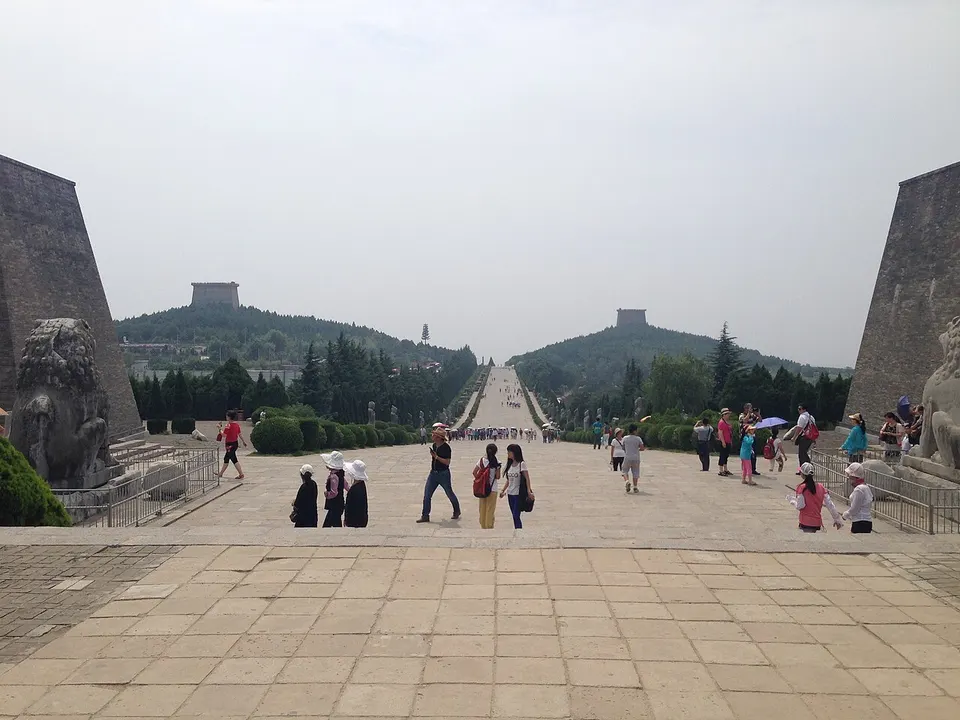
About Xianyang
Just upstream of Xi'an on the Wei River, Xianyang was the Qin capital, from which the First Emperor ruled after unifying China in 221 BC. The country to its north is crowded with imperial tombs: Maoling and the Han Yangling Mausoleum, whose pits are packed with small clay figures, and the Tang mountain tombs of Qianling, shared by Gaozong and Wu Zetian, and the Zhao Mausoleum. Xi'an's main airport lies here, and Yuanjia Village in Liquan draws millions to its lanes of snack stalls.
What to eat in Xianyang
- Qian County guokui flatbread (乾县锅盔)
Featured places in Xianyang
-
Qianling Mausoleum 乾陵
A spirit way of stone guardians climbing to the joint tomb of Gaozong and Wu Zetian
-
Han Yangling Mausoleum 汉阳陵
Walk on glass above burial pits full of armless clay figures at a Han emperor's tomb
Listed sites in Xianyang
32 sites in Xianyang are on the official lists. Those with a page of their own link to it; the rest open as cards on the map.
- Changyu Reina Castle Winery 张裕瑞那城堡酒庄 4A scenic area · on the map
A winery of the Changyu wine group, opened in October 2013 in Qinhan New City between Xi'an and Xianyang and run with Italy's Reina winemaking family. - Dafo Temple Grottoes 大佛寺石窟 4A scenic area · National heritage site · on the map
A cave temple cut into the cliff on the south bank of the Jing River west of Binzhou, listed in 2014 as part of the Silk Roads: Chang'an–Tianshan Corridor World Heritage Site. - Fucha Town 茯茶镇 4A scenic area · on the map
A tea-themed tourist town in Jinghe New City north of Xi'an, opened in August 2015 on the site of the old village of Shuangzhao and devoted to fu tea, a fermented brick tea. - Lewa Adventure 乐华欢乐世界 4A scenic area · on the map
An amusement park in Jinghe New City north of Xi'an, opened as Lewa Hengye Happy World around a cluster of roller coasters and some 30 rides. - Malan Revolutionary Site 马栏革命旧址 4A scenic area · National heritage site · on the map
Malan, in the hills of northern Xunyi County, was the seat of the Communist Party's Guanzhong sub-region of the Shaanxi–Gansu–Ningxia Border Region in the 1940s, on an important route from Xi'an to Yan'an. - Maoling 茂陵 4A scenic area · National heritage site
Maoling is the tomb of Emperor Wu of Han (157–87 BC), the largest of the Western Han imperial mausoleums, whose great flat-topped mound rises on the loess plateau between Xianyang and Xingping. - Mawei Station Folk Culture Park 马嵬驿 4A scenic area · on the map
A folk-culture park built from 2012 in a gully left empty when Lijiapo village was moved, named after the Mawei post station where Yang Guifei, consort of Emperor Xuanzong, was put to death during a mutiny of his guards in 756. - Northwest A&F University Museums 西北农林科技大学博览园 4A scenic area · on the map
A group of six museums on the campus of Northwest A&F University in Yangling, opened to the public in 2005 and described by the university as China's largest group of agriculture-themed museums. - Shilang Lake 侍郎湖 4A scenic area · on the map
A lake among the loess hills south-west of Binzhou, developed as an eco-tourism area. - Silk Road Happy World 丝路欢乐世界 4A scenic area · on the map
A Silk Road-themed park in Fengxi New City on the western edge of Xi'an, opened in April 2023 by the Shaanxi Tourism Group, laid out as seven themed streets that recreate places along the old trade routes, such as Rome, Persia and India, as stage-set architecture. - Xianyang Lake 咸阳湖 4A scenic area · on the map
An artificial lake by the Wei River in central Xianyang, lined with riverside parks and promenades. - Yangling Modern Agriculture Innovation Park 杨凌现代农业创新园 4A scenic area · on the map
A showcase of modern farming of about 87 hectares in the Yangling agricultural high-tech zone, and Shaanxi's first 4A-rated agricultural tourism site. - Yuanjia Village 袁家村 4A scenic area · on the map
A Guanzhong farming village near Liquan that turned to rural tourism in 2007 and is now lined with brick-and-timber houses in Ming–Qing style. - Yunji Eco-Park 云集生态园 4A scenic area · on the map
An eco-park and rural resort among locust-tree woodland in the hills of Yongshou County, with guesthouse courtyards, woodland walks and farm-style restaurants. - Zhao Mausoleum 昭陵 4A scenic area · National heritage site
Zhaoling, on Jiuzong Mountain in Liquan County, is the mausoleum of Emperor Taizong of Tang (died 649) and the largest of the Tang imperial tombs; begun in 636, it was the first Tang imperial tomb cut into a mountain, and its many satellite tombs hold princes, princesses and ministers such as Wei Zheng and Li Jing. - Zhengguo Canal Headworks 郑国渠 4A scenic area · National heritage site · on the map
Where the Jing River leaves the Zhongshan hills north-west of Jingyang lie the headworks of the Zhengguo Canal, the irrigation canal begun by the state of Qin in 246 BC that turned the salty northern Guanzhong plain into farmland. - Anwu Wartime Youth Training Class Site 安吴青训班旧址 National heritage site · on the map
The Wu family manor at Anwu village where, from 1938 to 1940, the Communist Party ran its Wartime Youth Training Class, a school that prepared young people for work in the war against Japan. - Baoben Temple Pagoda 报本寺塔 National heritage site · on the map
A seven-storey octagonal brick pagoda on the north side of Wugong town, on the site of the Baoben Temple that Emperor Taizong of Tang made out of a villa used by his mother, near the house where he was born. - Beidu Iron Pagoda 北杜铁塔 National heritage site · on the map
A nine-storey octagonal pagoda cast in iron between 1605 and 1610 on a brick base, the only survivor of Fuchang Temple at Beidu, first built under the Jin dynasty. - Chongwen Pagoda 崇文塔 National heritage site · on the map
A thirteen-storey octagonal brick pagoda built between 1591 and 1605 in Chongwen town, standing on a Sumeru-style base. - Kaiyuan Temple Pagoda, Binzhou 开元寺塔 National heritage site · on the map
A seven-storey octagonal brick-and-timber pagoda of 1053, from the Northern Song, in the centre of Binzhou, where it is known as the Bin County Pagoda. - Qin Straight Road at Shimen Pass 秦直道 National heritage site · on the map
The Qin Straight Road was the military highway that the First Emperor ordered in 212 BC, running north from Yunyang near today's Chunhua along the Ziwu Mountains to Jiuyuan beyond the Yellow River. - Qingfan Temple Pagoda 清梵寺塔 National heritage site · on the map
A Tang-dynasty brick pagoda, locally called the North Pagoda, on Beisi Lane in the old centre of Xingping. - Sanyuan City God Temple 三原城隍庙 National heritage site · on the map
A walled temple complex in Sanyuan town founded in 1375, whose mostly Ming-dynasty buildings line one axis of gates, carved timber and stone memorial archways, a Qing opera stage of 1757, twin bell and drum towers and a main hall with a large City God statue. - Shahe Ancient Bridge Site 沙河古桥遗址 National heritage site · on the map
Remains of ancient bridges of the Qin and Han periods across the Sha River in Fengxi New City, which carried one of the main routes linking the capital Chang'an with the outside world. - Shunling Mausoleum 顺陵 National heritage site · on the map
The tomb of Lady Yang (died 670), mother of Wu Zetian, which Wu raised to an imperial mausoleum and named Shunling in 690 after she proclaimed herself emperor. - Site of Qin Xianyang 秦咸阳城遗址 National heritage site
Remains of the palace district of Xianyang, capital of the state of Qin from 350 BC and of the First Emperor's empire until it was burned in 206 BC, on the terrace north of the Wei River. - Tai Pagoda, Xunyi 泰塔 National heritage site · on the map
A brick pagoda built in 1059 under the Northern Song, imitating a timber pavilion-style tower in its octagonal plan and seven storeys. - Wugong City God Temple 武功城隍庙 National heritage site · on the map
A Ming-dynasty City God temple on East Street in Wugong town, the former county seat, repaired in the Qing and in modern times. - Wuling Temple Pagoda 武陵寺塔 National heritage site · on the map
A five-storey octagonal brick pagoda on the site of the vanished Wuling Temple, founded under the Northern Wei, south-west of Yongping, the old county town of Yongshou. - Xianyang Confucian Temple (Xianyang Museum) 咸阳文庙 National heritage site
Xianyang's Confucian Temple, founded in 1371, has housed the city museum, now the Xianyang Museum, since 1962; its four courtyards combine the original Dacheng Hall and side galleries with Ming buildings moved here from other temples in 1963. - Zhaoren Temple 昭仁寺 National heritage site · on the map
A temple in Changwu town founded on the order of Emperor Taizong of Tang in 629 for the soldiers killed at the battle of Qianshuiyuan, where his army had defeated the warlord Xue Rengao.
On the map
Open Xianyang on the illustrated map to see its outline, its places and listed sites together, and to add them to a trip.
Open Xianyang on the map