 Atlas of China
Yungang Grottoes 云冈石窟Yúngāng Shíkū
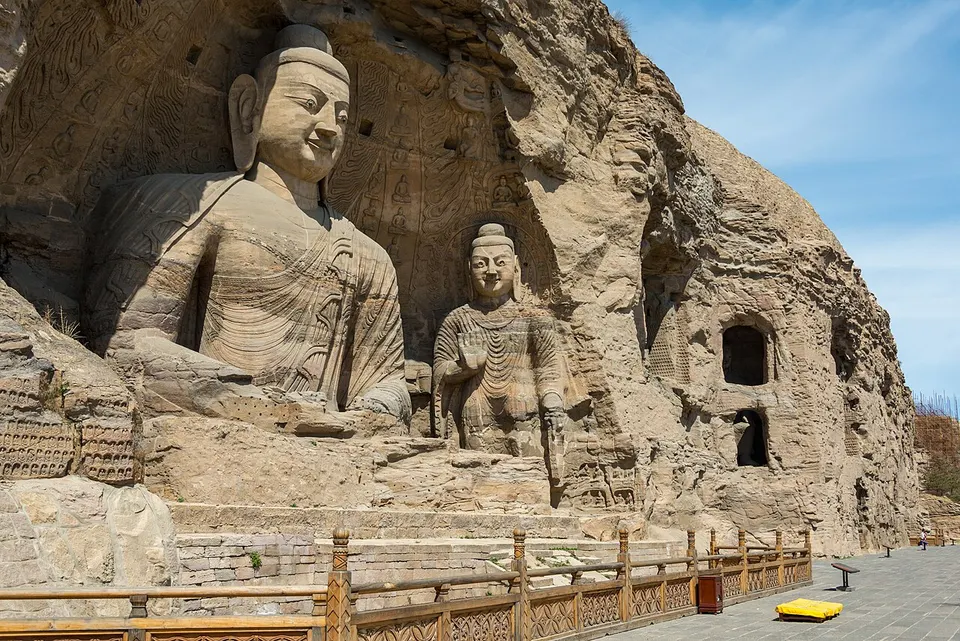
Giant Buddhas carved into a sandstone cliff some 1,500 years ago
- Best time
- May–Oct
- Time needed
- Half a day
- Days to budget
- Half a day
- Stay in
- Datong
- Region
- Shanxi
- Type
- Heritage
- Listed as
- 5A scenic area, National heritage site, UNESCO World Heritage
Why go to Yungang Grottoes
On the western edge of Datong, more than 250 caves and over 50,000 statues are cut into a low sandstone ridge. The largest Buddhas stand well over 10 metres tall, and one now sits open to the sky where the front of its cave fell away, making Yungang one of the great early landmarks of Chinese Buddhist art.
The story
The caves were sponsored by the Northern Wei, a dynasty founded by the nomadic Xianbei people, who ruled northern China from Datong in the 5th century. The five earliest caves, overseen by the monk Tanyao, are said to portray the dynasty's first emperors as Buddhas.
What to see at Yungang Grottoes
- Cave 3 第3窟: The biggest cave at Yungang, behind a cliff face about 25 metres high, with a front and a back chamber. The back chamber's Buddha and two bodhisattvas are judged to be later, Sui–Tang work, and parts of the cave look unfinished.
- Caves 5 and 6 第5、6窟: Twin caves fronted by wooden pavilions dating from 1621. Cave 5 holds the grottoes' largest statue, a seated Buddha about 17 metres tall; Cave 6 is carved floor to ceiling around a central pillar, with relief scenes from the life of the Buddha to walk round.
- Cave 12 第12窟: Often called the Music Cave for the heavenly musicians carved along the top of its front wall, a rare glimpse of the instruments of the day.
- Tan Yao Caves 昙曜五窟: Caves 16–20 are the earliest big caves, begun around 460 under the monk Tanyao. Each is a horseshoe-shaped cave around one colossal Buddha, and they are often read as representing five Northern Wei emperors.
- Cave 20 第20窟: The open-air Buddha seen on postcards, seated with a full face and heavy robe in a style that echoes Central Asia. The cave's front wall fell away, leaving the figure in the open.
How to visit Yungang Grottoes
The caves run in a line of about a kilometre along the south face of the cliff, so you simply walk along them. Many visitors go in numerical order from Cave 1 at the east end, while some walk it in reverse to stay ahead of tour groups. Allow roughly three to four hours for Caves 3, 5–6, 12 and 16–20 together with the museum inside the scenic area; with half that time, keep to Caves 5–6 and 16–20.
How to get to Yungang Grottoes
The grottoes are about 30 minutes west of central Datong by taxi or city bus; Datong is about two hours from Beijing by high-speed train.
Where to stay
Stay in Datong, where the old town and rebuilt city wall give you an evening stroll and trains, taxis and city buses reach the grottoes in about half an hour.
What to eat
- Datong knife-cut noodles 大同刀削面: Noodles shaved straight off a dough block into boiling water, then topped with a meat sauce, usually pork, and a few side dishes.
- Baihua shaomai 百花烧麦: A Datong speciality of steamed shaomai dumplings, found in the city's older restaurants.
- Old Datong assorted hotpot 老大同什锦火锅: A hotpot of mixed ingredients, a traditional Datong dish.
Tips for visiting Yungang Grottoes
- Combine with the Hanging Temple on a long day out from Datong with a hired car.
- Bring your passport; tickets are booked and checked against ID.
- Spend an evening on Datong's rebuilt city wall, which is lit up after dark.
Nearby
- Datong Ancient City 大同古城 10 km
Rebuilt Ming ramparts around genuine Liao–Jin temple halls and a glazed dragon screen - Yingxian Wooden Pagoda 应县木塔 60 km
A Liao-dynasty timber pagoda of 1056, five storeys outside and nine within - Hanging Temple 悬空寺 70 km
A wooden temple pinned to a sheer cliff, seemingly propped up on stilts - Yanmen Pass 雁门关 100 km
A Ming fortress gate on the Inner Great Wall, its ramparts running up the mountain ridges
Also within 30 km: Jinhuagong National Mining Park 晋华宫国家矿山公园 (under 10 km), Guanyin Hall, Datong 大同观音堂 (under 10 km), Former Shanxi Provincial Third Middle School 山西省立第三中学旧址 (under 10 km), Datong Mass Grave Memorial 大同煤矿万人坑 (under 10 km), Huayan Temple, Datong 华严寺 (10 km), Shanhua Temple 善化寺 (10 km).
Trips with Yungang Grottoes
- North China’s heritage line: Beijing, Datong, Pingyao and Xi’an 9 days · Beijing, Datong, Pingyao and Xi'an
On the map
Open Yungang Grottoes on the illustrated map to see the terrain around it, what else is close, and to add it to a trip and plan the days.
Open Yungang Grottoes on the map