 Atlas of China
Datong 大同Dàtóng
Coal city with 51,000 cave statues and a temple hung on a cliff face
About Datong
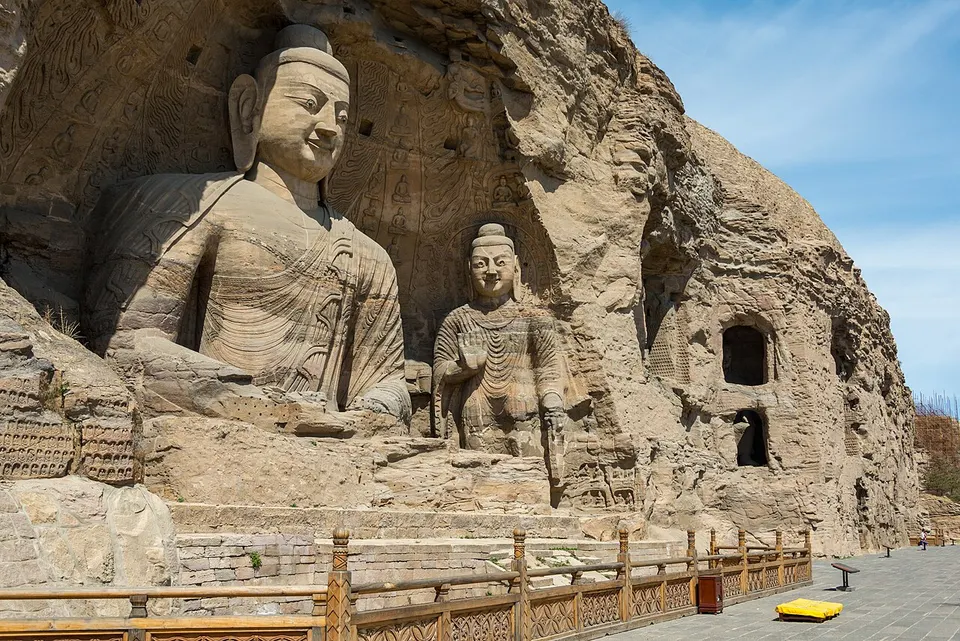
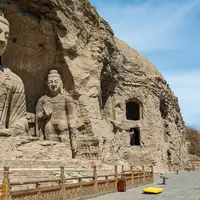
Datong was the capital of the Northern Wei dynasty until 494, and the Yungang Grottoes, 16 km west of the centre, hold some 51,000 statues carved in the 5th and 6th centuries. Inside its rebuilt Ming walls, Huayan Temple and Shanhua Temple keep halls of the Liao and Jin dynasties, and the glazed Nine-Dragon Wall once screened a Ming prince's palace. To the south-east, the Hanging Temple clings to a cliff near Mount Heng, the Northern Peak of China's Five Great Mountains.
What to eat in Datong
- Hunyuan liangfen jelly (浑源凉粉)
- Datong assorted hotpot (老大同什锦火锅)
Featured places in Datong
-
Yungang Grottoes 云冈石窟
Giant Buddhas carved into a sandstone cliff some 1,500 years ago
-
Datong Ancient City 大同古城
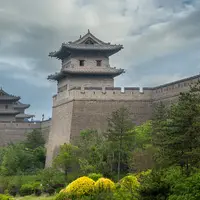
Rebuilt Ming ramparts around genuine Liao–Jin temple halls and a glazed dragon screen
-
Hanging Temple 悬空寺
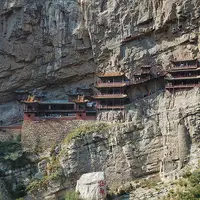
A wooden temple pinned to a sheer cliff, seemingly propped up on stilts
Listed sites in Datong
34 sites in Datong are on the official lists. Those with a page of their own link to it; the rest open as cards on the map.
- Chehe Organic Community 车河有机社区 4A scenic area · on the map
A rural community in the hills of Hongshileng township, set up in 2013 around the villages of Upper and Lower Chehe and run as a showcase for organic farming. - Daquanshan Ecological Tourism Area 大泉山 4A scenic area · on the map
A loess-hill area south of Yanggao that was once bare, gullied slopes and is now about 69% forest, held up as a national model of soil and water conservation. - Datong Volcanic Group 大同火山群 4A scenic area · on the map
A field of more than 30 volcanic cones on the loess plateau in Yunzhou District, formed in the Quaternary period; the best known are Heishan, Jinshan, Langwoshan, Gelaoshan and Haotianshan. - Fantawild Adventure, Datong 大同方特欢乐世界 4A scenic area · on the map
A theme park on the eastern edge of Datong, one of the Fantawild chain, which opened in 2016. - Huayan Temple, Datong 华严寺 4A scenic area · National heritage site
A large Buddhist temple in the west of Datong's old city, founded in 1038 as a royal temple of the Liao dynasty and divided into an upper and a lower temple under the Ming. - Jinhuagong National Mining Park 晋华宫国家矿山公园 4A scenic area · on the map
A former coal mine west of Datong, now a national mining park of about 36 hectares and one of the first 28 in China. - Li'erkou Great Wall 李二口长城 4A scenic area · on the map
A stretch of Ming-dynasty Great Wall built of rammed earth in the 16th century, in the hills of Tianzhen County in the far north of Shanxi. - Mount Heng (Beiyue Hengshan) 北岳恒山 4A scenic area
Mount Heng is the northern one of China's Five Great Mountains, rising to 2,016.1 m at Tianfengling just south of Hunyuan; it took over the title of Northern Peak from a mountain in Hebei in the early Qing. - Pingxingguan Battle Site 平型关大捷景区 4A scenic area · National heritage site · on the map
The memorial site for the Battle of Pingxingguan of 25 September 1937, when the Eighth Route Army's 115th Division ambushed a Japanese column in the Qiaogou gully, an engagement that Chinese accounts treat as the first major Chinese victory after the full-scale war began. - Shanhua Temple 善化寺 4A scenic area · National heritage site
A Buddhist temple just inside the south gate of Datong's old city, popularly known as the South Temple, which keeps buildings from both the Liao and Jin dynasties. - Weidu Water World, Datong 魏都水世界 4A scenic area · on the map
A large leisure complex of about 600 mu (40 hectares) on the southern edge of Datong, developed from 2015 around a water park with slides, a wave pool and a lazy river. - Chanfang Temple Pagoda 禅房寺塔 National heritage site · on the map
A Liao-dynasty brick pagoda of seven tiers and eight sides on the summit of Ta'er Mountain (Zhangren Peak) south-west of Datong, beside the site of the Tang-founded Chanfang Temple. - Ciyun Temple, Tianzhen 慈云寺 National heritage site
A Ming-dynasty Buddhist temple in the middle of Tianzhen, laid out in three courtyards on about 5,600 m², which took its present name when the Xuande emperor (1426–35) granted it. - Datong Drum Tower 大同鼓楼 National heritage site
A three-storey timber tower with triple eaves, standing on a stone base on Yongtai Street in the middle of Datong's old city. - Datong Mass Grave Memorial 大同煤矿万人坑 National heritage site
A memorial museum at Meiyukou, south-west of Datong, built where the remains of miners were found in two natural caves; it records the forced labour used in the Datong coal mines during the Japanese occupation of 1937–1945. - Dayun Temple, Jingzhuang 荆庄大云寺 National heritage site · on the map
The surviving main hall of Dayun Temple, which the 1763 county gazetteer records as a Northern Wei foundation, in the village of Jingzhuang south-west of Hunyuan. - Former Shanxi Provincial Third Middle School 山西省立第三中学旧址 National heritage site
A school campus built between 1918 and 1921 on the Shili River west of Datong, in a blend of Chinese and Western styles, and used for schools until recently. - Guandi Temple, Datong 大同关帝庙 National heritage site · on the map
A temple to the war god Guan Yu in the old city of Datong. - Guanyin Hall, Datong 大同观音堂 National heritage site
A small Buddhist temple on a low hill west of Datong, first founded under the Liao dynasty and rebuilt in 1651 under the Qing. - Guchengbao Han Tombs 古城堡墓群 National heritage site · on the map
A cemetery of 58 Han-dynasty mounds scattered over about 19 km² around Gucheng town in Yanggao County, the mounds about 4–6 m high and still well preserved. - Hunyuan Confucian Temple 浑源文庙 National heritage site · on the map
The county's Confucian temple, founded before the Liao and Jin and rebuilt on a large scale in 1472, set on a north–south axis over about 15,580 m² in the old town of Hunyuan. - Jueshan Temple 觉山寺 National heritage site · on the map
A temple founded in 483 as a Northern Wei imperial temple and rebuilt in the 1880s, whose Liao-dynasty brick pagoda survived the 1626 earthquake that brought down the rest of the compound. - Lülüshen Temple, Hunyuan 律吕神祠 National heritage site · on the map
A shrine of the rain-bringing Lülü deity, worshipped as the Water Mother and her husband, in Shenxi village, inside the Shenxi National Wetland Park north-west of Hunyuan. - Nine-Dragon Wall, Datong 大同九龙壁 National heritage site
A glazed-tile screen wall decorated with nine dragons, built between 1392 and 1396 in front of the palace of Zhu Gui, the Prince of Dai and thirteenth son of the first Ming emperor. - Pingcheng Site (Northern Wei capital) 平城遗址 National heritage site · on the map
Pingcheng was the capital of the Northern Wei dynasty from 398 to 494, and almost all of it now lies under modern Datong. - Quhui Temple Stone Sculptures 曲回寺石像冢 National heritage site · on the map
A mound-like heap of stone blocks beside the ruined Quhui Temple, carved with Buddha figures in the style of the late Tang and partly covered by sand and gravel, in the village of Quhuisi on the Duyu river. - Shaliangpo Han Tombs 沙梁坡墓群 National heritage site · on the map
A cemetery of Han-dynasty frontier garrison soldiers on the slopes south of Tianzhen, known locally as Huangliangdui. - Shuishen Temple, Guangling 水神堂 National heritage site · on the map
A temple complex on a small hill beside the Huquan spring in the middle of Guangling, whose name covers a water-god shrine and a Buddhist hall, Dashi'an. - Tomb of Li Yumei 栗毓美墓 National heritage site
The walled tomb park of Li Yumei (1778–1840), a Hunyuan-born Qing river-control official remembered for his brick-dam method of flood protection, built by imperial order after his death. - Xingguo Temple, Pingcheng 平城兴国寺 National heritage site · on the map
A former Buddhist temple in the southern part of central Datong, founded in 1619 under the Ming and repaired in 1667 and 1765. - Yong'an Temple, Hunyuan 浑源永安寺 National heritage site
A Yuan-dynasty temple compound in the old town of Hunyuan, begun under the Jin, burned down and rebuilt in the early Yuan, with extensions and repairs under the Ming and Qing. - Yonggu Mausoleum 方山永固陵 National heritage site · on the map
The tomb of Empress Dowager Feng (Wenming), the Northern Wei regent who died in 490, begun in 481 on the southern part of the Fangshan hill north of Datong. - Yuanjue Temple Pagoda, Hunyuan 圆觉寺塔 National heritage site
A nine-storey octagonal brick pagoda of 1158, over 30 m high, in the old town of Hunyuan, known locally as the Little Temple Pagoda. - Yunlin Temple, Yanggao 云林寺 National heritage site · on the map
A Ming-dynasty temple built by imperial decree in the south-west of Yanggao old town, locally called the West Temple, of which the main hall, the Heavenly Kings Hall and side halls survive.
Getting to Datong
Train, flight and driving times from the cities most visitors come from, with stations, fares and how many run a day; each opens the full comparison.
- Taiyuan 太原 high-speed train 1 h 23 min, 54 a day, from ¥112
- Beijing 北京 high-speed train 1 h 45 min, 48 a day, from ¥157
- Pingyao 平遥 high-speed train 2 h 14 min, 10 a day, from ¥153
- Tianjin 天津 train 7 h 31 min, 4 a day, from ¥72
- Zhengzhou 郑州 high-speed train 4 h 12 min, 9 a day, from ¥355; a nonstop route is listed
Trips with Datong
- North China’s heritage line: Beijing, Datong, Pingyao and Xi’an 9 days · Beijing, Datong, Pingyao and Xi'an
On the map
Open Datong on the illustrated map to see its outline, its places and listed sites together, and to add them to a trip.
Open Datong on the map