 Atlas of China
Huzhou 湖州Húzhōu
Silk merchants' mansions, the Classic of Tea and the Huzhou writing brush
About Huzhou
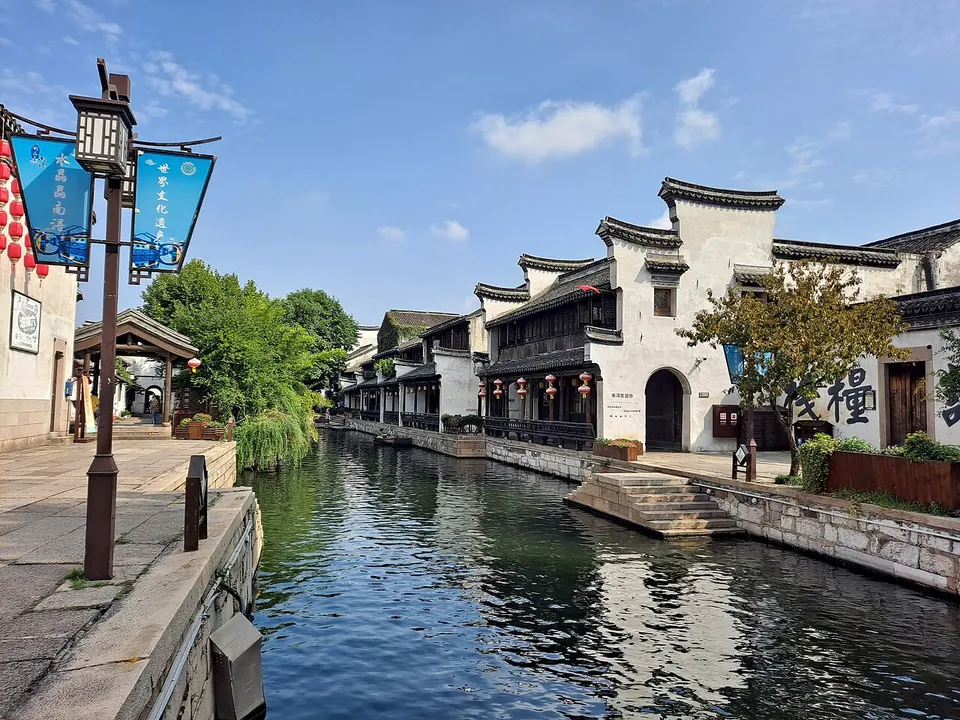
Huzhou takes its name from Lake Tai, on whose southern shore it lies, and its plain of canals, mulberry trees and fish ponds has lived on silk for millennia: 4,700-year-old fragments were found at the Qianshanyang Site. Silk fortunes filled Nanxun Ancient Town with mansions, gardens and the Jiaye Library. The Tang tea master Lu Yu wrote The Classic of Tea here, and to the west rise the bamboo forests of Anji and Mount Mogan, a summer retreat of early 20th-century villas.
What to eat in Huzhou
- Qianzhang tofu-skin parcels (千张包子)
- Anji white tea (安吉白茶)
Listed sites in Huzhou
38 sites in Huzhou are on the official lists. Those with a page of their own link to it; the rest open as cards on the map.
- Nanxun Ancient Town 南浔古镇 5A scenic area · National heritage site
A canal town that grew rich on the raw-silk trade from the Ming dynasty onward, where late-Qing silk magnates built houses and gardens mixing Chinese and Western styles. - China Alligator Village, Changxing 中国扬子鳄村 4A scenic area · on the map
A breeding and conservation centre for the Chinese alligator, a small endangered crocodilian found only in China, set among ponds, woods and bamboo in the countryside of western Changxing. - China Bamboo Expo Park 中国竹子博览园 4A scenic area · on the map
A bamboo garden on the south-western edge of Anji town, in a county known as China's 'home of bamboo', planted with more than 300 kinds of bamboo gathered from across China and abroad. - Digang Village 荻港 4A scenic area · on the map
A water village in Hefu town south-east of Huzhou, set among the fish ponds and mulberry dykes of the Taihu plain, with old houses and family halls along its canals, more than 30 old stone bridges, a temple and covered streets running beside the water. - Feiying Pagoda and the Gucheng Scenic Area 飞英塔 4A scenic area · National heritage site
Huzhou's 'pagoda within a pagoda': a stone relic pagoda of 884–894 enclosed from the Northern Song in an outer brick-and-timber pagoda, rebuilt after a lightning fire in the Southern Song and restored in the 1980s. - Golden Lakeshore, Taihu Lake Resort 黄金湖岸 4A scenic area · on the map
A stretch of the southern shore of Taihu Lake in Huzhou's Taihu tourist resort, running east from Moon Plaza and the ring-shaped 'Moon Hotel' that has become a city landmark. - Golden Spike Ancient World, Meishan 金钉子远古世界 4A scenic area · on the map
At Meishan in north-western Changxing a quarried limestone face, Section D, was chosen in 2001 as the global reference point, the 'golden spike', for the boundary between the Permian and Triassic periods about 250 million years ago, the time of the largest mass extinction in Earth's history; a second golden spike, for the base of the Changhsingian stage, was fixed in the same section in 2005. - Hello Kitty Park, Anji Hello Kitty乐园 4A scenic area · on the map
China's first Hello Kitty theme park, built on the eastern edge of Anji town by a Chinese company under licence from Sanrio and opened in 2015. - Huzhou Silk Town (Xishanyang) 湖州丝绸小镇 4A scenic area · on the map
A new silk-industry and leisure district in Huzhou's eastern new town, built around Xishanyang, a lake and wetland park that is the main attraction for visitors. - Jialebi Fantasy Park, Anji 奇幻嘉乐比 4A scenic area · on the map
A family amusement park in the Lingfeng resort area south-west of Anji town, listed as Tianyuan Jialebi and now run as Qihuan ('Fantasy') Jialebi together with a resort hotel, orchards and white-tea gardens. - Jiangnan Tianchi 江南天池 4A scenic area · on the map
The upper reservoir of the Tianhuangping pumped-storage power station, a lake held on a mountain top in southern Anji, with the power plant itself hidden in caverns deep inside the mountain. - Mount Mogan 莫干山 4A scenic area · National heritage site
A bamboo-covered hill resort in western Deqing, about 60 km from Hangzhou, where foreign missionaries and merchants built summer villas from the 1890s and Chinese officials, businessmen and cultural figures followed in the 1920s and 1930s. - New Fourth Army Jiangsu–Zhejiang Military Region Sites 新四军苏浙军区旧址 4A scenic area · National heritage site
In 1944–45 the Communist-led New Fourth Army made the hill villages around Huaikan, in north-western Changxing, the base of its Jiangsu–Zhejiang Military Region, which was formally set up at Wentang village in February 1945 with Su Yu as commander. - Shuikou Tea Culture Area (Guzhu Mountain) 水口茶文化景区 4A scenic area · National heritage site · on the map
Guzhu Mountain in Shuikou township grew Zisun ('purple shoot') tea, sent to the Tang court as tribute from 770, when a tribute-tea workshop was set up here, and Lu Yu, author of the Classic of Tea, studied tea on these hills. - Taihu Lougang Waterways (Yigao) 太湖溇港 4A scenic area · National heritage site
The lougang are hundreds of small channels and larger waterways cut from the Spring and Autumn period onward through the southern shore of Taihu Lake, which with cross-dykes and polder fields drained the land and regulated the lake; the network is best preserved in Wuxing and was listed as a World Heritage Irrigation Structure in 2016. - Taihu Tuying Wetland Park 太湖图影湿地文化园 4A scenic area · on the map
A wetland park on the south-western shore of Taihu Lake in Changxing's Tuying resort area, described as the last natural lakeside wetland on this stretch of shore, with fish ponds, winding channels, reed beds and more than 20 small islands. - Xianshan Lake 仙山湖 4A scenic area · on the map
A reservoir lake and national wetland park at the western tip of Changxing county, close to where Zhejiang, Jiangsu and Anhui meet. - Xiazhu Lake Wetland 下渚湖湿地 4A scenic area · on the map
A natural lake-and-marsh landscape of about 10 km² in eastern Deqing, a maze of some 600 low islets, reed beds, bamboo groves and fish ponds threaded by channels. - Yu Village (Yucun), Anji 余村 4A scenic area
A village in the bamboo hills of Tianhuangping town that closed its limestone quarries and cement works in the early 2000s and turned to forestry and rural tourism. - Yuanxiang Town (Butterfly Valley) 原乡小镇 4A scenic area · on the map
A rural leisure park opened in 2018 at Zhao village in the Xisaishan hills west of Huzhou, built around a large indoor butterfly house where visitors watch butterflies breed, emerge and fly. - Yucun, Moganshan 庾村 4A scenic area · on the map
The village at the eastern foot of Mount Mogan where Huang Fu, a Republican-era statesman who retired to the mountain in 1928, founded a library, a school and a silkworm-egg farm in the 1930s; he is buried here. - Zhebei Grand Canyon 浙北大峡谷 4A scenic area · on the map
A forested river gorge in the hills of south-western Anji, near Baofu, where a walking trail follows a clear mountain stream past boulders, pools and a string of waterfalls. - Zhejiang Museum of Natural History, Anji Branch 浙江自然博物院安吉馆 4A scenic area · on the map
The second site of the provincial natural history museum, opened in December 2018 on a hillside north-west of Anji town in a group of eight buildings designed by David Chipperfield Architects. - Zhongnan Baicaoyuan Eco-Park 中南百草原 4A scenic area · on the map
A hillside eco-park on the north-western edge of Anji town, laid out as a series of themed gardens (cherry, plum, Japanese maple, purple bamboo, white tea, roses, osmanthus and medicinal herbs) among streams and ponds. - Anji Ancient City Site 安吉古城遗址 National heritage site · on the map
The square earthen enclosure of an ancient walled town at Gucheng village, north of Anji, occupied from the Spring and Autumn period to the Southern Dynasties and identified with Guzhang, where the Qin later based its Zhang commandery; its rammed-earth walls still rise above the fields. - Anji Old City Wall (Ancheng) 安城城墙 National heritage site
The stone-faced walls of the former Anji prefectural and county town at Ancheng, north of present-day Anji, described as the most complete prefecture- and county-level city walls left in Zhejiang. - Chaoyin Bridge 潮音桥 National heritage site · on the map
A three-arch stone bridge of 1539, rebuilt in 1605, across the Zha Stream just inside the old south gate of Huzhou, named after the Chaoyin ferry it replaced. - Daochang Hill Prayer Inscription 道场山祈年题记 National heritage site
A Yuan-dynasty rock inscription on Daochang Hill on the southern edge of Huzhou, recording prayers for a good harvest by the darughachi, the Mongol overseer of the prefecture, and one of very few dated Yuan carvings of its kind in Zhejiang. - Deqing Proto-porcelain Kiln Sites 德清原始瓷窑址 National heritage site · on the map
The low hills around Longsheng and Longshan villages, north-east of Deqing's county town, hold kiln sites that fired proto-porcelain from the Shang to the Warring States period, an early centre of Chinese porcelain-making named one of China's six major archaeological discoveries of 2010. - Dusong Pass and the Old Post Road 独松关 National heritage site · on the map
A stone gateway on the Dusong ridge, on the old road between Hangzhou and Xuancheng, built in the Jianyan era (1127–30) to guard the approaches to the Southern Song capital at Lin'an, today's Hangzhou. - Lingzhi Pagoda (Yong'an Temple Pagoda) 灵芝塔 National heritage site
A solid nine-storey octagonal brick pagoda at the foot of Longtou hill on the east bank of the West Tiao stream, facing the old Anji county town across the water; tradition dates it to the Wuyue kingdom, and inscriptions record repairs in 1047 and 1260. - Pangong Bridge 潘公桥 National heritage site · on the map
A three-arch stone bridge over the Fangsheng canal outside Huzhou's old north-eastern gate, named after the Ming hydraulic engineer Pan Jixun, who paid for the first bridge here in 1585–90. - Qianshanyang Site 钱山漾遗址 National heritage site · on the map
A late Neolithic village site on the east bank of the former Qianshanyang lake, south-east of Huzhou, where excavations in the 1950s found fragments of silk fabric, silk thread and ribbon some 4,700 years old, among the oldest silk textiles known; in 2014 its remains were defined as a distinct Qianshanyang culture. - Shouchang Bridge 寿昌桥 National heritage site · on the map
A single-arch stone bridge over the Shangzhu river at Wayao hamlet in Erdu, built in 1265–74 under the Southern Song by a local man, Yao Zhi, and the best-preserved old bridge in Deqing. - Three Bridges of Shuanglin 双林三桥 National heritage site
Three stone arch bridges, Wankui, Huacheng and Wanyuan, span the Shuanglin canal within about 350 m of each other on the north side of Shuanglin, an old silk town in Nanxun district. - Tomb of Chen Qimei (Chen Yingshi) 陈英士墓 National heritage site
The tomb of Chen Qimei (1878–1916), courtesy name Yingshi, a Huzhou-born revolutionary of the Tongmenghui who took Shanghai for the republicans in 1911 and was a close ally of Sun Yat-sen, on the eastern slope of Xian Hill on the southern edge of the city. - Tomb of Zhao Mengfu 赵孟頫墓 National heritage site
The joint tomb of Zhao Mengfu (1254–1322), the leading painter and calligrapher of the Yuan dynasty, and his wife Guan Daosheng, herself a noted painter, on a hillside at Dongheng village in Luoshe, northern Deqing. - Xiagucheng Ancient City Site 下菰城遗址 National heritage site · on the map
The rammed-earth ramparts of Gucheng, regarded as the forerunner of Huzhou: the Chu lord Chunshen made it the seat of Gucheng county in the late Warring States, and under the Qin it was the seat of Wucheng county until the town moved north to the present city site.
On the map
Open Huzhou on the illustrated map to see its outline, its places and listed sites together, and to add them to a trip.
Open Huzhou on the map