
 An illustrated travel map
Sui–Tang Luoyang City Site (Yingtian Gate and Mingtang) 隋唐洛阳城Suí Táng Luòyáng Chéng
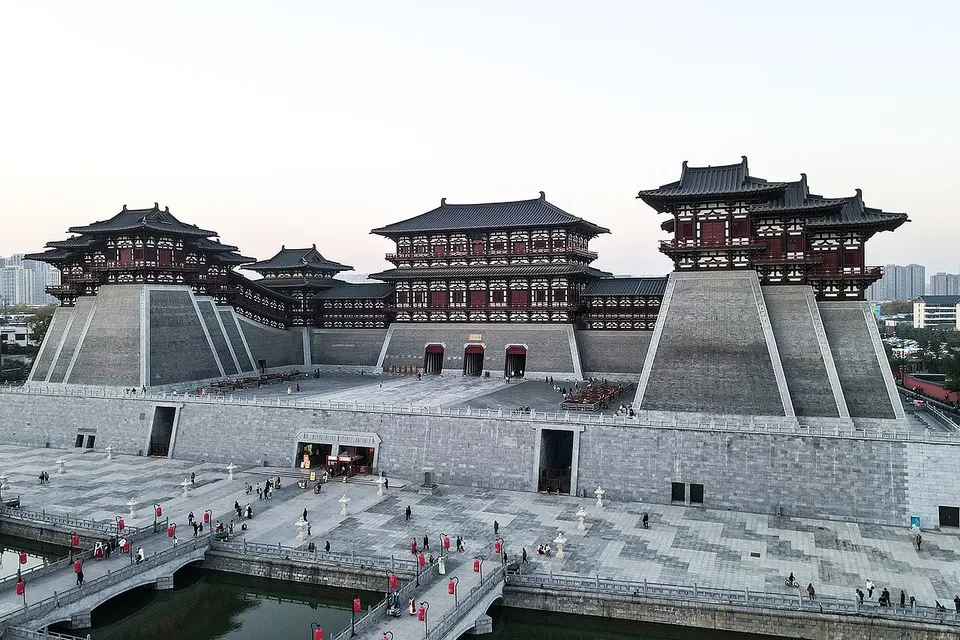
Where Wu Zetian ruled: a rebuilt Tang palace gate and the foundations of her halls
- Best time
- Apr–May, Sep–Oct
- Time needed
- Half a day
- Days to budget
- Half a day
- Stay in
- Luoyang
- Region
- Henan
- Type
- Heritage
- Listed as
- 4A scenic area, National heritage site, UNESCO World Heritage
Why go to Sui–Tang Luoyang City Site (Yingtian Gate and Mingtang)
This is the site of the Sui–Tang eastern capital, rebuilt by Emperor Yang of Sui from 605 and later the seat of Empress Wu Zetian. The palace heart is now a national archaeological site park: the Yingtian Gate is a Tang-style reconstruction raised over its excavated base, and the Mingtang (Hall of Light) and Tiantang (Heavenly Hall) are modern buildings on or beside the original foundations. A short ride south, the Dingding Gate museum shows the outer city's main south gate, whose ruins are part of the Silk Roads World Heritage listing.
The story
Wu Zetian ruled from Luoyang as emperor of her own Zhou dynasty (690–705) and had the Mingtang built over the old audience hall's foundations from 688. Tang accounts put her Tiantang at about a thousand Chinese feet high, almost certainly an exaggeration. Gates named Ōtenmon after the Yingtian Gate were built in Japan's ancient capitals at Nara and Kyoto.
What to see at Sui–Tang Luoyang City Site (Yingtian Gate and Mingtang)
- Yingtian Gate 应天门: The palace's south gate, first built in 605 as Zetian Gate and now rebuilt on its original site as a Tang-style gate about 35 m tall with flanking towers. The 9.2 m base houses a museum showing the excavated remains, and Wu Zetian is said to have proclaimed her dynasty here.
- Mingtang 明堂: Wu Zetian's ceremonial hall of state, built on the foundations of the earlier Qianyang Hall. A modern protective hall about 33 m high now covers the excavated base and column pits, and opened to visitors in 2011.
- Tiantang 天堂: A modern Tang-style rebuilding of the tall tower that stood in the palace compound, beside the Mingtang. Both are best treated as reconstructions that give a sense of scale rather than as original fabric.
- Jiuzhou Pond 九洲池: The pond of the Sui–Tang palace gardens, one of the city's protected remains, now landscaped as a display area.
- Dingding Gate 定鼎门: The outer city's south gate, called Jianguo Gate under the Sui and Dingding Gate under the Tang, in use for about 530 years. A Tang-style gate was rebuilt on the spot in 2009 with a museum showing the excavated base below; the ruins are a component of the Silk Roads World Heritage site.
How to visit Sui–Tang Luoyang City Site (Yingtian Gate and Mingtang)
Start at the Yingtian Gate, walk through its museum on the excavated base, then continue north to the Mingtang and Tiantang, which stand next to each other. The three sights can be covered in two to three hours; adding the Jiuzhou Pond remains makes a half-day visit. Dingding Gate is a separate half-hour or so on its own, and works best as a second stop later in the day.
How to get to Sui–Tang Luoyang City Site (Yingtian Gate and Mingtang)
The palace area is in central Luoyang on Dingding Avenue, with a metro station named Yingtian Gate close by. Dingding Gate is a separate site about 6 km south, best reached by taxi or ride-hailing.
Where to stay
Stay in Luoyang's old town (Laocheng), a short ride from the palace area, for night markets and food; the Luolong district is the alternative near Longmen and the new museums.
What to eat
- Luoyang water banquet 洛阳水席: A set sequence of around two dozen mostly soup-based courses, the city's best-known formal meal.
- Luoyang beef soup 洛阳牛肉汤: A long-simmered clear beef broth, a Luoyang breakfast staple eaten with flatbread.
- No-flip soup 不翻汤: A thin, savoury egg soup from the water-banquet tradition, so called because the egg is not turned over in the bowl.
Tips for visiting Sui–Tang Luoyang City Site (Yingtian Gate and Mingtang)
- Be clear what you are seeing: the Yingtian Gate is a reconstruction (rebuilt from 2016 on its original site), the Mingtang is a modern protective hall over its excavated foundations, and the Tiantang is a modern Tang-style rebuilding. Only the excavated bases, pits and foundations are original.
- Dingding Gate is a separate site 6 km from the palace area; plan them as two stops. Its museum is closed on Mondays except public holidays, while the palace-area park lists no regular weekly closure on ticketing pages, so check the official channels for current days and booking, which can change around holidays.
- The Tang-style buildings look best in late-afternoon light and are also a popular backdrop for visitors in Tang-style dress; weekends in the April peony season are the busiest.
Nearby
- Longmen Grottoes 龙门石窟 10 km
Some 100,000 Buddhas carved into riverside cliffs, watched over by a serene giant - White Horse Temple 白马寺 10 km
China's first Buddhist temple, with Thai, Indian and Burmese halls beside it - Erlitou Site Museum of the Xia Capital 二里头夏都遗址博物馆 20 km
Bronze Age finds from Erlitou, a candidate for China's earliest capital - Shaolin Temple 少林寺 50 km
The cradle of Chan Buddhism and kung fu, at the foot of Mount Song - Songyue Pagoda 嵩岳寺塔 50 km
China's oldest standing brick pagoda, a twelve-sided tower from the 520s - Gaocheng Astronomical Observatory 观星台 70 km
A 13th-century observatory where shadows were measured to fix the year
Also within 30 km: Zhougong Temple Museum 洛阳周公庙 (under 10 km), Eastern Zhou Royal Horse and Chariot Museum 天子驾六博物馆 (under 10 km), Eighth Route Army Luoyang Office Memorial Hall 八路军驻洛办事处纪念馆 (under 10 km), Shanxi–Shaanxi Guild Hall (Wanli Tea Road Museum) 洛阳山陕会馆 (under 10 km), Henan Prefecture Confucian Temple 河南府文庙 (under 10 km), China National Flower Garden 中国国花园 (under 10 km).
On the map
Open Sui–Tang Luoyang City Site (Yingtian Gate and Mingtang) on the illustrated map to see the terrain around it, what else is close, and to add it to a trip and plan the days.
Open Sui–Tang Luoyang City Site (Yingtian Gate and Mingtang) on the map