 Atlas of China
Wuhou Shrine & Jinli Street 武侯祠与锦里Wǔhóu Cí yǔ Jǐnlǐ
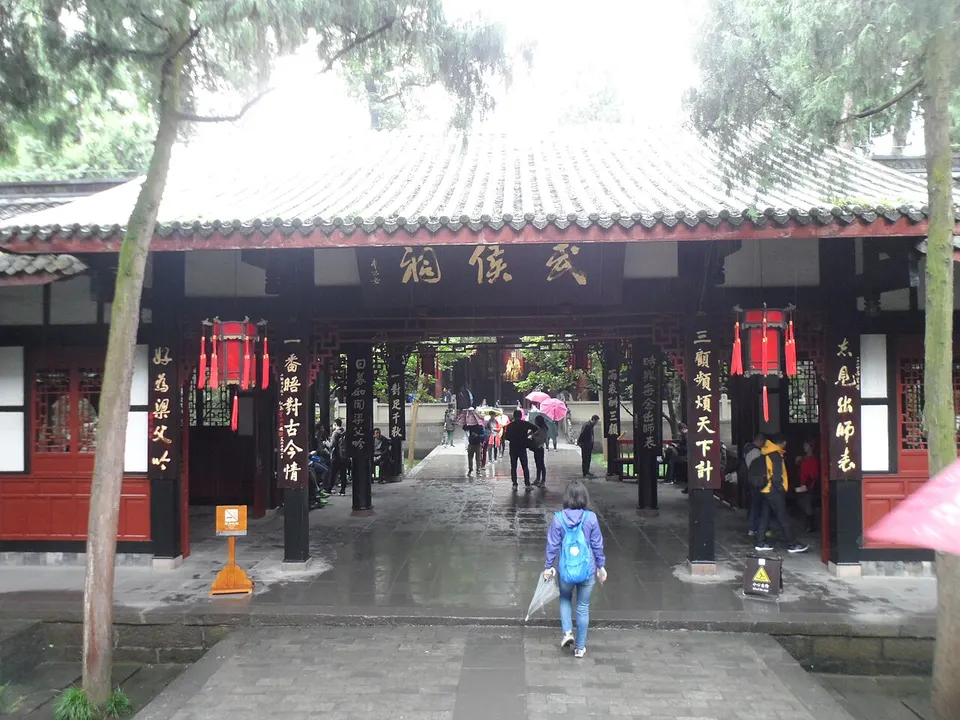
Cypress-shaded halls honouring Three Kingdoms heroes, with a bustling snack lane next door
- Best time
- Mar–May, Sep–Nov
- Time needed
- Half a day
- Days to budget
- Half a day
- Stay in
- Chengdu
- Region
- Sichuan
- Type
- Heritage
- Listed as
- 4A scenic area, National heritage site
Why go to Wuhou Shrine & Jinli Street
Chengdu's Wuhou Shrine honours Zhuge Liang, the celebrated strategist of the Three Kingdoms era, together with Liu Bei, the Shu Han emperor he served, whose tomb mound lies within the same walls. Halls of painted statues of ministers and generals, a Tang-dynasty stele and a curving red-walled lane shaded by bamboo make it China's best-known Three Kingdoms site. Next door, Jinli is a rebuilt Qing-style street of snack stalls, craft shops and teahouses.
The story
Liu Bei was buried here in 223, and in the early Ming his temple was merged with Zhuge Liang's shrine, making it China's only temple where an emperor and his ministers are honoured together. 'Wuhou' comes from Zhuge Liang's posthumous title, Marquis Zhongwu; his fame long outshone his emperor's, so the whole complex took his name.
What to see at Wuhou Shrine & Jinli Street
- Tang Stele 唐碑(三绝碑): Just inside the main gate, among the cypresses, stands a Tang-dynasty stele whose text, calligraphy and carving were each done by a famed hand, which is why it is called the 'three perfections' stele. It is the shrine's oldest showpiece.
- Liu Bei Hall 汉昭烈庙(昭烈殿): The front hall honours Liu Bei, the Shu Han emperor, with side halls holding statues of his sworn brothers Guan Yu and Zhang Fei. It stands higher than the hall behind it.
- Civil and Military Corridors 文武廊: Two long galleries flanking the approach to the Zhuge Liang Hall hold 28 painted statues of Shu Han ministers and generals, each with a short biography.
- Zhuge Liang Hall 诸葛亮殿(忠武殿): The rear hall is dedicated to the strategist Zhuge Liang. Look for the many plaques and couplets in and around the halls, among them a famous Qing-dynasty couplet on ruling Shu by judgement rather than force.
- Huiling Mausoleum 惠陵: Liu Bei's burial mound lies at the end of the red-walled, bamboo-lined lane at the back of the complex. It is the oldest part of the site and the quietest corner.
- Jinli Street 锦里: The shrine's folk-culture quarter is a 550-metre pedestrian lane of Qing-style buildings, opened in 2004, with craft stalls, snack counters, inns and teahouses, lit up after dark.
How to visit Wuhou Shrine & Jinli Street
Enter by the shrine's main gate and follow the central axis: Tang stele, Liu Bei Hall, the corridors, Zhuge Liang Hall, then the red-walled lane to Liu Bei's tomb. A half-day fits the shrine in the morning and Jinli next door in the late afternoon, when its lanterns come on; with less time, do the axis and tomb, then walk through Jinli to a snack.
How to get to Wuhou Shrine & Jinli Street
Metro Line 10, which runs direct from Shuangliu Airport, stops at Wuhouci (Jinli) station, about three minutes' walk from the shrine. Gaoshengqiao station on Lines 3 and 5 is about ten minutes away on foot.
Where to stay
Base yourself in Chengdu. The streets around Wuhouci (Jinli) metro station are a few minutes' walk from the shrine, and Jinli itself has inns, but central Chengdu on the metro gives a wider choice of food and onward trains.
What to eat
- Three Cannons 三大炮: A traditional Chengdu street snack and one of the signature foods sold along Jinli.
- Pork intestine rice noodles 肥肠粉: A Sichuan noodle bowl topped with stewed pork intestines, found at Jinli's stalls and restaurants.
- Zhang Fei beef 张飞牛肉: A beef snack named after the Shu general Zhang Fei, a fitting Three Kingdoms treat to pick up in Jinli.
Tips for visiting Wuhou Shrine & Jinli Street
- Book a real-name ticket online with your passport, or show it at the on-site window; the shrine is open every day.
- Follow the red-walled, bamboo-lined lane that curves beside the gate to Liu Bei's tomb; it is quietest early in the day.
- Jinli is busiest in the evenings and at weekends, and at Spring Festival the complex hosts a huge temple fair with crowds to match.
Nearby
- People's Park & Heming Teahouse 人民公园与鹤鸣茶社 under 10 km
Bamboo chairs, jasmine tea and roving ear cleaners in Chengdu's favourite park - Kuanzhai Alley 宽窄巷子 under 10 km
Three restored Qing-era lanes of courtyard gateways, teahouses and Sichuan snacks - Du Fu Thatched Cottage 杜甫草堂 under 10 km
Bamboo groves and plum blossom where Du Fu, China's 'Poet-Sage', once lived - Wenshu Monastery 文殊院 under 10 km
An active Buddhist monastery of incense-filled courtyards, a teahouse and vegetarian food - Chengdu Giant Panda Base 成都大熊猫繁育研究基地 10 km
Watch giant pandas munch bamboo and tumble about among the trees - Luodai Ancient Town 洛带古镇 30 km
A Hakka market town on Chengdu's edge, with grand guild halls built by Qing-era settlers
Also within 30 km: Immaculate Conception Cathedral, Chengdu 平安桥天主教堂 (under 10 km), Early Buildings of Sichuan University (Huaxiba) 四川大学早期建筑 (under 10 km), Tomb of Wang Jian 王建墓(永陵) (under 10 km), Shuijingfang Distillery Site 水井街酒坊遗址 (under 10 km), Wangjianglou Park 望江楼 (under 10 km), Jinsha Site Museum 金沙遗址博物馆 (under 10 km).
On the map
Open Wuhou Shrine & Jinli Street on the illustrated map to see the terrain around it, what else is close, and to add it to a trip and plan the days.
Open Wuhou Shrine & Jinli Street on the map