
 An illustrated travel map
Fangshan 房山Fángshān
Where Peking Man was found, and a Buddhist library carved in stone
- Type
- District
- Region
- Beijing
- Featured places
- 1
- Listed sites
- 114 rated 4A · 8 national heritage
- Intangible heritage
- 3 items on the national list
About Fangshan
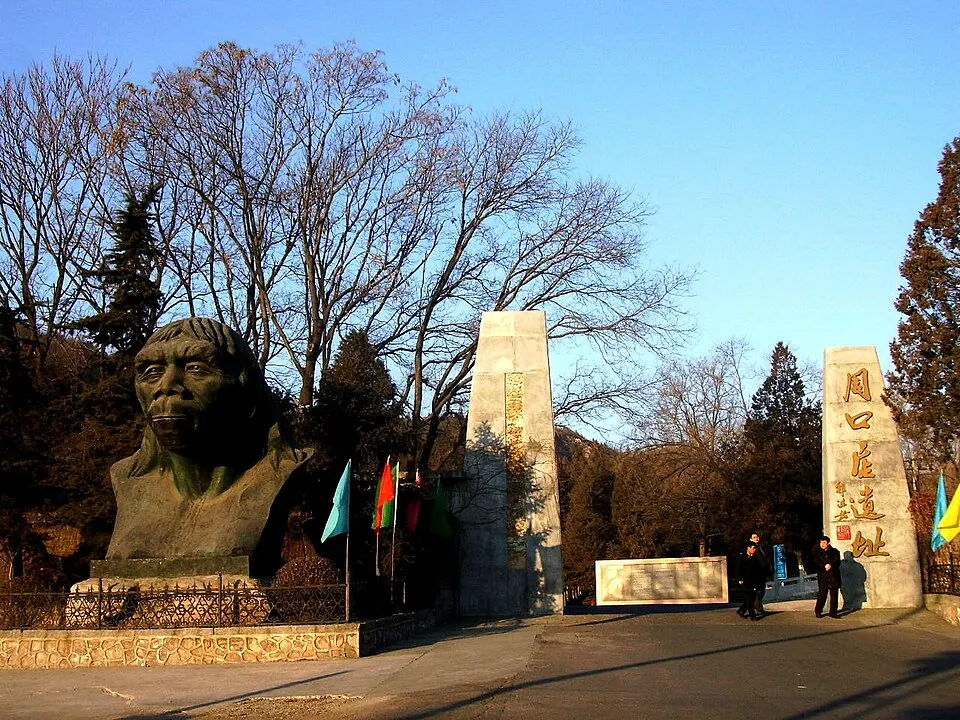
Fangshan lies south-west of the centre, about 38 km out, and mixes mountain valleys with a petrochemical works at Yanshan. The Peking Man Site at Zhoukoudian, a World Heritage cave complex, is where the first Peking Man fossil, a tooth, turned up in 1921. Yunju Temple keeps more than 14,000 carved stone sutra tablets, and the Jin Dynasty Imperial Tombs, Shidu gorges and Shihua Cave give a day plenty of variety.
Featured places in Fangshan
-
Zhoukoudian Peking Man Site 周口店北京人遗址
Limestone caves on Dragon Bone Hill where the fossils of Peking Man were found
Listed sites in Fangshan
11 sites in Fangshan are on the official lists. Those with a page of their own link to it; the rest open as cards on the map.
- Shenglian Mountain 圣莲山 4A scenic area · on the map
A steep limestone mountain in the upper Dashi River valley, part of the Fangshan UNESCO Global Geopark, with karst peaks, arches, caves and springs. - Shidu 十渡 4A scenic area
A long valley where the Juma River has cut through the northern end of the Taihang Mountains, leaving limestone peaks and cliffs above the water; it is one of the largest karst landscapes in northern China and part of the Fangshan UNESCO Global Geopark. - Shihua Cave 石花洞 4A scenic area · on the map
A large limestone show cave on the Dashi River, the core of the Shihuadong National Geopark and part of the Fangshan UNESCO Global Geopark. - Yunju Temple 云居寺 4A scenic area · National heritage site
A Buddhist temple at the foot of Shijing Shan ('Stone Sutra Mountain'), famous for the Buddhist scriptures that monks carved on thousands of stone slabs from the Sui dynasty to the Ming, begun by the monk Jingwan to protect the texts from destruction. - Cross Temple 十字寺遗址 National heritage site
The ruins of a hillside temple that was Buddhist for most of its history but was used by Christians of the Church of the East during the Yuan dynasty, one of very few such places of worship known in China. - Haotian Pagoda 昊天塔 National heritage site
A five-storey octagonal brick pagoda in pavilion style on a low hill on the east side of Liangxiang, the only pagoda of this type in Beijing. - Jin Dynasty Imperial Tombs 金陵 National heritage site
The burial ground of the Jin dynasty emperors, laid out below Jiulong Mountain after the Jurchen court moved its capital to Zhongdu (Beijing) in the 1150s, and the earliest imperial cemetery in the Beijing area. - Liulihe Bridge 琉璃河大桥 National heritage site
A Ming stone arch bridge over the Liuli River on the old main road south from Beijing, ordered by the Yongle Emperor in 1418 and rebuilt in 1539–1546. - Liulihe Yan Capital Site 琉璃河遗址 National heritage site
The site of the capital of Yan, a vassal state of the Western Zhou dynasty, founded about 3,000 years ago and the earliest known city in the Beijing area. - Wanfotang and Kongshui Cave 万佛堂、孔水洞 National heritage site
A Buddhist site above a karst spring cave, founded as a temple in the Tang dynasty: a Ming-rebuilt brick hall stands on a platform over the mouth of the Kongshui Cave, and inside it is a long Tang marble relief of Manjushri and Samantabhadra with a host of bodhisattvas. - Yao Guangxiao's Tomb Pagoda 姚广孝墓塔 National heritage site
The tomb pagoda of Yao Guangxiao (1335–1418), the Buddhist monk who advised the future Yongle Emperor during his seizure of the throne and later helped compile the Yongle Encyclopedia.
Intangible heritage in Fangshan
3 items on China's national list of intangible cultural heritage are filed for Fangshan.
- Folk literature: Legend of the Yang family generals (Mu Guiying)
- Traditional art: Beijing embroidery
- Traditional craftsmanship: Traditional blended liquor brewing (Chrysanthemum white liquor)
Getting to Beijing
Train, flight and driving times from the cities most visitors come from, with stations, fares and how many run a day; each opens the full comparison.
- Tianjin 天津 high-speed train 25 min, 185 a day, from ¥45
- Zhangjiakou 张家口 high-speed train 47 min, 88 a day, from ¥77
- Chengde 承德 high-speed train 49 min, 52 a day, from ¥106
- Datong 大同 high-speed train 1 h 45 min, 48 a day, from ¥157
- Dalian 大连 high-speed train 3 h 36 min, 10 a day, from ¥472; 14 nonstop flights a day, 1 h 15 min in the air
- Pingyao 平遥 high-speed train 3 h 35 min, 6 a day, from ¥251
- Qingdao 青岛 high-speed train 3 h 7 min, 18 a day, from ¥362; 5 nonstop flights a day, 1 h 25 min in the air
- Luoyang 洛阳 high-speed train 2 h 59 min, 23 a day, from ¥419
- Nanjing 南京 high-speed train 3 h 14 min, 74 a day, from ¥532; 8 nonstop flights a day, 1 h 55 min in the air
- Xi'an 西安 high-speed train 4 h 10 min, 38 a day, from ¥587; 32 nonstop flights a day, 2 h 15 min in the air
- Harbin 哈尔滨 high-speed train 4 h 33 min, 31 a day, from ¥605; 19 nonstop flights a day, 2 h 5 min in the air
- Shanghai 上海 high-speed train 4 h 18 min, 50 a day, from ¥661; 65 nonstop flights a day, 2 h 15 min in the air
- Hangzhou 杭州 high-speed train 4 h 17 min, 28 a day, from ¥578; 36 nonstop flights a day, 2 h 15 min in the air
- Chengdu 成都 high-speed train 7 h 28 min, 12 a day, from ¥872; 53 nonstop flights a day, 3 h in the air
- Guangzhou 广州 high-speed train 7 h 17 min, 12 a day, from ¥1033; 44 nonstop flights a day, 3 h 25 min in the air
- Hong Kong 香港 high-speed train 8 h 12 min, 1 a day, from ¥1248; 18 nonstop flights a day, 3 h 45 min in the air
On the map
Open Fangshan on the illustrated map to see its outline, its places and listed sites together, and to add them to a trip.
Open Fangshan on the map