
 An illustrated travel map
China high-speed rail map
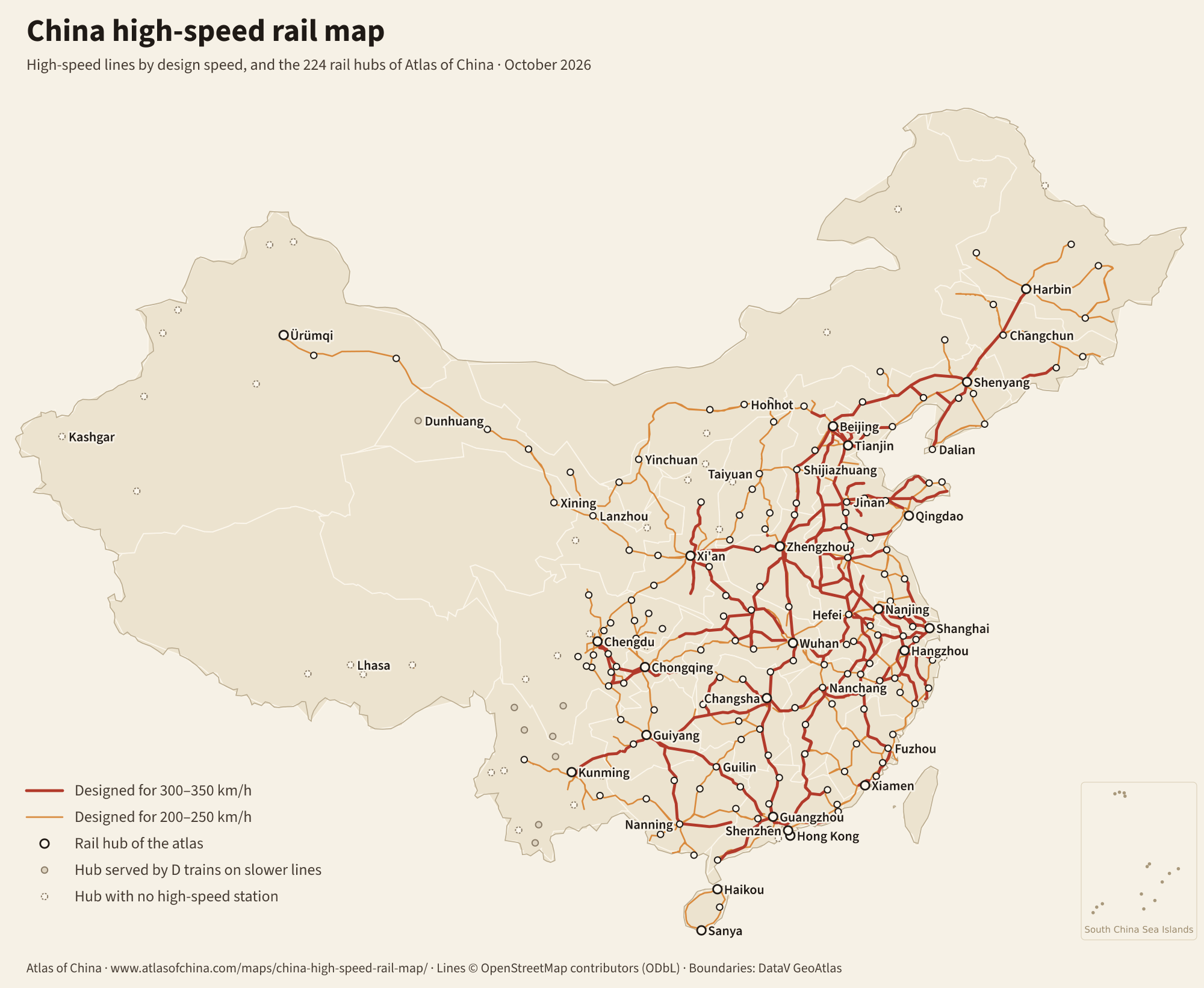
- Designed for 300–350 km/h
- Designed for 200–250 km/h
- Rail hub
- Hub served by D trains on slower lines
- Hub with no high-speed station
- under 2 hours
- 2 to 4 hours
- 4 to 6 hours
- 6 to 9 hours
- over 9 hours
- no direct train or single change
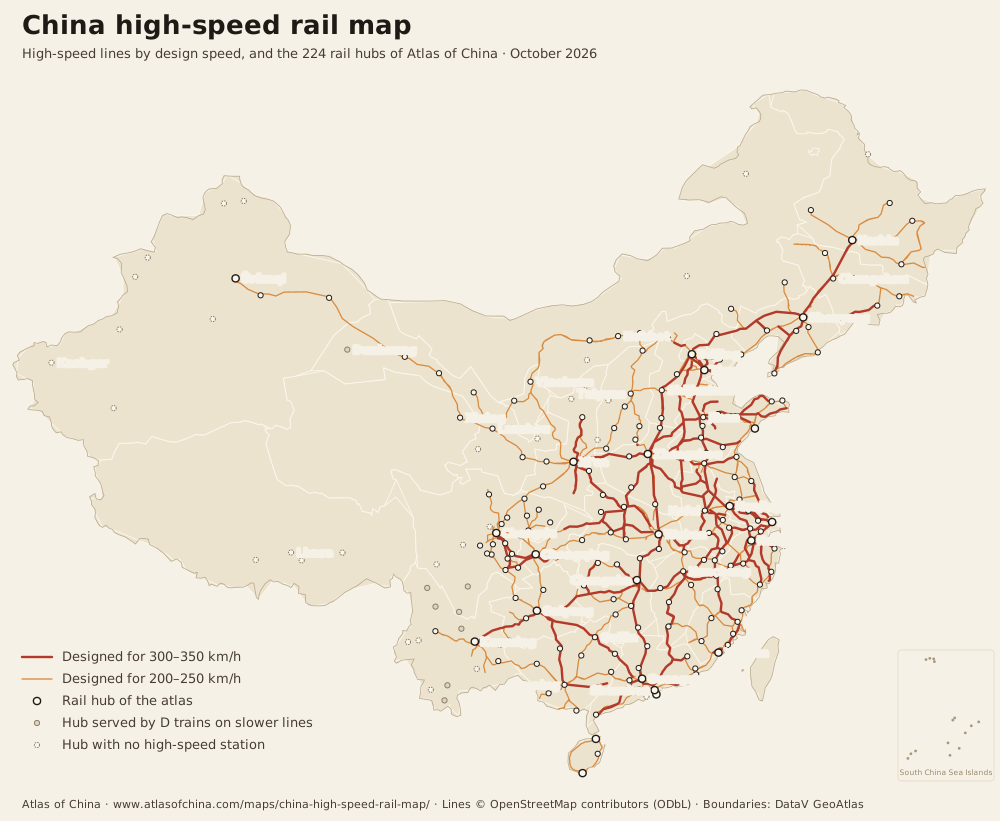
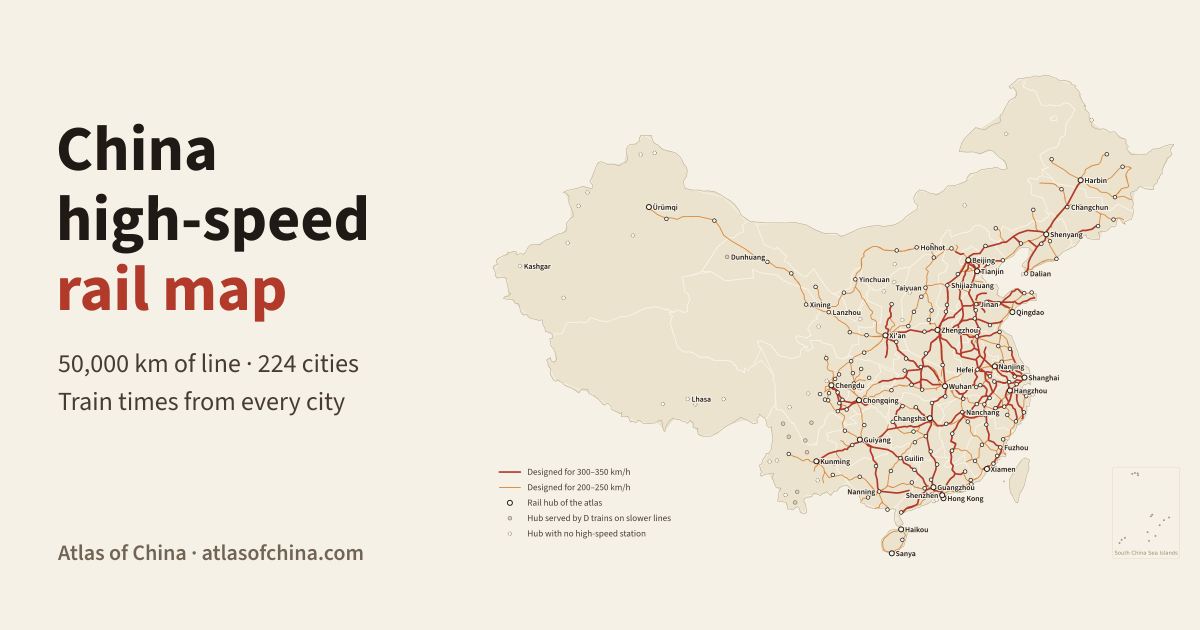
China had 50,000 km of high-speed railway in service at the end of 2025, by the National Railway Administration's count, more than the rest of the world combined; the fastest scheduled trains run at 350 km/h. This map draws every high-speed line in OpenStreetMap, thick red where it was built for 300–350 km/h and thin orange for 200–250 km/h, with the atlas's 224 rail hubs. Pick a city to colour every other by the fastest train from it in the 12306 timetable.
Click a city on the map, or pick one above, to colour every other hub by the fastest train from it and list the nearest ten.
China's high-speed rail in numbers
- 50,000 km
- high-speed railway in service, end of 2025 (National Railway Administration, 2025 statistical bulletin; Science and Technology Daily, 26 Dec 2025)
- 350 km/h
- top speed of scheduled trains, on lines such as Beijing–Shanghai, Beijing–Guangzhou, Beijing–Zhangjiakou and Chengdu–Chongqing (Xinhua, 20 Sep 2024; Caixin, 10 Aug 2026 (CR450 testing))
- 2,298 km
- Beijing–Guangzhou, the longest high-speed line, Beijing to Guangzhou South (Xinhua, 15 Jun 2024)
- 7,800
- pairs of the atlas's 224 hubs linked by a direct train or one change in the 12306 timetable for 2026-10-28 or 2026-11-11
How long do the trains take between the big cities?
The fastest train in the 12306 timetable for 2026-10-28 or 2026-11-11, its standard-class fare, the flight's time in the air, and door to door by train against door to door by air (about 20 minutes to board the train, 2½ hours at the airports).
| Route | Fastest train | Fare | Flight | Door to door, train vs air |
|---|---|---|---|---|
| Beijing – Shanghai | 4 h 18 min G25, 50 a day | ¥661 | 2 h 15 min | 4 h 36 min vs 4 h 45 min |
| Beijing – Xi'an | 4 h 10 min G351, 38 a day | ¥587 | 2 h 15 min | 4 h 28 min vs 4 h 45 min |
| Beijing – Guangzhou | 7 h 17 min G381, 12 a day | ¥1033 | 3 h 25 min | 7 h 35 min vs 5 h 55 min |
| Beijing – Harbin | 4 h 33 min G101, 31 a day | ¥605 | 2 h 5 min | 4 h 51 min vs 4 h 35 min |
| Beijing – Chengdu | 7 h 28 min G323, 12 a day | ¥872 | 3 h | 7 h 46 min vs 5 h 30 min |
| Shanghai – Hangzhou | 45 min G205, 228 a day | ¥87 | 1 h 10 min | 1 h 3 min vs 3 h 40 min |
| Shanghai – Nanjing | 59 min G94, 290 a day | ¥162 | 1 h 5 min | 1 h 17 min vs 3 h 35 min |
| Shanghai – Wuhan | 3 h 32 min G460, 45 a day | ¥360 | 1 h 55 min | 3 h 50 min vs 4 h 25 min |
| Shanghai – Guangzhou | 6 h 14 min G251, 11 a day | ¥855 | 2 h 35 min | 6 h 32 min vs 5 h 5 min |
| Xi'an – Chengdu | 3 h 5 min G321, 67 a day | ¥300 | 1 h 35 min | 3 h 23 min vs 4 h 5 min |
| Chongqing – Chengdu | 1 h 2 min G8612, 131 a day | ¥156 | – | – |
| Guangzhou – Shenzhen | 29 min G3017, 295 a day | ¥75 | – | – |
| Guangzhou – Hong Kong | 47 min G6503, 50 a day | ¥215 | 1 h 20 min | 1 h 5 min vs 3 h 50 min |
| Guangzhou – Guilin | 2 h 4 min G908, 62 a day | ¥223 | – | – |
| Kunming – Dali | 1 h 55 min D8652, 55 a day | ¥109 | 1 h 10 min | 2 h 13 min vs 3 h 40 min |
| Dunhuang – Lanzhou | 7 h 18 min D2759, 4 a day | ¥324 | 1 h 35 min | 7 h 36 min vs 4 h 5 min |
What are the main high-speed lines?
Ten of the lines the network grew from. The first five run 1,000 to 2,300 km each; the others are the southern and western links and the busiest short lines. Lines built in sections are dated from the first section to the last.
Lengths, design speeds and opening years as given by the sources linked in each row, checked 2026-10-31. Sources disagree on several lengths (English Wikipedia gives Beijing–Guangzhou as 2,230 km and Shanghai–Kunming as 2,066 km), so the table uses Chinese state-media figures where they exist. Shanghai–Wuhan–Chengdu and Hangzhou–Shenzhen are corridors of several railways, not single lines, and only Wikipedia gives their totals. Point at a row, or tap it, to see the line on the map; the line's name opens its page, with every station in order.
Every high-speed line on the map of 200 km or more has a page: 78 lines, grouped by corridor, with their stations, the cities on them and the fastest trains between those cities. The 11 conventional railways that reach 200 km/h in places are drawn but have no page.
All 78 lines, by corridor
Coastal corridor 沿海通道
| Line | From – to | Length, km | Top speed, km/h | Opened | Hub cities on it |
|---|---|---|---|---|---|
| Hangzhou–Shenzhen railway 杭深线 | Hangzhou East – Shenzhen North | 1,464 | 300 | 2009–2013 | Hangzhou, Ningbo, Taizhou, Wenzhou, Ningde, Fuzhou, Putian, Quanzhou, Xiamen, Chaozhou, Shenzhen |
| Ningbo–Guangzhou high-speed railway 甬广高速线 section | Fuzhou South – Guangzhou Xintang | 790 | 350 | – | Fuzhou, Putian, Quanzhou, Xiamen, Shantou, Huizhou, Guangzhou |
| Qingdao–Yancheng railway 青盐线 | Qingdao North – Yancheng North | 427 | 200 | – | Qingdao, Lianyungang, Yancheng |
| Shenzhen–Zhanjiang railway 深湛线 | Jiangmen – Zhanjiang West | 354 | 200 | 2013–2018 | Jiangmen, Zhanjiang |
| Dandong–Dalian railway 丹大线 | Dandong – Dalian North | 292 | 200 | 2015 | Dandong, Dalian |
| Tianjin–Qinhuangdao high-speed railway 津秦高速线 | Tianjin West – Qinhuangdao | 266 | 350 | 2013 | Tianjin, Tangshan, Qinhuangdao |
| Weifang–Yantai high-speed railway 潍烟高速线 | Changyi – Zhifu | 237 | 350 | 2024 | Weifang, Yantai |
Beijing–Shanghai corridor 京沪通道
| Line | From – to | Length, km | Top speed, km/h | Opened | Hub cities on it |
|---|---|---|---|---|---|
| Beijing–Shanghai high-speed railway 京沪高铁 | Beijing South – Shanghai Hongqiao | 1,310 | 350 | 2011 | Beijing, Tianjin, Jinan, Tai'an, Qufu, Zaozhuang, Xuzhou, Nanjing, Changzhou, Suzhou, Shanghai |
| Hefei–Hangzhou high-speed railway 合杭高速线 | Feidong – Tonglu East | 437 | 350 | – | Hefei, Wuhu, Xuancheng, Huzhou, Hangzhou |
| Xuzhou–Yancheng high-speed railway 徐盐客专线 | Xuzhou East – Yancheng | 313 | 250 | 2019 | Xuzhou, Huai'an, Yancheng |
| Lianyungang–Zhenjiang railway 连镇线 | Dongji – Dantu | 305 | 250 | 2019–2020 | Lianyungang, Huai'an, Yangzhou |
| Nanjing–Hangzhou high-speed railway 宁杭高速线 | Nanjing South – Hangzhou East | 254 | 350 | 2013 | Nanjing, Huzhou, Hangzhou |
Beijing–Hong Kong (Taipei) corridor 京港(台)通道
| Line | From – to | Length, km | Top speed, km/h | Opened | Hub cities on it |
|---|---|---|---|---|---|
| Beijing–Hong Kong high-speed railway 京港高速线 | Xiong'an – Guangmingcheng | 2,225 | 350 | – | Hefei, Anqing, Jiujiang, Nanchang, Ji'an, Ganzhou, Huizhou, Shenzhen |
| Hefei–Fuzhou high-speed railway 合福高速线 | Hefei Beicheng – Fuzhou | 851 | 300 | 2015 | Hefei, Huangshan City, Wuyuan, Shangrao, Wuyishan, Fuzhou |
Beijing–Harbin and Beijing–Hong Kong–Macau corridor 京哈~京港澳通道
| Line | From – to | Length, km | Top speed, km/h | Opened | Hub cities on it |
|---|---|---|---|---|---|
| Beijing–Guangzhou high-speed railway 京广高速线 | Beijing Fengtai – Guangzhou South | 2,098 | 350 | 2009–2012 | Beijing, Baoding, Shijiazhuang, Handan, Anyang, Zhengzhou, Xinyang, Wuhan, Xianning, Yueyang, Changsha, Hengyang, Chenzhou, Shaoguan, Qingyuan, Guangzhou |
| Beijing–Harbin high-speed railway 京哈高速线 | Beijing Chaoyang – Harbin | 1,212 | 350 | 2012–2021 | Beijing, Chengde, Shenyang, Changchun, Harbin |
Hohhot–Nanning corridor 呼南通道
| Line | From – to | Length, km | Top speed, km/h | Opened | Hub cities on it |
|---|---|---|---|---|---|
| Zhengzhou–Chongqing high-speed railway 郑渝高速线 | Zhengzhou East – Chongqing North | 1,068 | 350 | – | Zhengzhou, Nanyang, Xiangyang, Shennongjia, Chongqing |
| Zhengzhou–Taiyuan high-speed railway 郑太客专线 | Nanyangzhai – Taiyuan South | 429 | 250 | – | Zhengzhou, Jincheng, Changzhi, Taiyuan |
| Liuzhou–Nanning high-speed railway 柳南客专线 | Liuzhou – Nanning | 223 | 250 | 2013 | Liuzhou, Nanning |
Beijing–Kunming corridor 京昆通道
| Line | From – to | Length, km | Top speed, km/h | Opened | Hub cities on it |
|---|---|---|---|---|---|
| Datong–Xi'an high-speed railway 大西高速线 | Huairen East – Xi'an North | 830 | 250 | 2014–2018 | Taiyuan, Pingyao, Linfen, Yuncheng, Xi'an |
| Xi'an–Chengdu high-speed railway 西成客专线 | Xi'an North – Chengdu East | 656 | 250 | 2017 | Xi'an, Hanzhong, Guangyuan, Mianyang, Deyang, Chengdu |
| Chengdu–Yibin high-speed railway 成宜高速线 | Chengdu East – Yibin East | 247 | 350 | 2023 | Chengdu, Ziyang, Zigong, Yibin |
| Chongqing–Kunming high-speed railway 渝昆高速线 section | Chongqing West – Yibin | 207 | 350 | – | Chongqing, Luzhou, Yibin |
| Shijiazhuang–Taiyuan high-speed railway 石太客专线 | Shijiazhuang – Taiyuan South | 204 | 250 | – | Shijiazhuang, Taiyuan |
Baotou (Yinchuan)–Haikou corridor 包(银)海通道
| Line | From – to | Length, km | Top speed, km/h | Opened | Hub cities on it |
|---|---|---|---|---|---|
| Yinchuan–Xi'an high-speed railway 银西高速线 | Wuzhong – Xi'an North | 543 | 250 | – | Xi'an |
| Guiyang–Nanning high-speed railway 贵南高速线 | Longli North – Nanning East | 481 | 350 | 2023 | Hechi, Nanning |
| Chongqing–Guiyang railway 渝贵线 | Geleshan – Guiyang | 370 | 200 | 2018 | Chongqing, Zunyi, Guiyang |
| Hainan western ring high-speed railway 海南西环高速线 | Haikou – Sanya | 346 | 200 | 2015 | Haikou, Sanya |
| Hainan eastern ring high-speed railway 海南东环高速线 | Haikou – Sanya | 309 | 250 | 2010 | Haikou, Qionghai, Sanya |
| Baotou–Xi'an high-speed railway 包西高速线 | Yan'an – Xi'an East | 304 | 350 | 2025–2026 | Yan'an, Xi'an |
Lanzhou (Xining)–Guangzhou corridor 兰(西)广通道
| Line | From – to | Length, km | Top speed, km/h | Opened | Hub cities on it |
|---|---|---|---|---|---|
| Guiyang–Guangzhou high-speed railway 贵广客专线 | Guiyang East – Guangzhou South | 855 | 300 | 2014 | Guiyang, Guilin, Hezhou, Zhaoqing, Guangzhou |
| Chengdu–Guiyang high-speed railway 成贵客专线 | Chengdu East – Guiyang East | 648 | 250 | – | Chengdu, Meishan, Leshan, Yibin, Bijie, Guiyang |
| Sichuan–Qinghai railway 川青线 | Qingbaijiang – Huangshengguan | 276 | 200 | – | Chengdu, Songpan |
Suifenhe–Manzhouli corridor 绥满通道
| Line | From – to | Length, km | Top speed, km/h | Opened | Hub cities on it |
|---|---|---|---|---|---|
| Harbin–Mudanjiang high-speed railway 哈牡客专线 | Harbin – Mudanjiang | 298 | 250 | 2018 | Harbin, Mudanjiang |
| Harbin–Qiqihar high-speed railway 哈齐客专线 | Harbin – Qiqihar South | 279 | 250 | 2015 | Harbin, Qiqihar |
Beijing–Lanzhou corridor 京兰通道
| Line | From – to | Length, km | Top speed, km/h | Opened | Hub cities on it |
|---|---|---|---|---|---|
| Beijing–Baotou high-speed railway 京包客专线 | Beijing North – Baotou | 631 | 350 | – | Beijing, Zhangjiakou, Ulanqab, Hohhot, Baotou |
| Baotou–Yinchuan high-speed railway 包银高速线 | Baotou – Yinchuan | 515 | 250 | – | Baotou, Yinchuan |
| Yinchuan–Lanzhou high-speed railway 银兰高速线 | Yinchuan – Qinwangchuan | 408 | 250 | 2019 | Yinchuan, Zhongwei |
Qingdao–Yinchuan corridor 青银通道
| Line | From – to | Length, km | Top speed, km/h | Opened | Hub cities on it |
|---|---|---|---|---|---|
| Shijiazhuang–Jinan high-speed railway 石济客专线 | Shijiazhuang – Jinan East | 307 | 250 | 2017–2018 | Shijiazhuang, Jinan |
| Jinan–Qingdao high-speed railway 济青高速线 | Jinan East – Hongdao | 303 | 300 | 2018 | Jinan, Zibo, Weifang, Qingdao |
Land Bridge corridor 陆桥通道
| Line | From – to | Length, km | Top speed, km/h | Opened | Hub cities on it |
|---|---|---|---|---|---|
| Lanzhou–Xinjiang high-speed railway 兰新客专线 | Lanzhou West – Ürümqi | 1,783 | 250 | 2014 | Lanzhou, Xining, Zhangye, Jiayuguan, Hami, Turpan, Ürümqi |
| Xuzhou–Lanzhou high-speed railway 徐兰高速线 | Xuzhou East – Lanzhou West | 1,399 | 350 | 2010–2017 | Xuzhou, Kaifeng, Zhengzhou, Luoyang, Xi'an, Baoji, Tianshui, Lanzhou |
Yangtze River corridor 沿江通道
| Line | From – to | Length, km | Top speed, km/h | Opened | Hub cities on it |
|---|---|---|---|---|---|
| Shanghai–Wuhan–Chengdu railway 沪蓉线 | Nanjing South – Chengdu East | 1,642 | 250 | 2008–2014 | Nanjing, Hefei, Lu'an, Wuhan, Jingzhou, Yichang, Enshi, Chongqing, Suining, Chengdu |
| Chengdu–Chongqing high-speed railway 成渝高速线 | Chengdu East – Shapingba | 300 | 350 | 2015 | Chengdu, Ziyang, Neijiang, Chongqing |
| Shanghai–Nanjing riverside high-speed railway 沪宁沿江高速线 | Taicang – Nanjing South | 274 | 350 | – | Nanjing |
| Shanghai–Chongqing–Chengdu high-speed railway 沪渝蓉高速线 | Hanchuan North – Yichang East | 269 | 350 | – | Yichang |
| Nanjing–Anqing high-speed railway 宁安客专线 | Nanjing South – Anqing | 257 | 250 | 2015 | Nanjing, Wuhu, Chizhou, Anqing |
| Wuhan–Jiujiang high-speed railway 武九客专线 | Wuchang East – Lushan | 203 | 250 | 2017 | Wuhan, Jiujiang |
Shanghai–Kunming corridor 沪昆通道
| Line | From – to | Length, km | Top speed, km/h | Opened | Hub cities on it |
|---|---|---|---|---|---|
| Shanghai–Kunming high-speed railway 沪昆高速线 | Shanghai Hongqiao – Kunming South | 2,252 | 350 | 2010–2016 | Shanghai, Jiaxing, Hangzhou, Jinhua, Quzhou, Shangrao, Fuzhou, Nanchang, Yichun, Changsha, Shaoyang, Kaili, Guiyang, Anshun, Kunming |
Xiamen–Chongqing corridor 厦渝通道
| Line | From – to | Length, km | Top speed, km/h | Opened | Hub cities on it |
|---|---|---|---|---|---|
| Chongqing–Xiamen high-speed railway 渝厦高速线 | Chongqing East – Changsha West | 734 | 350 | – | Chongqing, Zhangjiajie, Changde, Changsha |
| Ganzhou–Ruijin–Longyan railway 赣瑞龙线 | Ganxian – Longyan | 247 | 200 | – | Ganzhou, Longyan |
Guangzhou–Kunming corridor 广昆通道
| Line | From – to | Length, km | Top speed, km/h | Opened | Hub cities on it |
|---|---|---|---|---|---|
| Nanning–Kunming high-speed railway 南昆客专线 | Nanning – Luoyangzhen | 717 | 250 | – | Nanning, Baise, Qiubei, Kunming |
| Nanning–Guangzhou railway 南广线 | Nanning – Guangzhou South | 572 | 250 | 2014 | Nanning, Wuzhou, Zhaoqing, Guangzhou |
Other lines
The 8+8 grid: China's sixteen high-speed rail corridors
The Medium- and Long-Term Railway Network Plan of 2016 (中长期铁路网规划) lays the network out as eight north–south and eight east–west corridors, 八纵八横, each a chain of lines between the cities it names. Point at a corridor, or tap it, to light every line it runs on; the corridor's name opens its page, with the lines in order, what is open, under construction or planned, and the cities along it.
| Corridor | From – to | Open, km | Sections |
|---|---|---|---|
| Coastal corridor 沿海通道 | Dalian (Dandong) – Beihai (Fangchenggang) | 3,350 | 13 of 19 open, 5 under construction, 1 no report found |
| Beijing–Shanghai corridor 京沪通道 | Beijing – Shanghai (Hangzhou) | 2,575 | 9 of 11 open, 2 under construction |
| Beijing–Hong Kong (Taipei) corridor 京港(台)通道 | Beijing – Hong Kong (Kowloon) | 3,742 | 9 of 10 open, 1 planned |
| Beijing–Harbin and Beijing–Hong Kong–Macau corridor 京哈~京港澳通道 | Harbin – Hong Kong | 3,543 | 4 of 5 open, 1 no report found |
| Hohhot–Nanning corridor 呼南通道 | Hohhot – Nanning | 1,833 | 10 of 13 open, 1 under construction, 2 no report found |
| Beijing–Kunming corridor 京昆通道 | Beijing – Kunming | 2,919 | 10 of 12 open, 2 under construction |
| Baotou (Yinchuan)–Haikou corridor 包(银)海通道 | Baotou – Haikou (Sanya) | 2,701 | 8 of 13 open, 3 under construction, 2 planned |
| Lanzhou (Xining)–Guangzhou corridor 兰(西)广通道 | Lanzhou (Xining) – Guangzhou | 2,392 | 5 of 6 open, 1 under construction |
| Suifenhe–Manzhouli corridor 绥满通道 | Suifenhe – Manzhouli | 577 | 3 of 4 open, 1 planned |
| Beijing–Lanzhou corridor 京兰通道 | Beijing – Lanzhou | 1,554 | 3 of 3 open |
| Qingdao–Yinchuan corridor 青银通道 | Qingdao – Yinchuan | 814 | 4 of 5 open, 1 no report found |
| Land Bridge corridor 陆桥通道 | Lianyungang – Ürümqi | 3,366 | 4 of 4 open |
| Yangtze River corridor 沿江通道 | Shanghai – Chengdu | 2,674 | 10 of 15 open, 5 under construction |
| Shanghai–Kunming corridor 沪昆通道 | Shanghai – Kunming | 2,252 | 1 of 1 open |
| Xiamen–Chongqing corridor 厦渝通道 | Xiamen – Chongqing | 981 | 3 of 4 open, 1 under construction |
| Guangzhou–Kunming corridor 广昆通道 | Guangzhou – Kunming | 1,289 | 2 of 2 open |
The first eight are the north–south corridors, the last eight the east–west. Open kilometres are the lengths along OpenStreetMap's track of each corridor's open stretches, so a line two corridors share is counted in both; stretches under construction or planned are counted as sections but not measured. The lines light whole, though a corridor may use only part of one.
How to read this map
- Thick red lines were built for 300–350 km/h, the trunk lines most G trains run on; thin orange lines for 200–250 km/h, where D trains and slower G trains run. The classes come from the maximum speed OpenStreetMap records for each stretch; a stretch with none is counted at 200–250 km/h.
- Dots are the 224 rail hubs the atlas's trip planner uses: the cities and towns travellers go to, each with its main station. A grey dot has D trains, but on lines OpenStreetMap records at under 200 km/h, which the map leaves out (Lijiang, Jinghong, Dunhuang); a dashed dot has no high-speed station, so only conventional trains reach it.
- Point at a line (or tap it on a phone) to see its name; high-speed lines of 200 km or more link to a page of their own. The tables below light each trunk line on the map, and every line of one of the sixteen corridors of the 8+8 grid.
- Pick a hub and the others turn to its time bands: the fastest direct train, or the quickest single change counting the wait, in the 12306 timetable for 2026-10-28 or 2026-11-11. Both are weekdays, so weekend and holiday trains differ. Grey dots have no direct train or single change from it in the table; pairs more than 1,000 km apart were only looked up between big cities.
- The lines are the network as OpenStreetMap had it in October 2026, simplified to print; lines under construction are not drawn. The rail data covers the mainland and Hong Kong, so the line in Taiwan, which has no through trains to that network, is not drawn.
- The islands of the South China Sea are in the inset, as on printed maps of China.
Download the map
The map as a vector SVG (opens in any browser or drawing program, styles included) and as a 2000×1642 PNG. Free to reuse in articles, slides and classrooms with a credit to Atlas of China and a link to this page; the rail lines are © OpenStreetMap contributors under the Open Database License, and the region boundaries are from DataV GeoAtlas.
How fast are China's high-speed trains?
The fastest scheduled trains run at 350 km/h, the highest commercial speed of any railway, on lines including Beijing–Shanghai, Beijing–Tianjin, Beijing–Guangzhou, Beijing–Zhangjiakou and Chengdu–Chongqing. The CR450, built to run at about 400 km/h, was still being tested in August 2026. On the table above, G25 covers Beijing to Shanghai in 4 h 18 min, and the fastest Beijing–Guangzhou train takes 7 h 17 min.
How do you buy high-speed train tickets in China?
On the official 12306 app or website once your passport is verified, in the train mini program inside Alipay, or through an agent such as Trip.com, which adds a small fee. Sales open 15 days ahead and the ticket is paperless, tied to your passport. The guide to trains and 12306 goes through each step.
Do foreigners need a passport to ride?
Yes. The ticket is booked under your passport number, and you show the original passport at the station entrance and at the gate; a photocopy or a photo is not accepted. Most automatic gates read only Chinese ID cards, so use the staffed channel unless the gate has a passport reader.
Which seat class should you book?
Trains numbered G, D and C have second class (five seats across), first class (four across, more legroom) and business class (lie-flat seats, a few per train). Second class is roomier than economy on a plane and is what most travellers book; first class is worth it on trips over about five hours. Some D trains run overnight with sleeping berths.
When is the train better than flying?
Up to about 4 hours on board, the train is quicker door to door: stations are in or near the city, you board about 20 minutes before departure, and a flight needs about 2½ hours of airport time on top of the flight. On the table above, Beijing to Shanghai is 4 h 36 min door to door by the fastest train against 4 h 45 min by air, the longest trip the train still wins; from Beijing to Harbin, 4 h 33 min on board, flying wins (4 h 51 min against 4 h 35 min), and by more on longer trips such as Beijing to Chengdu, 7 h 46 min against 5 h 30 min. Each route page compares the two for its pair.
Plan the trip
- The 78 lines with a page, each with its stations in order, the cities on it and the trains between them.
- Train, flight and driving times between 205 city pairs, and where you can get to from each big city in 2, 4, 6 and 9 hours, such as from Beijing and from Shanghai.
- How to book trains in China and use 12306: registering your passport, the gates, luggage and overnight trains.
- Itineraries laid out by the planner with the trains between the stops, and the map itself, where the rail layer and the planner use the same data.
- For the geography under the lines: China's physical geography, the blank map of the provinces and the provinces quiz.
Sources: rail lines © OpenStreetMap contributors (ODbL), as drawn on the atlas's map; region boundaries from DataV GeoAtlas; train times derived from the China Railway 12306 timetable for 2026-10-28 or 2026-11-11, built 2026-10-30 (times.json, derived from the planner's network rail-net.json and like it under the ODbL); flights from the airlines' schedules; network figures and the line table from the sources linked beside them, checked 2026-10-31.
Cite this page
- APA
- Atlas of China. (2026, October 31). China high-speed rail map: every line, 224 cities and train times. https://www.atlasofchina.com/maps/china-high-speed-rail-map/
- MLA
- “China high-speed rail map: every line, 224 cities and train times.” Atlas of China, 31 Oct. 2026, www.atlasofchina.com/maps/china-high-speed-rail-map/.